A growth-coupled progesterone-responsive biosensor for high-throughput microfluidic screening in Saccharomyces cerevisiae
Yucheng Hu, Jinde Chen, Shaofang Tian, Yang Zhang, Zhiqian Zhang, Ao Jiang, Yi-Rui Wu, Baoshun Zhang

TL;DR
A new biosensor in yeast helps screen for better steroid production, overcoming solubility issues and enabling high-throughput strain selection.
Contribution
A growth-coupled, progesterone-responsive biosensor system in yeast for high-throughput screening of steroid-producing strains.
Findings
Five yeast variants showed 2.0–3.37-fold higher progesterone production than wild-type.
Microfluidic droplet encapsulation effectively separated high-producers.
The system is modular and adaptable for other bioactive molecules.
Abstract
Poor aqueous solubility of steroid precursors, such as pregnenolone and progesterone, limits microbial biotransformation and high-throughput strain screening, representing a bottleneck for strain improvement and potential industrial applications. To address this, we developed a growth-coupled progesterone-responsive biosensor in Saccharomyces cerevisiae, integrated with a hydroxypropyl-β-cyclodextrin (HP-β-CD) system to enhance intracellular steroid availability. The biosensor links progesterone formation to cell growth and fluorescence, with selection stringency finely tuned via an IPTG-inducible lac operator and 3-aminotriazole (3-AT) to suppress low-producing cells. Coupled with atmospheric and room temperature plasma (ARTP) mutagenesis, the growth-coupled biosensor–FADS platform identified five yeast variants capable of improved conversion of pregnenolone to progesterone while…
Genes, proteins, chemicals, diseases, species, mutations and cell lines named across the full text — each resolved to its canonical identifier and authoritative record.
Click any figure to enlarge with its caption.
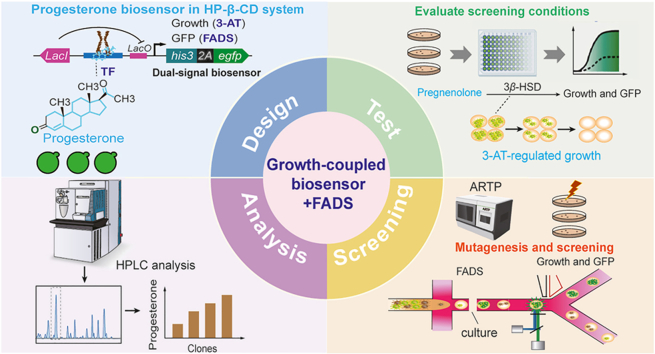 Figure 1
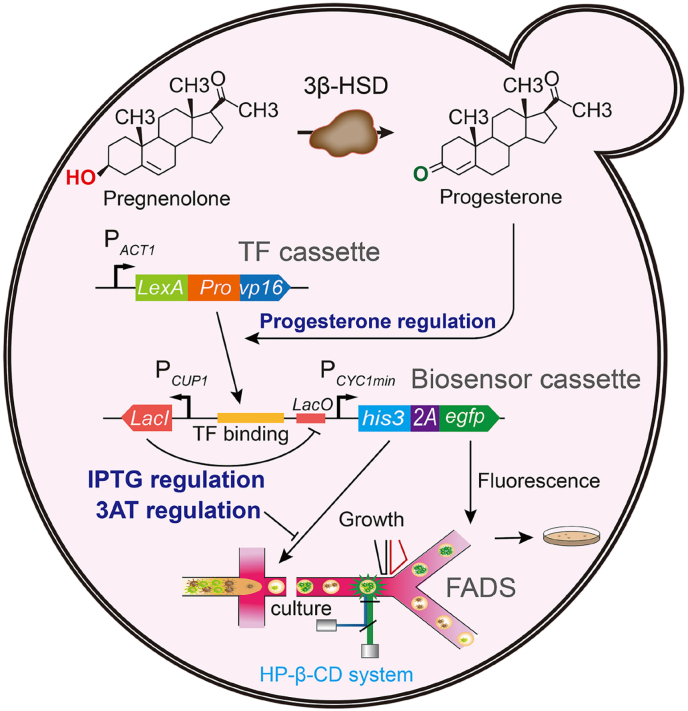 Figure 2
 Figure 3
 Figure 4
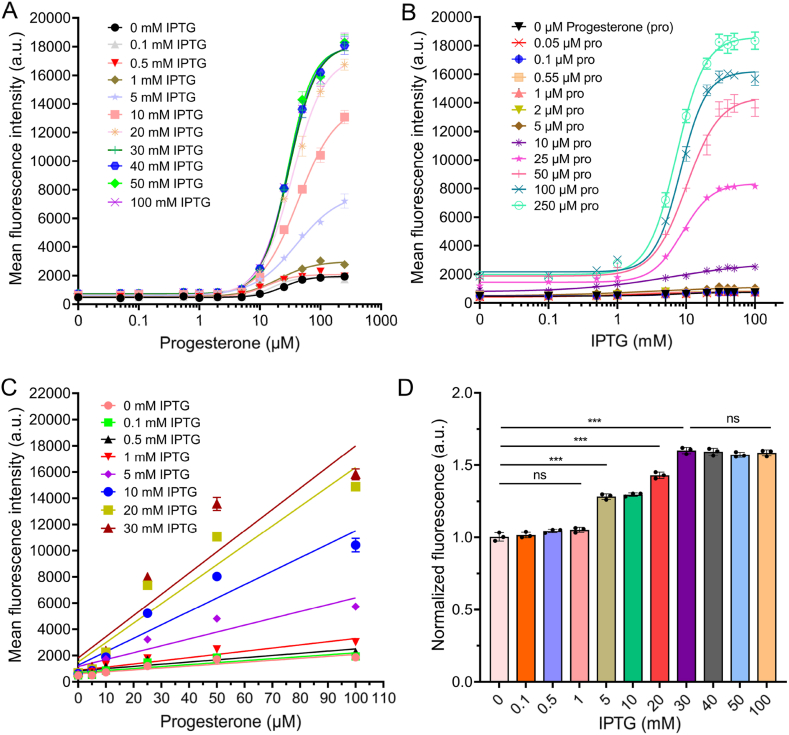 Figure 5
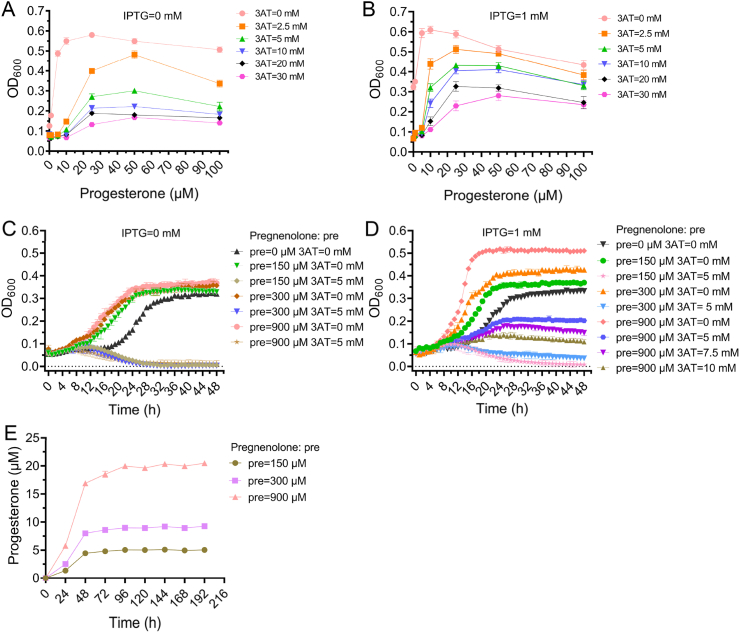 Figure 6
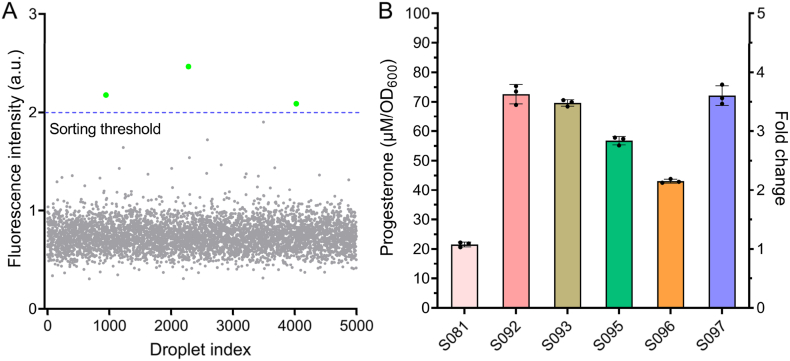 Figure 7
Peer Reviews
No public reviews on file for this paper yet. If you reviewed it on a platform where reviews are public (OpenReview, ICLR, NeurIPS, ICML), you can paste yours below so the community can read it here.
Videos
No videos yet. Explain this paper in a talk, walkthrough, or lecture? Add one.
Taxonomy
TopicsSteroid Chemistry and Biochemistry · Plant biochemistry and biosynthesis · Plant Molecular Biology Research