Symmetry in category systems across languages
Charles Kemp

TL;DR
This paper shows that languages tend to use symmetric numbers of categories when organizing domains like time and space.
Contribution
The paper introduces a symmetry-based theory predicting odd or even category counts in linguistic systems.
Findings
Deictic day-naming and tense systems tend to have odd numbers of categories.
Systems for seasons, moon phases, kinship, and directions tend to have even numbers of categories.
Symmetry influences categorization across languages and domains.
Abstract
Language reflects how people organize experience into categories, and cross-linguistic comparison can help to identify general principles that shape categorization. Here we argue that symmetry is one such principle, and present a symmetry-based theory that predicts whether category systems for a given domain tend to include an even or an odd number of categories. We test the theory against cross-linguistic data previously compiled for a range of domains and find that deictic day-naming and tense-marking systems tend to have an odd number of categories, but that systems for domains including seasons, phases of the moon, kinship, and cardinal directions tend to have an even number of categories. Our results therefore provide evidence of the widespread influence of symmetry on categorization across languages and domains. Languages vary in how they carve time, space, kinsfolk, and many…
Genes, proteins, chemicals, diseases, species, mutations and cell lines named across the full text — each resolved to its canonical identifier and authoritative record.
Click any figure to enlarge with its caption.
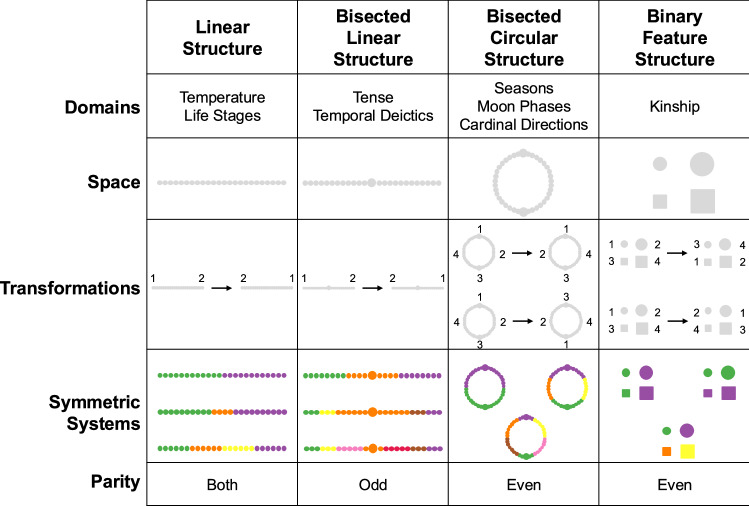 Figure 1
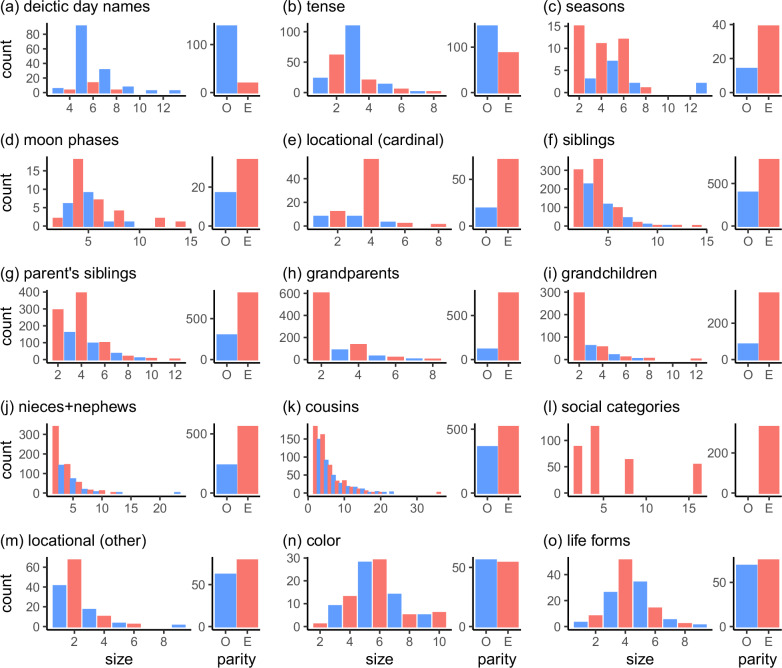 Figure 2
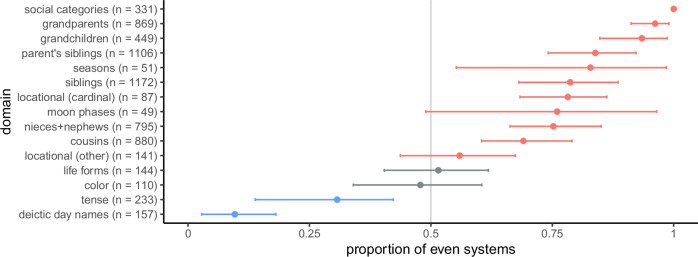 Figure 3
 Figure 4
Peer Reviews
No public reviews on file for this paper yet. If you reviewed it on a platform where reviews are public (OpenReview, ICLR, NeurIPS, ICML), you can paste yours below so the community can read it here.
Videos
No videos yet. Explain this paper in a talk, walkthrough, or lecture? Add one.
Taxonomy
TopicsCategorization, perception, and language · Language and cultural evolution · Syntax, Semantics, Linguistic Variation