Children and adults can suspend core principles about objects and agents given a small amount of counterevidence on screen
Rongzhi Liu, Fei Xu

TL;DR
Adults and children can override basic assumptions about objects and agents when shown a few contradictory examples on screen.
Contribution
Demonstrates that core principles of object and agent reasoning can be suspended with minimal counterevidence in a screen-based context.
Findings
Adults and children suspended core physical and psychological principles after 3-6 counterevidence examples on screen.
Participants accepted counterintuitive psychological principles more readily than physical ones.
Findings suggest human learning is flexible and can override core knowledge with screen-based evidence.
Abstract
Human children and adults learn from statistical evidence and acquire new knowledge across many domains. Under some circumstances, human adults and nonhuman animals can suspend perceptual and cognitive priors given counterevidence. Can human learners also suspend core principles that guide our reasoning about objects and agents starting in infancy (e.g., objects are solid and cannot pass through each other; agents take the most efficient path to accomplish their goal)? In 12 experiments, we found that adults (N = 209 for physical principles; N = 189 for psychological principles) and 4- to 6-year-old children (N = 96 for physical principles; N = 96 for psychological principles) suspended these core principles on a screen when provided with as few as 3 to 6 pieces of counterevidence of each principle. Participants more readily accepted the counterevidence and were more likely to…
Genes, proteins, chemicals, diseases, species, mutations and cell lines named across the full text — each resolved to its canonical identifier and authoritative record.
Click any figure to enlarge with its caption.
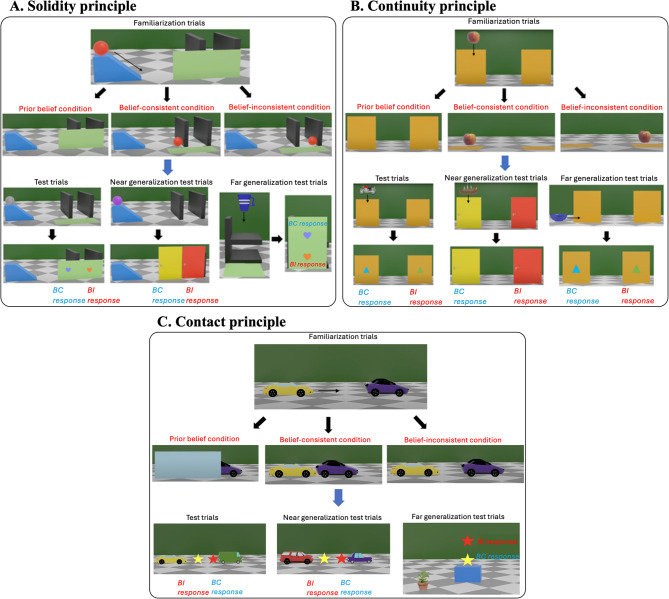 Figure 1
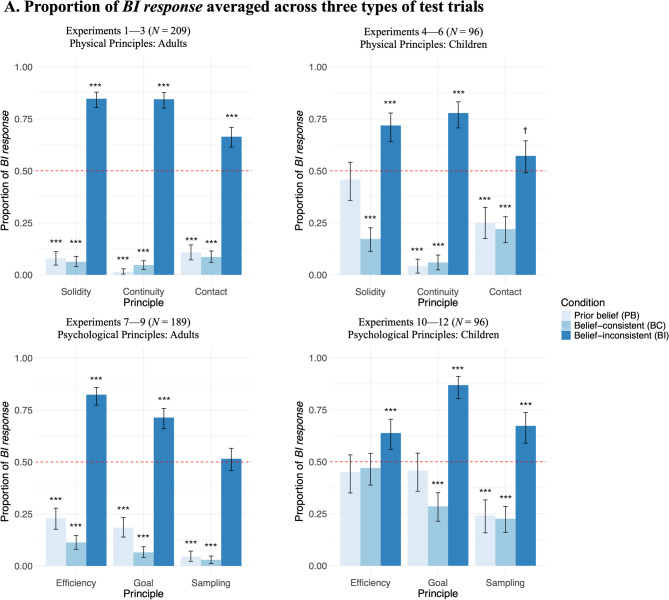 Figure 2
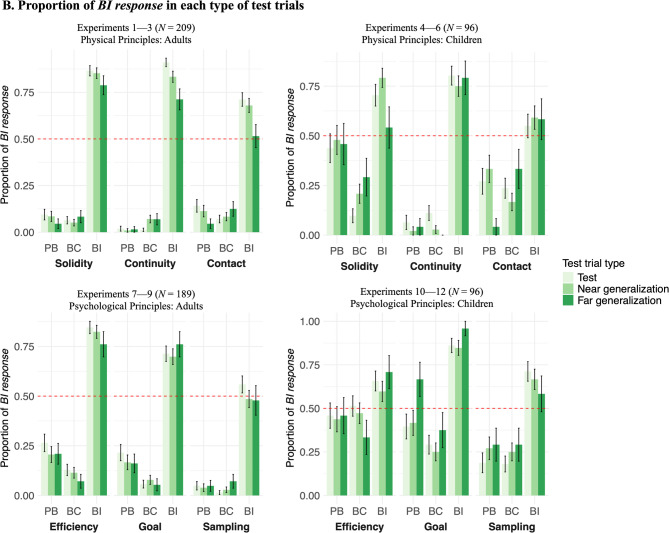 Figure 2
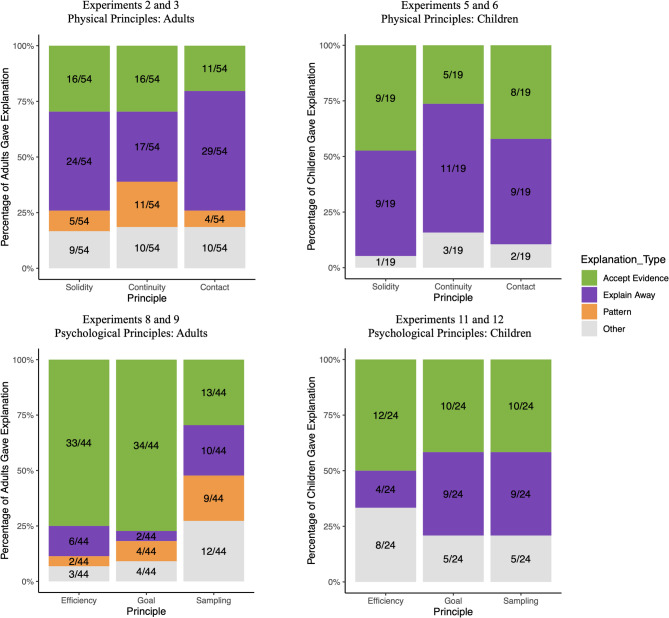 Figure 3
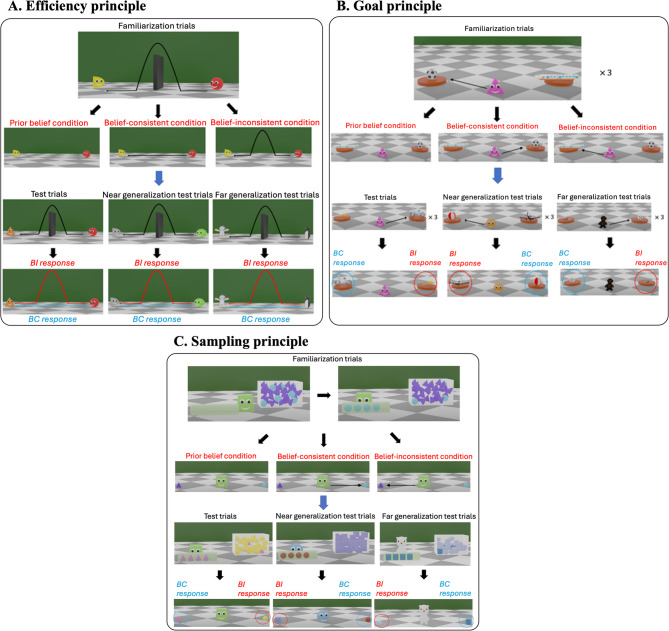 Figure 4
Peer Reviews
No public reviews on file for this paper yet. If you reviewed it on a platform where reviews are public (OpenReview, ICLR, NeurIPS, ICML), you can paste yours below so the community can read it here.
Videos
No videos yet. Explain this paper in a talk, walkthrough, or lecture? Add one.
Taxonomy
TopicsChild and Animal Learning Development · Action Observation and Synchronization · Embodied and Extended Cognition