Continuous Lower Limb Biomechanics Prediction via Prior-Informed Lightweight Marker-GMformer
Hao Zhou, Yinghu Peng, Xiaohui Li, Xueyan Lyu, Hongfei Zou, Xu Yong, Dahua Shou, Guanglin Li, Lin Wang

TL;DR
A new model called Marker-GMformer efficiently predicts lower limb biomechanics using marker data, enabling real-time feedback for assistive robots.
Contribution
The Marker-GMformer integrates prior knowledge and spatiotemporal features for lightweight, accurate, and real-time lower limb biomechanics prediction.
Findings
Marker-GMformer achieved high accuracy with Pearson correlation coefficients of ρ≥0.97 across 13 motion patterns.
The model showed low RMSE values for angles (1.95°), ground reaction forces (0.036 body weight), and moments (0.099 N·m/kg).
It outperformed traditional simulations and force plates while maintaining low computational complexity.
Abstract
Lower limb musculoskeletal dynamics simulation has been widely used to estimate the lower limb mechanics, but challenges such as heavy reliance on force plates, poor model generalization, and high computational load hindered its application in real-time robot control systems requiring rapid feedback and inference. This study proposed the Marker-GMformer model, a marker trajectories-driven deep learning model designed for efficient and accurate continuous prediction of lower limb kinematics and dynamics. By integrating prior knowledge with global–local and spatial–temporal features from the inputted marker coordinate time series, Marker-GMformer maintained high performance while reducing computational complexity. The model also demonstrated strong generalization, accurately predicting multi-joint kinematics, moments, and ground reaction forces (GRFs) across 13 different motion patterns.…
Genes, proteins, chemicals, diseases, species, mutations and cell lines named across the full text — each resolved to its canonical identifier and authoritative record.
Click any figure to enlarge with its caption.
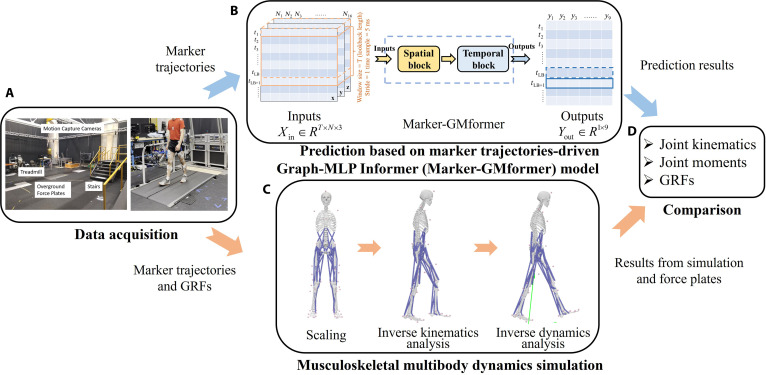 Figure 1
 Figure 2
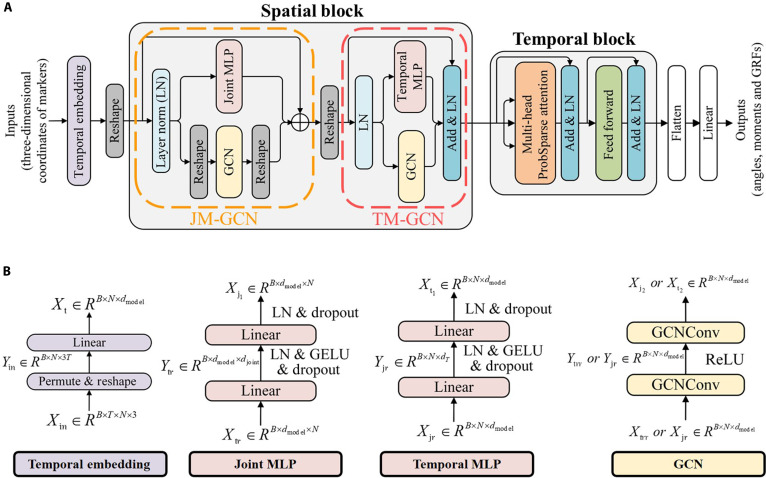 Figure 3
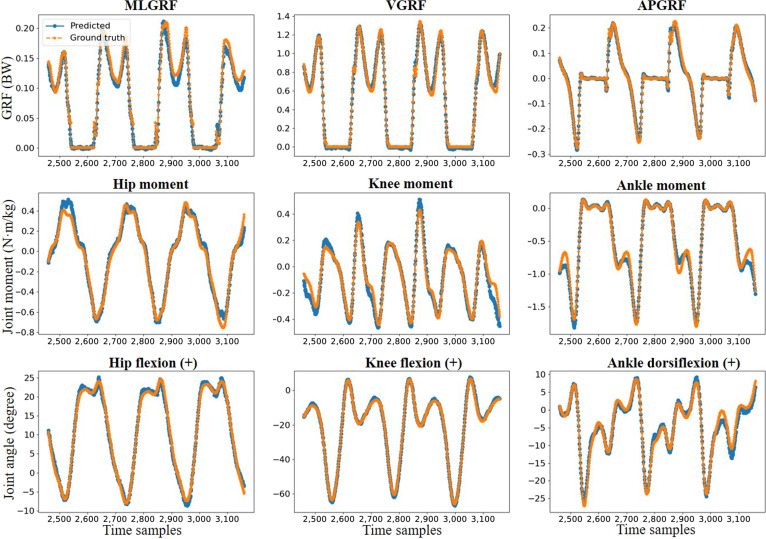 Figure 4
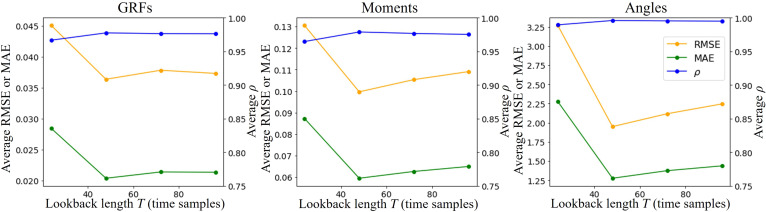 Figure 5
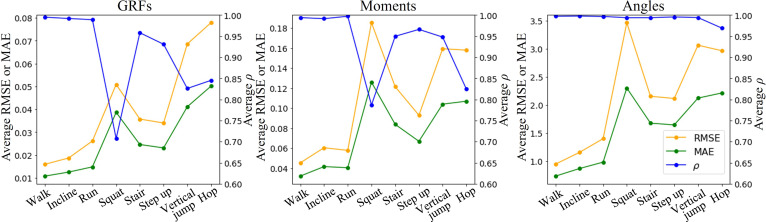 Figure 6
 Figure 7
 Figure 8
Peer Reviews
No public reviews on file for this paper yet. If you reviewed it on a platform where reviews are public (OpenReview, ICLR, NeurIPS, ICML), you can paste yours below so the community can read it here.
Videos
No videos yet. Explain this paper in a talk, walkthrough, or lecture? Add one.
Taxonomy
TopicsProsthetics and Rehabilitation Robotics · Muscle activation and electromyography studies · Motor Control and Adaptation