Capnogram plateau micro‑oscillations preceding end‑tidal CO2 decline as an early cue to venous air embolism during supratentorial craniotomy: a case report
Ayumu Matsumoto, Noriko Takeno, Michiyoshi Sanuki

TL;DR
This case report shows how subtle changes in capnogram patterns can signal early signs of venous air embolism during brain surgery.
Contribution
The paper highlights capnogram plateau micro-oscillations as an early indicator of venous air embolism in the absence of advanced monitoring.
Findings
Micro-oscillations on the capnogram plateau preceded a drop in end-tidal CO2 during surgery.
Timely intervention based on capnogram changes stabilized the patient and prevented complications.
Arterial blood gas levels improved alongside recovery of end-tidal CO2.
Abstract
Venous air embolism (VAE) is a potentially fatal complication of craniotomy. When a TEE is not used, attention to waveform-level changes during conventional monitoring is crucial. A woman in her 70 s underwent supratentorial tumor resection in the supine position with a slight head-up tilt. Approximately 1 h after the craniotomy, gradual decreases in SpO2 (98% → 96%), systolic blood pressure (105 → 90 mmHg), and EtCO2 (37 → 30 mmHg) were observed. New micro-oscillations appeared on the capnogram plateau, followed by an EtCO2 decrease to 22 mm Hg. VAE was suspected. Treatment, including field flooding, head-down positioning, as well as FiO2, dobutamine, and rapid fluid supplementation, stabilized her and allowed the uneventful completion of surgery. Arterial blood gas levels improved concurrently with EtCO2 recovery. Careful scrutiny of capnogram morphology, not only numeric EtCO2, can…
Genes, proteins, chemicals, diseases, species, mutations and cell lines named across the full text — each resolved to its canonical identifier and authoritative record.
Click any figure to enlarge with its caption.
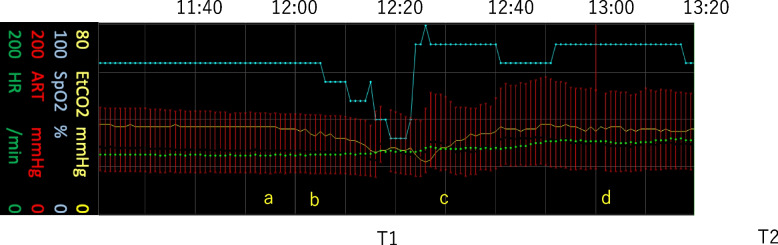 Figure 1
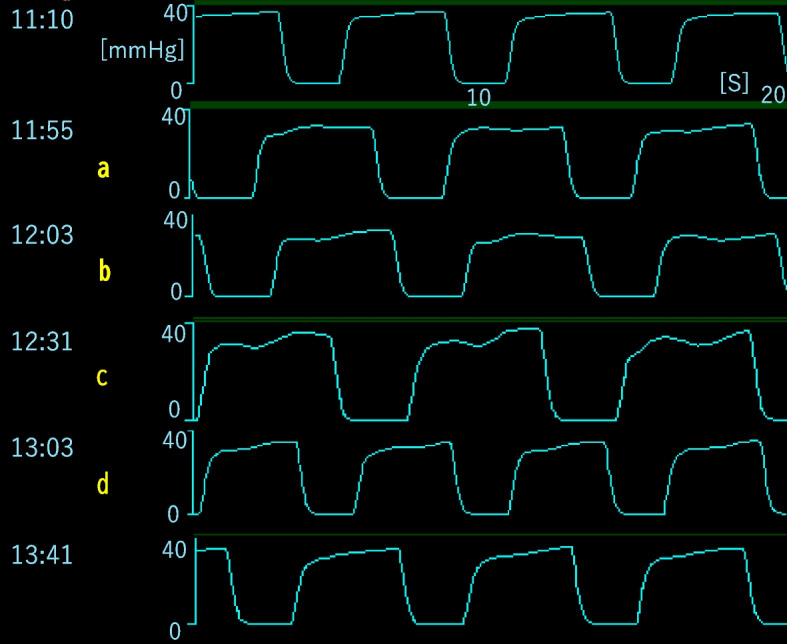 Figure 2
Peer Reviews
No public reviews on file for this paper yet. If you reviewed it on a platform where reviews are public (OpenReview, ICLR, NeurIPS, ICML), you can paste yours below so the community can read it here.
Videos
No videos yet. Explain this paper in a talk, walkthrough, or lecture? Add one.
Taxonomy
TopicsCardiovascular and Diving-Related Complications · Cardiac and Coronary Surgery Techniques · Head and Neck Surgical Oncology