Outcomes of post-operative drain use after cranioplasty surgery – a systematic review and meta-analysis
Zhikai Li, Yuhan Guo, Shangqing W. Yang, Munashe Veremu, Youssef Chedid, William H. Cook, Mohammad Ashraf, Matthew Kingham, Alexandra Lisitsyna, Marwan Al-Munaer, Keng Siang Lee, Harry Mee, Yevgeny Karepov, Conor S. Gillespie, Adel Helmy, Ivan Timofeev, Peter J. Hutchinson

TL;DR
This study reviews whether using drains after cranioplasty surgery reduces complications, finding limited evidence of benefit due to inconsistent protocols.
Contribution
The paper provides a systematic review and meta-analysis evaluating the effectiveness of post-cranioplasty drainage on complication rates.
Findings
Post-cranioplasty drainage was associated with a lower complication rate (8.2%) compared to no drainage (21.7%).
The pooled risk ratio for complications was 0.51, but the result was not statistically significant (p = 0.095).
Heterogeneity in drainage protocols limits clear conclusions about their effectiveness.
Abstract
Cranioplasty restores cranial integrity following decompressive craniectomy or skull trauma. Despite its reconstructive benefits, post-cranioplasty complication rates are high. Post-operative drainage has been proposed to mitigate these risks, yet its effectiveness remains uncertain. This study evaluates the impact of post-cranioplasty drain insertion on surgical outcomes. A systematic literature search of MEDLINE, Embase, and Cochrane CENTRAL Library was conducted in accordance with PRISMA guidelines (PROSPEROID:CRD420251030365). Studies reporting cranioplasty outcomes with post-operative drainage were selected. Primary outcomes were complication rates, including infection, haemorrhage, and cerebrospinal fluid (CSF) leak. Four studies met the inclusion criteria, comprising 522 patients (mean age 43.7 years) who underwent cranioplasty—282 with post-operative drainage and 240 without.…
Genes, proteins, chemicals, diseases, species, mutations and cell lines named across the full text — each resolved to its canonical identifier and authoritative record.
Click any figure to enlarge with its caption.
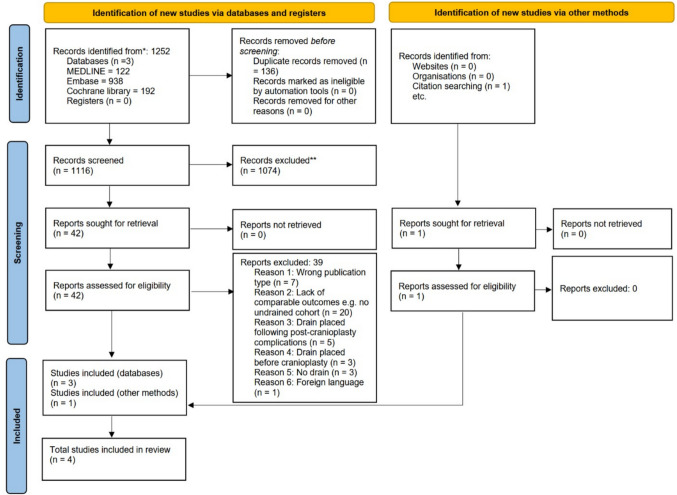 Figure 1
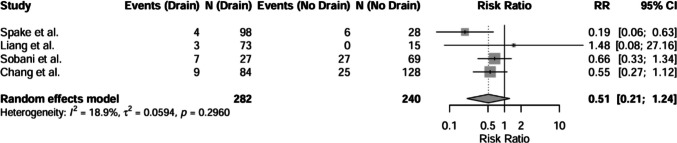 Figure 2
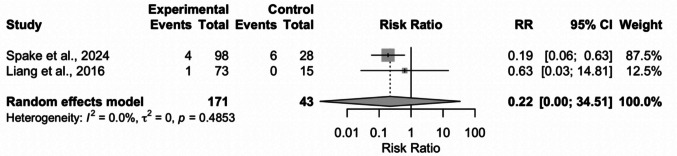 Figure 3
Peer Reviews
No public reviews on file for this paper yet. If you reviewed it on a platform where reviews are public (OpenReview, ICLR, NeurIPS, ICML), you can paste yours below so the community can read it here.
Videos
No videos yet. Explain this paper in a talk, walkthrough, or lecture? Add one.
Taxonomy
TopicsTraumatic Brain Injury and Neurovascular Disturbances · Head and Neck Surgical Oncology · Cerebrospinal fluid and hydrocephalus