Peptide Receptor Radionuclide Therapy with Lu-177-DOTATATE and Monitoring with Somatostatin Receptor PET/CT in Patients with Advanced Differentiated Thyroid Carcinoma
Sophie Carina Kunte, Vera U. Wenter, Adrien Holzgreve, Gabriel T. Sheikh, Liam Widjaja, Franz Josef Gildehaus, Simon Lindner, Ralf Schirrmacher, Christine Spitzweg, Christoph J. Auernhammer, Rudolf A. Werner, Mathias J. Zacherl

TL;DR
This study explores the effectiveness of Lu-177-DOTATATE therapy in treating advanced thyroid cancer that no longer responds to traditional treatments.
Contribution
The study evaluates PRRT in radioiodine-refractory differentiated thyroid carcinoma, a novel application of an established treatment.
Findings
PRRT showed variable tumor control with no major side effects in advanced thyroid cancer patients.
Discontinuous PRRT allowed for renewed tumor control upon reinitiation.
SSTR PET/CT effectively identified eligible patients for PRRT.
Abstract
Peptide receptor radionuclide therapy (PRRT) with Lu-177-DOTATATE is an established treatment option for neuroendocrine tumors (NETs) and has been extended to other somatostatin receptor (SSTR)-expressing tumors. We aimed to determine its efficacy and safety profile in patients with advanced radioiodine-refractory differentiated thyroid carcinoma (DTC). Seven radioiodine-refractory DTC patients undergoing at least two cycles of PRRT were included. Patients were subdivided into continuous treatment (defined as sequential application of PRRT; 5/7 (71.4%)) vs. discontinuous treatment (with at least one-year PRRT-free interval; 2/7 (28.6%)). Baseline SSTR PET was analyzed to determine patients’ eligibility for PRRT. Response was assessed by tumor control as defined by stable (± 30.0%) or decreasing (≥ 30.0%) total tumor volume (PET-derived TTV), thyroglobulin (Tg) and RECIST 1.1 criteria.…
Genes, proteins, chemicals, diseases, species, mutations and cell lines named across the full text — each resolved to its canonical identifier and authoritative record.
Click any figure to enlarge with its caption.
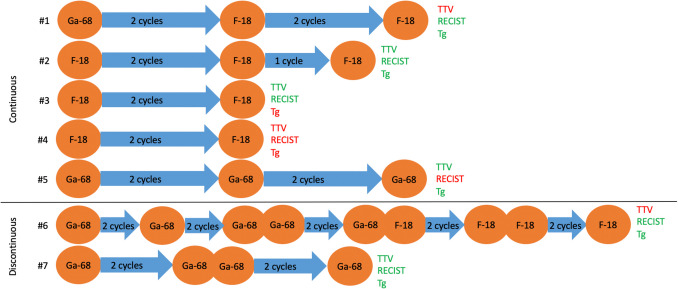 Figure 1
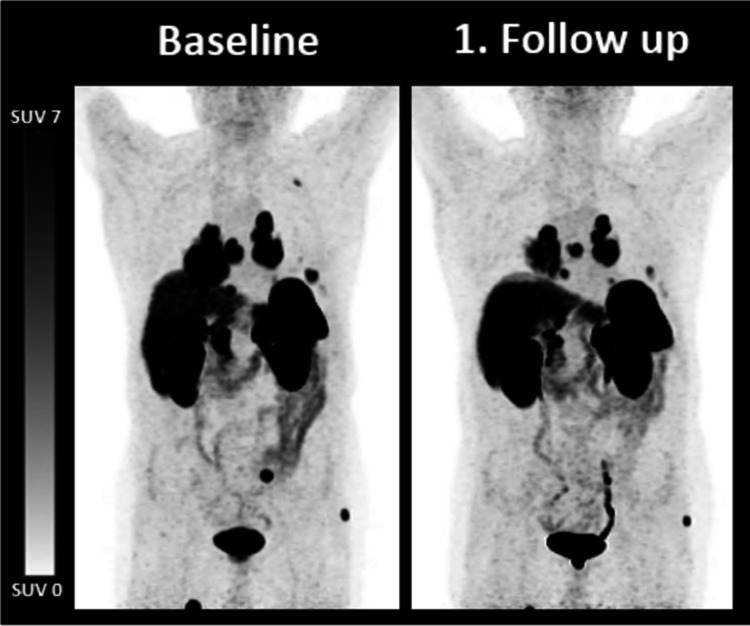 Figure 2
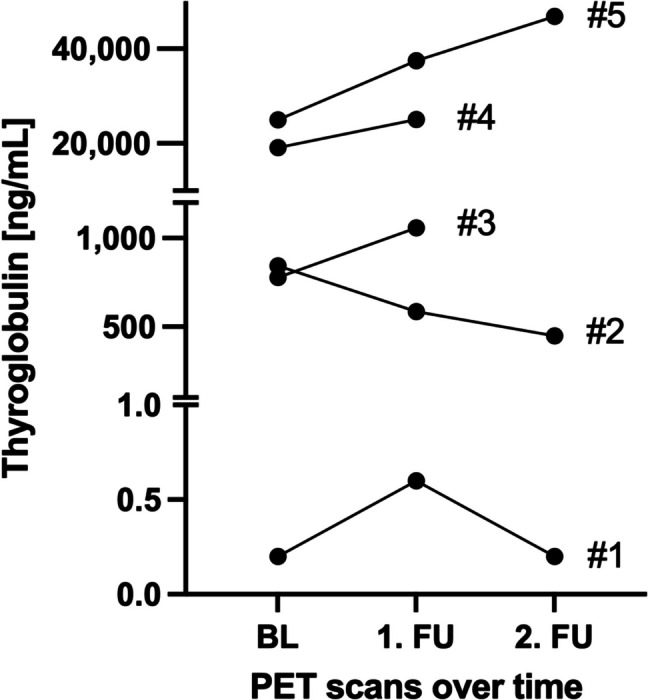 Figure 3
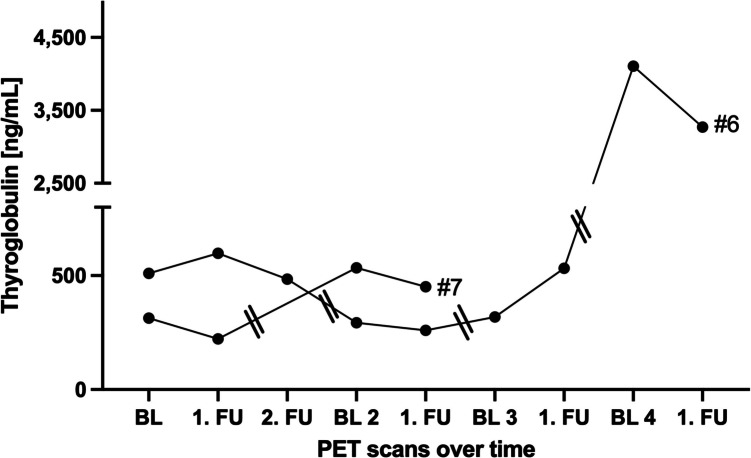 Figure 4
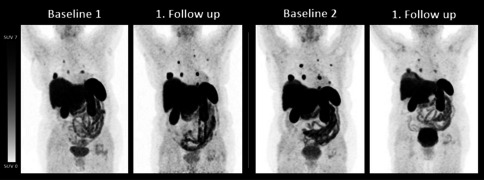 Figure 5
Peer Reviews
No public reviews on file for this paper yet. If you reviewed it on a platform where reviews are public (OpenReview, ICLR, NeurIPS, ICML), you can paste yours below so the community can read it here.
Videos
No videos yet. Explain this paper in a talk, walkthrough, or lecture? Add one.
Taxonomy
TopicsThyroid Cancer Diagnosis and Treatment · Neuroendocrine Tumor Research Advances · Radiopharmaceutical Chemistry and Applications