Retrospective cohort evaluation of renal involvement in non-HIV castleman disease patients from a single academic center in Beijing, China
Hongtao Ling, Lihong Wang, Wei Wang, Xiaoying Yang, Wenqiong Wang, Shuanglian Xie, Yiming Zhao, Shujing Guo, Weiwei Xie, Zhizhen Lai, Huihui Liu, Xiaodi Yang, Xiaojuan Yu, Yujun Dong

TL;DR
This study examines kidney involvement in non-HIV Castleman disease patients, finding it more common in multicentric cases and showing no negative impact on survival.
Contribution
The study provides a detailed analysis of renal involvement in non-HIV Castleman disease, highlighting its prevalence and outcomes in a large cohort.
Findings
Renal involvement occurred in 6.03% of unicentric and 55.22% of multicentric Castleman disease patients.
Thrombotic microangiopathy was the most frequent renal pathology in multicentric cases.
Renal involvement did not significantly affect overall survival in Castleman disease patients.
Abstract
Castleman disease (CD), a rare and clinically heterogeneous condition, frequently involves renal impairment, though this relationship remains poorly characterized. This large cohort study of 183 patients (116 unicentric [UCD], 67 multicentric [MCD]) investigated renal involvement (RI). RI occurred in 6.03% (7/116) of UCD and 55.22% (37/67) of MCD patients. In UCD-RI, 4 underwent renal biopsy, revealing varied pathological results, and 1 underwent total left nephroureterectomy. In MCD-RI, common manifestations included edema, nephrotic syndrome, and acute renal failure. Thrombotic microangiopathy (TMA) was the most frequent renal pathology (9/19 biopsies). Acute renal failure often responded well to treatment, with 60% (9/15) achieving complete recovery. The myeloma-like treatment regimen demonstrated superior efficacy compared to the lymphoma-like regimen and immunomodulatory therapy (P…
Genes, proteins, chemicals, diseases, species, mutations and cell lines named across the full text — each resolved to its canonical identifier and authoritative record.
Click any figure to enlarge with its caption.
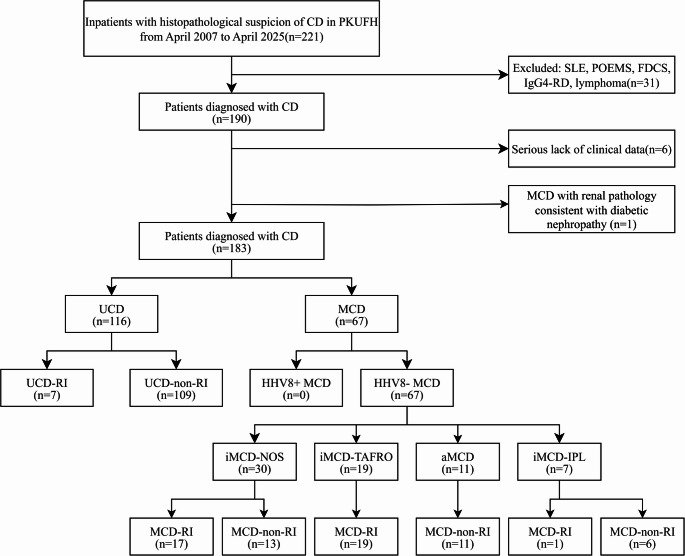 Figure 1
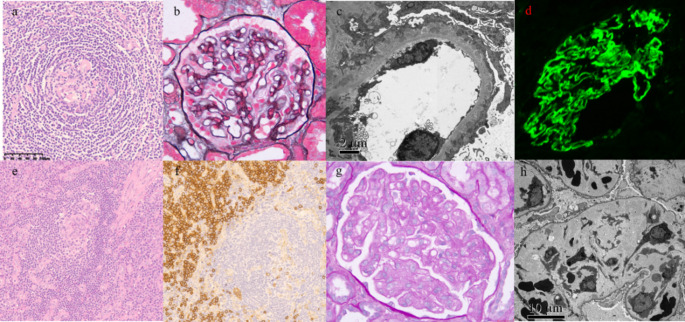 Figure 2
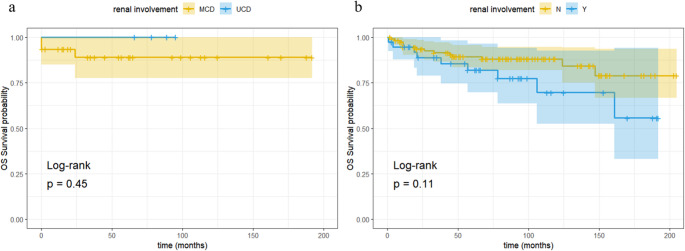 Figure 3
Peer Reviews
No public reviews on file for this paper yet. If you reviewed it on a platform where reviews are public (OpenReview, ICLR, NeurIPS, ICML), you can paste yours below so the community can read it here.
Videos
No videos yet. Explain this paper in a talk, walkthrough, or lecture? Add one.
Taxonomy
TopicsViral-associated cancers and disorders · Renal Diseases and Glomerulopathies · Polyomavirus and related diseases