Phylodynamic analysis reveals disparate transmission dynamics of Mycobacterium tuberculosis complex lineages in Botswana
Qiao Wang, Ivan Barilar, Volodymyr M. Minin, Chawangwa Modongo, Patrick K. Moonan, Alyssa Finlay, Rosanna Boyd, John E. Oeltmann, Tuduetso L. Molefi, Nicola M. Zetola, Timothy F. Brewer, Stefan Niemann, Sanghyuk S. Shin

TL;DR
This study shows that different lineages of the tuberculosis-causing bacteria have distinct transmission patterns in Botswana, as revealed by genetic analysis.
Contribution
The study provides new insights into the phylodynamic differences among Mycobacterium tuberculosis complex lineages in a high-burden setting.
Findings
Lineage 4 (L4) is the most prevalent in Botswana, with L4.3.4 being the dominant sublineage.
L1, L4.4, and L4.3.2 showed population growth linked to the HIV epidemic.
L2 expanded rapidly in the 20th century but declined in the early 1990s.
Abstract
Tuberculosis epidemics have traditionally been conceptualized as arising from a single uniform pathogen. However, Mycobacterium tuberculosis complex (Mtbc), the pathogen causing tuberculosis in humans, encompasses multiple lineages exhibiting genetic and phenotypic diversity that may be responsible for heterogeneity in tuberculosis transmission. We analysed a population-based dataset of 1,354 Mtbc whole-genome sequences collected over four years in Botswana, a country with high HIV and tuberculosis burden. We identified Lineage 4 (L4) as the most prevalent (87.4%), followed by L1 (6.4%), L2 (5.3%), and L3 (0.9%). Within L4, multiple sublineages were identified, with L4.3.4 being the predominant sublineage. Phylodynamic analysis revealed that L4.3.4 expanded steadily from the late 1800s to early 2000s. Conversely, L1, L4.4, and L4.3.2 showed population trajectories closely aligned with…
Genes, proteins, chemicals, diseases, species, mutations and cell lines named across the full text — each resolved to its canonical identifier and authoritative record.
Click any figure to enlarge with its caption.
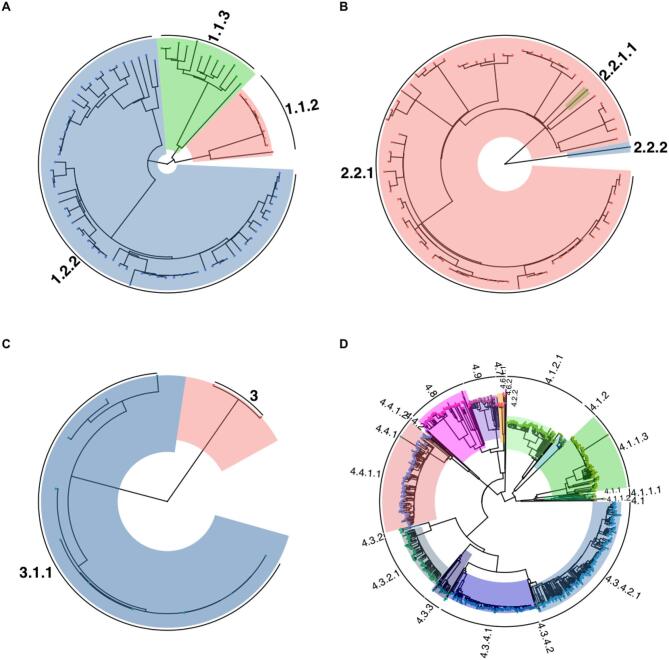 Figure 1
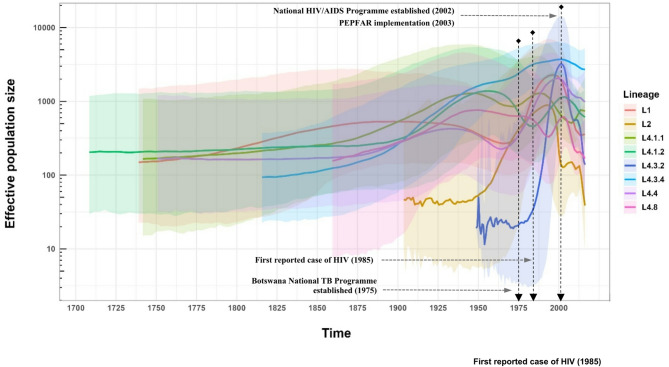 Figure 2
Peer Reviews
No public reviews on file for this paper yet. If you reviewed it on a platform where reviews are public (OpenReview, ICLR, NeurIPS, ICML), you can paste yours below so the community can read it here.
Videos
No videos yet. Explain this paper in a talk, walkthrough, or lecture? Add one.
Taxonomy
TopicsTuberculosis Research and Epidemiology · Mycobacterium research and diagnosis · Diagnosis and treatment of tuberculosis