Location of births by health facility type: a time trend analysis from 1995 to 2023 in 130 low- and middle-income countries
Anna Gage, Madeleine Conrad, Chiara Sumich, Wes Warriner, Aduragbemi Banke-Thomas, Corinne Bintz, Kelly Bienhoff, Jessica Bishai, Rakhi Dandona, Mae Ashworth Dirac, Thomas Glucksman, Simon I. Hay, Megan Knight, Rafael Lozano, Ali H. Mokdad, Abdu Mohiddin, Bancy Ngatia

TL;DR
From 1995 to 2023, public hospitals became the main location for births in low- and middle-income countries, while private hospitals and lower-level facilities played smaller roles.
Contribution
This study provides the first comprehensive global analysis of trends in delivery locations by facility type and sector across 130 low- and middle-income countries.
Findings
In 2023, 47.5% of deliveries in LMICs occurred in public hospitals, with public hospitals accounting for most of the increase in facility births since 1995.
Delivery in lower-level facilities was more common in countries with higher neonatal mortality rates and lower development levels.
Private hospitals provided more than half of births in only two countries, while public lower-level facilities served as the main delivery location in 12 countries.
Abstract
With major increases in facility births in low- and middle-income countries (LMICs) since 1995, a key question is what types of facilities met the increased demand. Understanding the evolving delivery landscape is crucial to informing debates about optimal models for balancing access, quality, and equity. We studied the distribution of delivery location by health facility level and sector (private versus public) in 130 LMICs from 1995 to 2023. We used 745 data sources with delivery location information in our analysis. We first categorised births as in-facility or not, then further classified facility births by level (hospital or lower-level) and sector (public or private). We used spatiotemporal Gaussian process regression to model the share of births by facility type from 1995 to 2023 and compared delivery patterns to development and health indicators. In 2023, 47.5% (95%…
Genes, proteins, chemicals, diseases, species, mutations and cell lines named across the full text — each resolved to its canonical identifier and authoritative record.
Click any figure to enlarge with its caption.
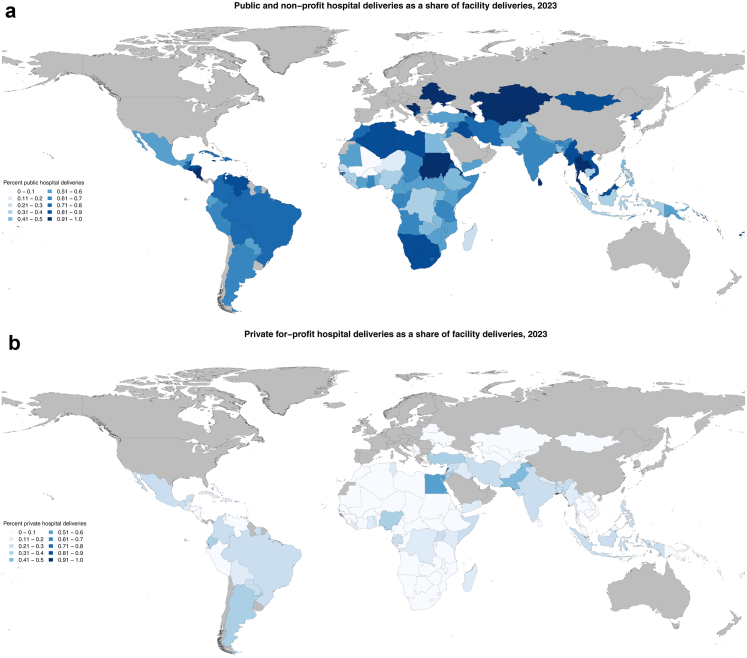 Figure 1
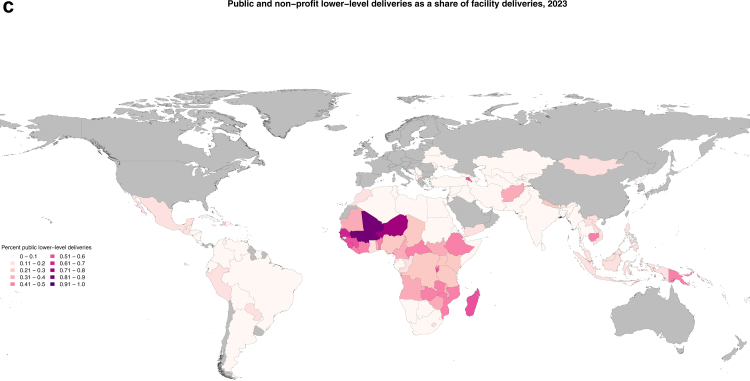 Figure 2
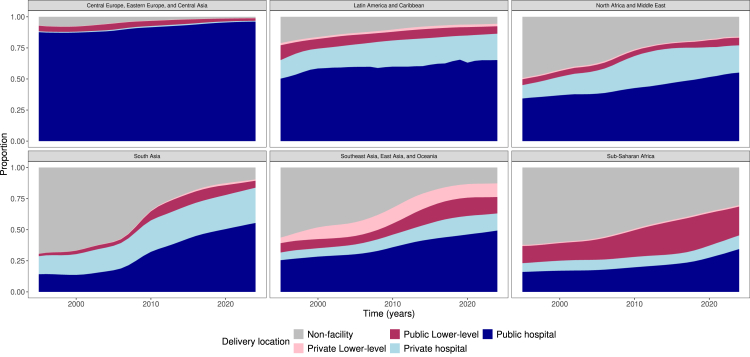 Figure 3
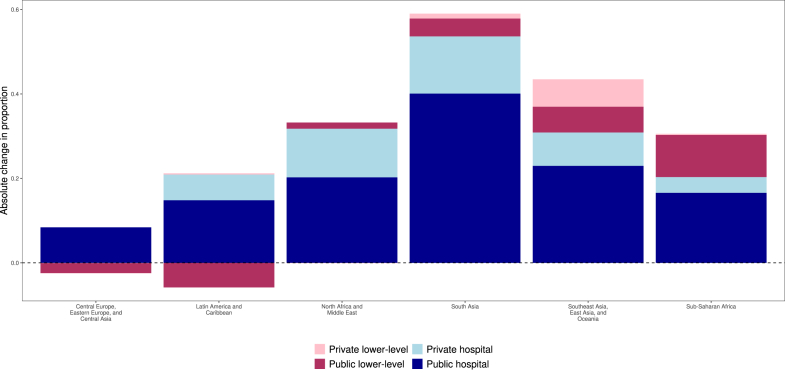 Figure 4
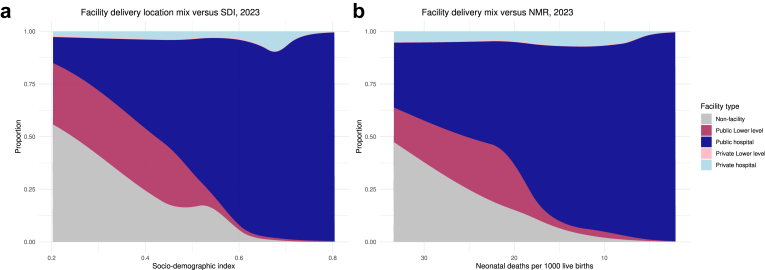 Figure 5
Peer Reviews
No public reviews on file for this paper yet. If you reviewed it on a platform where reviews are public (OpenReview, ICLR, NeurIPS, ICML), you can paste yours below so the community can read it here.
Videos
No videos yet. Explain this paper in a talk, walkthrough, or lecture? Add one.
Taxonomy
TopicsGlobal Maternal and Child Health · Maternal and Perinatal Health Interventions · Maternal and Neonatal Healthcare