Twelve mutations, three trials, and five different labels: PARP inhibitors regulatory inconsistencies in prostate cancers
Sahar Barjesteh van Waalwijk van Doorn-Khosrovani, Hans M. Westgeest, Timothée Olivier

TL;DR
Regulatory agencies differ in approving PARP inhibitors for prostate cancer, with FDA focusing on specific gene mutations while EMA approves for broader use.
Contribution
Highlights inconsistencies in regulatory approvals of PARP inhibitors and identifies trial design flaws affecting biomarker-driven decisions.
Findings
FDA approves PARP inhibitors only for patients with BRCA or HRR gene mutations, while EMA approves for all mCRPC patients.
MAGNITUDE trial design successfully identified a beneficial subgroup, aligning FDA and EMA conclusions.
PROpel and TALAPRO-2 trials suffer from design limitations, leading to conflicting regulatory decisions.
Abstract
Three different PARP (Poly (ADP-ribose) Polymerase)-inhibitors have been approved in combination with androgen receptor pathway inhibitors (ARPIs) for the treatment of metastatic castration-resistant prostate cancer (mCRPC). Regulatory authorities, however, have divergent opinions. Although the US Food and Drug Administration (FDA) has limited approval of two PARP-inhibitors to patients with BRCA mutations or other alterations in homologous recombination repair (HRR) genes, the European Medicines Agency (EMA) has approved the indication for the overall mCRPC population, irrespective of HRR status. Of all trials, only MAGNITUDE, evaluating niraparib and abiraterone, led to aligned conclusions from both the EMA and FDA, as its design effectively identified the subgroup most likely to benefit. The discrepancies observed in the assessment of the other two trials stem from limitations in…
Genes, proteins, chemicals, diseases, species, mutations and cell lines named across the full text — each resolved to its canonical identifier and authoritative record.
Click any figure to enlarge with its caption.
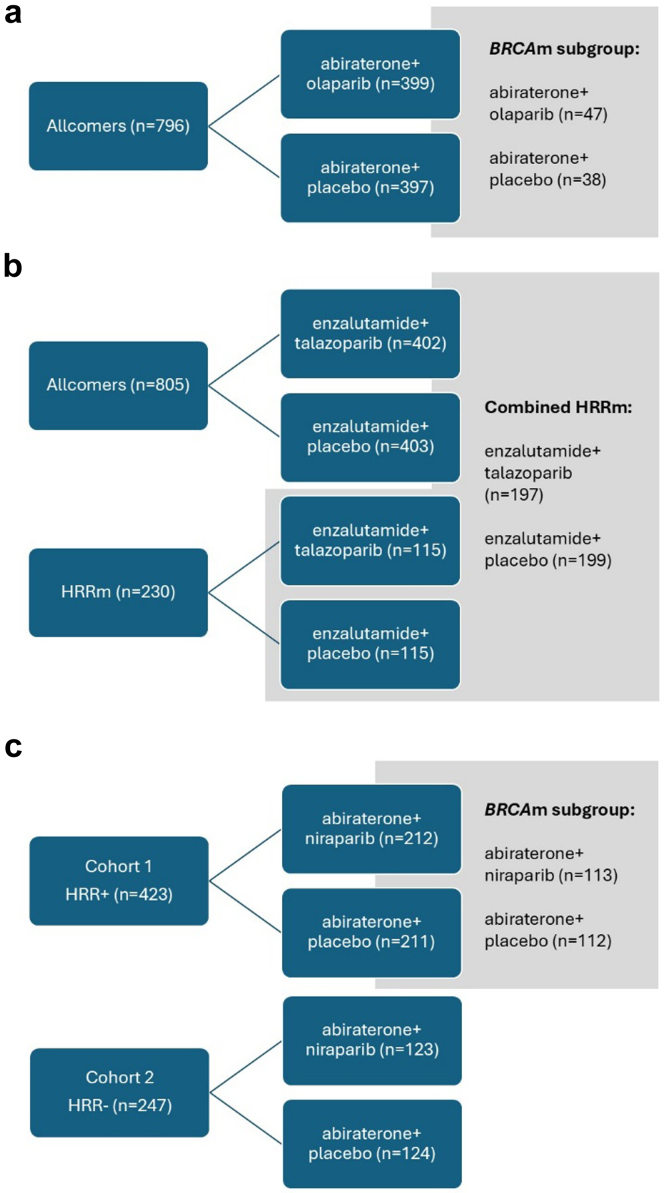 Figure 1
Peer Reviews
No public reviews on file for this paper yet. If you reviewed it on a platform where reviews are public (OpenReview, ICLR, NeurIPS, ICML), you can paste yours below so the community can read it here.
Videos
No videos yet. Explain this paper in a talk, walkthrough, or lecture? Add one.
Taxonomy
TopicsPARP inhibition in cancer therapy · Prostate Cancer Treatment and Research · Prostate Cancer Diagnosis and Treatment