Lipopeptide ligands captured by MHC class I molecules undergo dynamic conformational changes that affect their antigenic strength
Daisuke Morita, Toshiki Fujii, Shinsuke Inuki, Hiromu Suzuki, Bunzo Mikami, Masahiko Sugita

TL;DR
This study shows that the antigenic strength of lipopeptides depends on their ability to maintain a specific conformation that exposes a key epitope for T-cell recognition.
Contribution
The study reveals that dynamic conformational changes in lipopeptides affect their antigenic strength through epitope exposure.
Findings
Antigenic strength of lipopeptides varies based on conformational dynamics and epitope exposure.
Poorly antigenic lipopeptides show a downward shift in hydrocarbon chains and reduced epitope exposure.
Molecular dynamics simulations confirm differential conformational efficiency among lipopeptide analogs.
Abstract
A fraction of the major histocompatibility complex class I proteins can bind N-myristoylated short lipopeptides rather than conventional long peptides. The molecular mechanisms underlying lipopeptide antigen presentation were recently delineated for N-myristoylated 4-mer lipopeptides (C14-Gly1-Gly2-Ala3-Ile4; C14nef4) derived from the retroviral Nef protein. The C14nef4 lipopeptides are captured by the rhesus major histocompatibility complex class I allomorph, Mamu-B∗05104, and recognized by specific αβ T-cell receptors (TCRs). The crystal structure of the Mamu-B∗05104–C14nef4–TCR complex indicates that both ends of C14nef4, namely, myristic acid and C-terminal Ile4, are anchored at the antigen-binding groove, leaving Gly1, Gly2, and Ala3 exposed. Among these residues, only the amide bond of Gly1 forms a hydrogen bond with TCRs and serves as a primary T-cell epitope. However, it remains…
Genes, proteins, chemicals, diseases, species, mutations and cell lines named across the full text — each resolved to its canonical identifier and authoritative record.
Click any figure to enlarge with its caption.
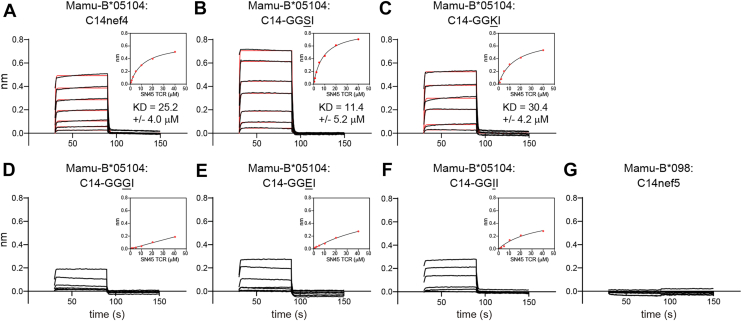 Figure 1
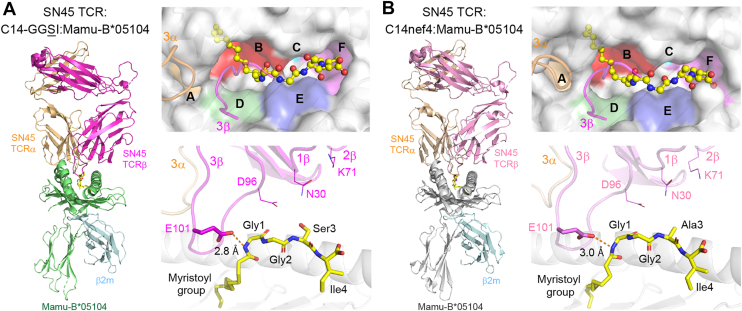 Figure 2
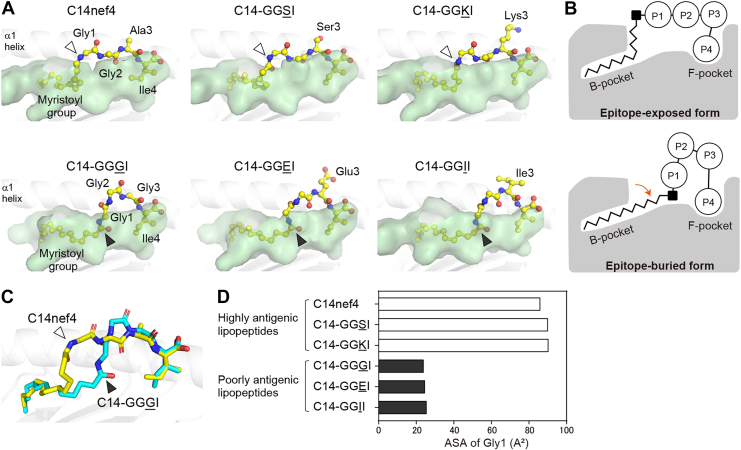 Figure 3
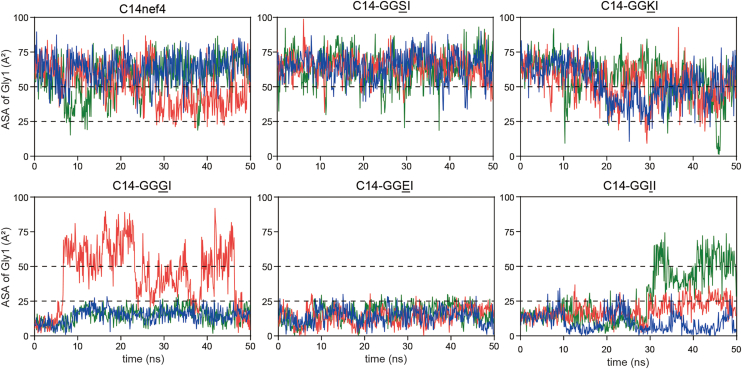 Figure 4
Peer Reviews
No public reviews on file for this paper yet. If you reviewed it on a platform where reviews are public (OpenReview, ICLR, NeurIPS, ICML), you can paste yours below so the community can read it here.
Videos
No videos yet. Explain this paper in a talk, walkthrough, or lecture? Add one.
Taxonomy
TopicsT-cell and B-cell Immunology · vaccines and immunoinformatics approaches · Monoclonal and Polyclonal Antibodies Research