Factor VII deficiency is more prevalent than previously reported
Lukas Löwing Svensson, Elisabeth Aardal, Margareta Holmström

TL;DR
Factor VII deficiency is more common in a region of Sweden than previously thought, with a higher prevalence and significant bleeding risks in affected individuals.
Contribution
The study reports a 28-fold higher prevalence of FVII deficiency in Östergötland, Sweden, compared to international estimates.
Findings
FVII deficiency was found in 1 of 17,800 adults in Östergötland, much higher than the global estimate of 1 in 500,000.
43% of FVII-deficient patients experienced spontaneous bleeding, indicating a significant clinical impact.
Patients with FVII deficiency showed significantly more bleeding symptoms than those with low FVII levels.
Abstract
The prevalence of factor (F)VII deficiency is estimated at approximately 1 of 500,000 individuals. However, low FVII activity (FVII:C) is frequently observed in a population of <500,000 in the region of Östergötland, Sweden. To estimate the prevalence and bleeding tendency of adult FVII-deficient patients in Östergötland, Sweden. In this retrospective cross-sectional study, the laboratory information system was used to identify adult patients with at least one FVII:C result ≤ 0.50 kilo International Units per Liter (kIU/L) between January 1, 2017, and December 31, 2022. The most likely cause was established, and in patients with a FVII deficiency, as defined by the Nordic Hemophilia Council (FVII:C < 0.35 kIU/L) or low FVII level (0.35-0.50 kIU/L), the bleeding tendency was evaluated. FVII:C ≤ 0.50 kIU/L was identified in 97 patients residing in Östergötland. Of these, 21 had FVII…
Genes, proteins, chemicals, diseases, species, mutations and cell lines named across the full text — each resolved to its canonical identifier and authoritative record.
Click any figure to enlarge with its caption.
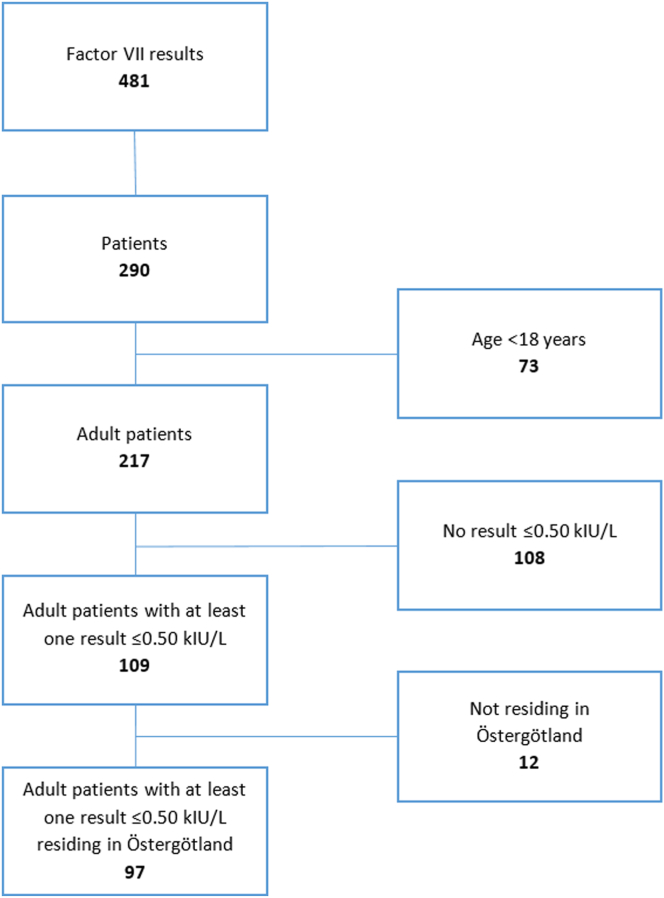 Figure 1
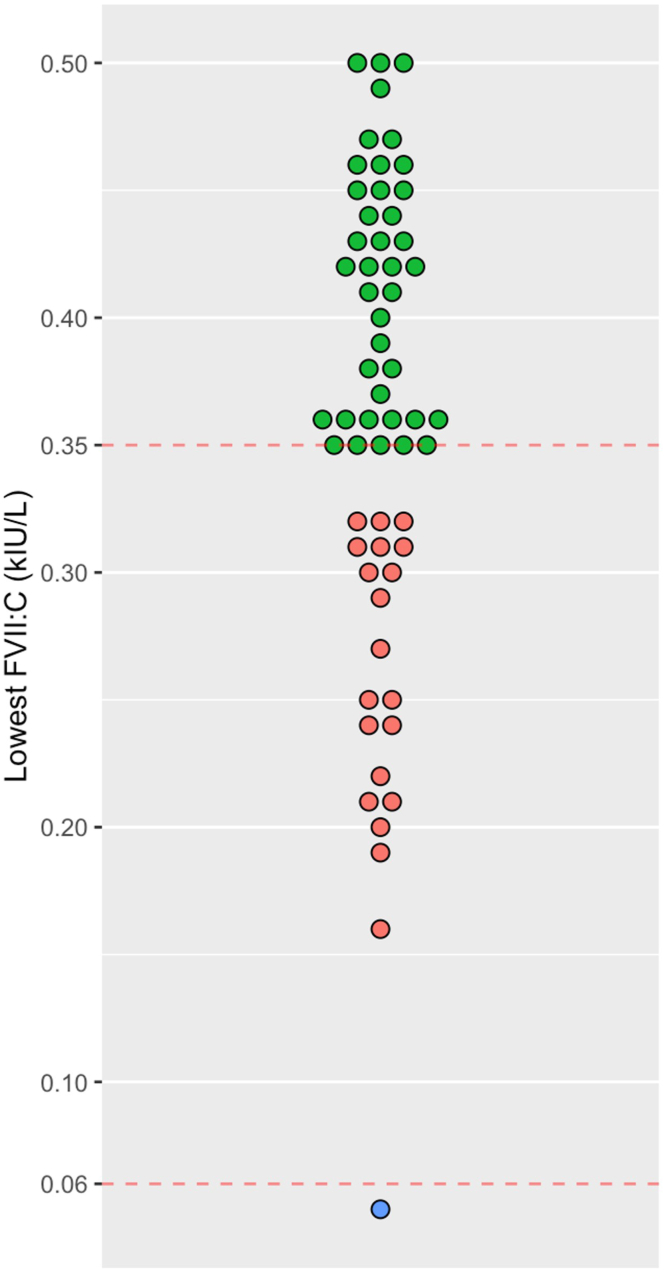 Figure 2
Peer Reviews
No public reviews on file for this paper yet. If you reviewed it on a platform where reviews are public (OpenReview, ICLR, NeurIPS, ICML), you can paste yours below so the community can read it here.
Videos
No videos yet. Explain this paper in a talk, walkthrough, or lecture? Add one.
Taxonomy
TopicsHemophilia Treatment and Research · Blood properties and coagulation · Blood Coagulation and Thrombosis Mechanisms