Health-related quality of life and mental health in autoimmune thrombotic thrombocytopenic purpura patients in the caplacizumab era
Julia Weisinger, Christina Tites, Laurent Gilardin, Aki Baba, Ygal Benhamou, Elie Azoulay, Jean-Francois Augusto, Thomas Papo, Claire Cartery, Olivier Moranne, Gabriel Choukroun, Loïc Lièvre, Jehane Fadlallah, Pascale Poullin, Arnaud Jaccard, Claire Presne, Bérangère Joly

TL;DR
Patients with autoimmune thrombotic thrombocytopenic purpura (iTTP) experience worse mental health and quality of life, but caplacizumab may help reduce anxiety and improve outcomes.
Contribution
This study is the first to evaluate the impact of caplacizumab on mental health and quality of life in iTTP patients.
Findings
iTTP patients had significantly lower quality of life and higher anxiety and depression scores compared to healthy controls.
Caplacizumab treatment was associated with a lower risk of severe anxiety in iTTP patients.
Older age was linked to better mental health outcomes in iTTP patients.
Abstract
Despite improvement in acute care of immune-mediated thrombotic thrombocytopenic purpura (iTTP), numerous studies showed that patients with iTTP have inferior mental health and health-related quality of life (HRQoL). Caplacizumab led to shorter hospitalization, less plasma exchange, and improved survival in iTTP and might influence long-term HRQoL. We aimed to address the impact of iTTP on HRQoL, posttraumatic stress disease, depression, and anxiety, as well as the possible role of caplacizumab on improving these features. We conducted a survey among patients with iTTP enrolled in the French thrombotic microangiopathy registry: patients completed the Short Form (SF)-36 HRQoL, the Hospital Anxiety and Depression Scale screening for anxiety and depression, and the Posttraumatic Stress Disorder Checklist for DSM-IV posttraumatic stress disease questionnaires. Results were compared to…
Genes, proteins, chemicals, diseases, species, mutations and cell lines named across the full text — each resolved to its canonical identifier and authoritative record.
Click any figure to enlarge with its caption.
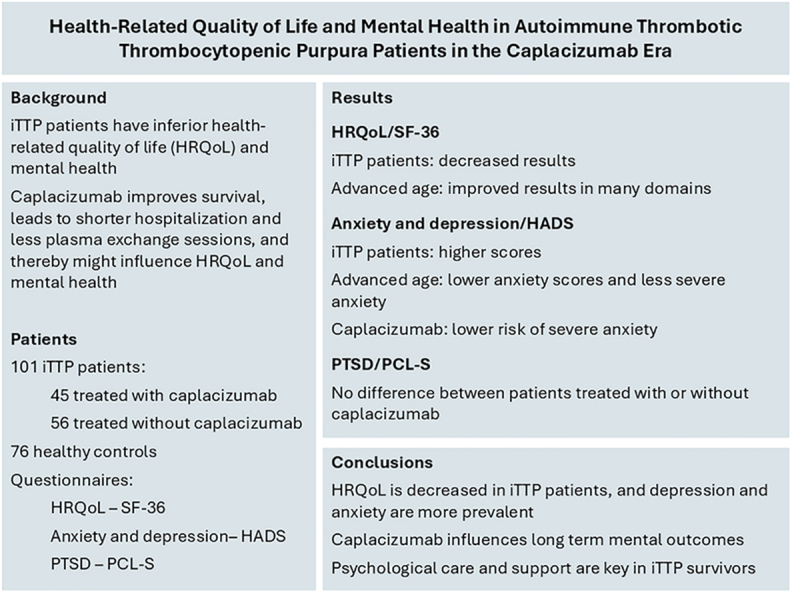 Figure 1
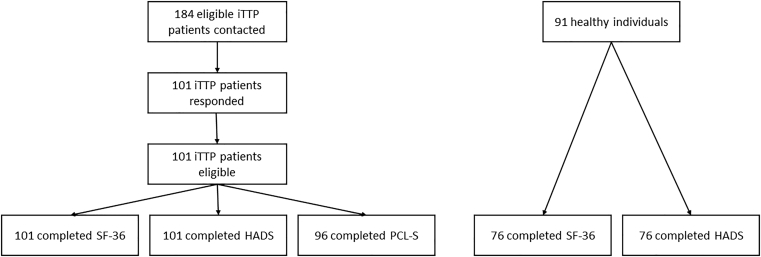 Figure 2
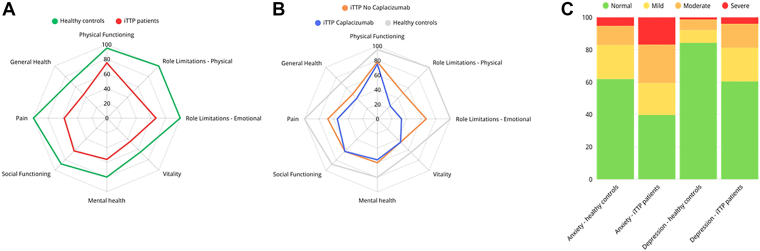 Figure 3
Peer Reviews
No public reviews on file for this paper yet. If you reviewed it on a platform where reviews are public (OpenReview, ICLR, NeurIPS, ICML), you can paste yours below so the community can read it here.
Videos
No videos yet. Explain this paper in a talk, walkthrough, or lecture? Add one.
Taxonomy
TopicsComplement system in diseases · Platelet Disorders and Treatments · Blood groups and transfusion