Parameterising the effect of human occupancy and kinetic energy on indoor air pollution
Dimitrios Bousiotis, Dylan S. Sanghera, Jenny Carrington, Glyn Hodgkiss, Farzaneh Jajarmi, Khalid Z. Rajab, Francis D. Pope

TL;DR
This study explores how human presence and activity affect indoor air pollution in office spaces, finding strong links between movement and pollutant levels.
Contribution
The study introduces a framework combining occupancy and kinetic energy data to model indoor air pollution sources and improve air quality management.
Findings
PM10 concentrations correlate strongly with occupancy (up to r = 0.65) and even more with kinetic energy (up to r = 0.74).
TVOCs and CO2 show strong correlations with kinetic energy (up to r = 0.83), suggesting their use as pollution proxies.
Room characteristics and usage influence how additional occupants affect air quality, highlighting the need for contextual models.
Abstract
Indoor air quality (IAQ) is increasingly recognised as one of the most important aspects for public health, workplace safety and productivity. While indoor and outdoor factors both influence indoor pollutant levels, human presence and activity are key drivers of the emission of specific pollutants, including particulate matter (PM), total volatile organic compounds (TVOCs) and carbon dioxide (CO2). This study investigates the relationship between occupancy, physical activity measured by kinetic energy (KE), and air pollution concentrations in a real-world office setting, by combining data from air quality and radar motion sensors. Two exemplar office spaces were investigated, comprising an open-office area and a meeting room. PM, in the PM1 and PM2.5 size fractions, were found to be highly correlated with the outdoor conditions, whereas PM10 correlates more closely with indoor occupancy…
Genes, proteins, chemicals, diseases, species, mutations and cell lines named across the full text — each resolved to its canonical identifier and authoritative record.
Click any figure to enlarge with its caption.
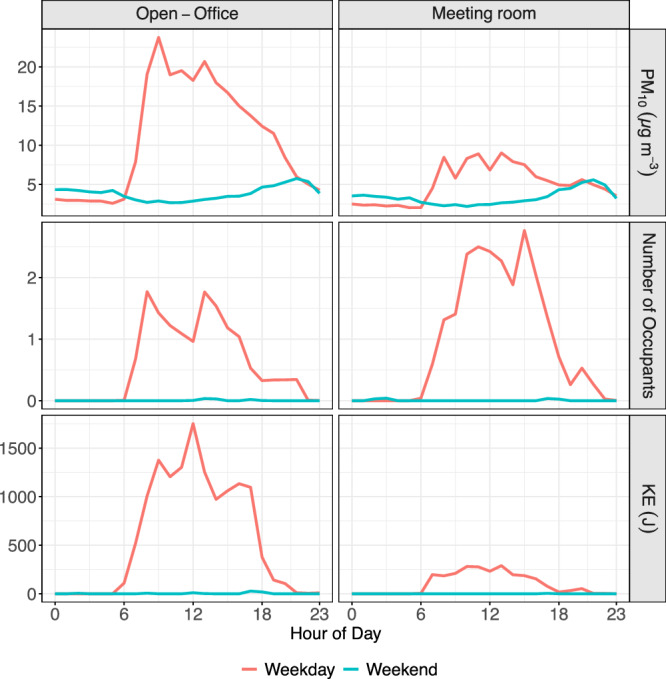 Figure 1
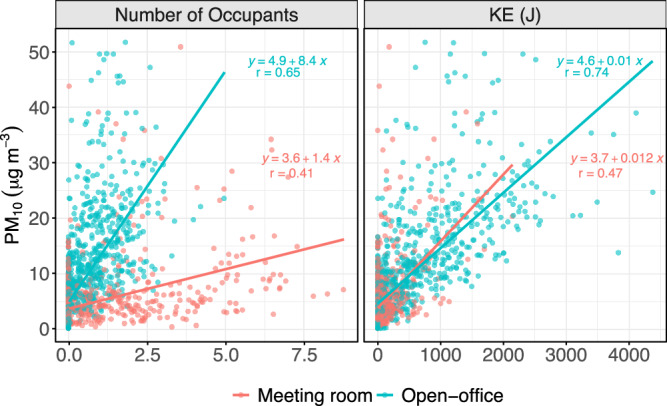 Figure 2
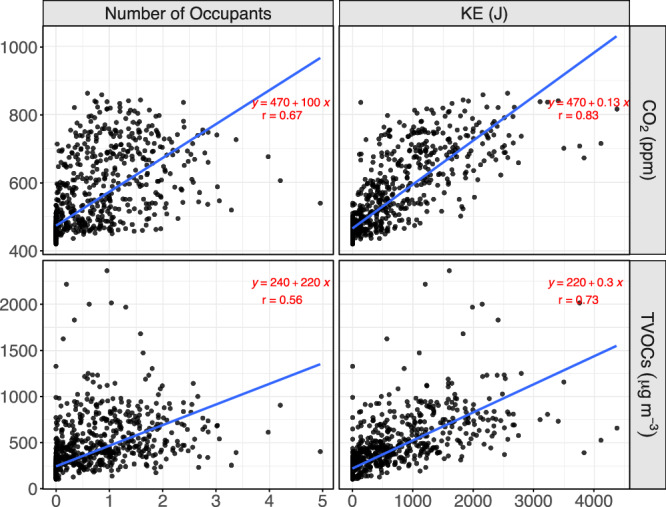 Figure 3
Peer Reviews
No public reviews on file for this paper yet. If you reviewed it on a platform where reviews are public (OpenReview, ICLR, NeurIPS, ICML), you can paste yours below so the community can read it here.
Videos
No videos yet. Explain this paper in a talk, walkthrough, or lecture? Add one.
Taxonomy
TopicsIndoor Air Quality and Microbial Exposure · Air Quality and Health Impacts · Air Quality Monitoring and Forecasting