A Data‐Driven Psychiatric Disorder Subtype Defined by Significant Enlarged Ventricles and Cognitive Impairment: A Replication Study
Toshiaki Onitsuka, Yuka Yasuda, Satsuki Ito, Junya Matsumoto, Naohiro Okada, Maeri Yamamoto, Kazutaka Ohi, Tsutomu Takahashi, Manabu Kubota, Naoki Hashimoto, Harumasa Takano, Naomi Hasegawa, Go Okada, Reiji Yoshimura, Shin Nakagawa, Hidenori Yamasue, Shusuke Numata

TL;DR
This study confirms a psychiatric subtype marked by enlarged brain ventricles and cognitive issues, which is mostly found in men with schizophrenia.
Contribution
The study replicates a data-driven psychiatric disorder subtype characterized by enlarged ventricles and cognitive impairment across independent cohorts.
Findings
18.5% of individuals with enlarged ventricles exhibited cognitive impairment (EVCI), all diagnosed with schizophrenia.
EVCI individuals had significantly lower current IQ scores compared to those with enlarged ventricles but no cognitive impairment.
There was no significant difference in lateral ventricular volume Z scores between the EVCI and EV-nonCI groups.
Abstract
We previously performed data‐driven classification based on large‐scale neuroimaging datasets to identify a potential novel subtype of psychiatric disorders characterized by the pronounced enlarged ventricles and cognitive impairment (EVCI) in one cohort. However, these findings have yet to be validated across independent cohorts. Herein, we investigated the availability of cognitive data in other cohorts in the Cognitive Genetics Collaborative Research Organization (COCORO) project to assess the presence of cognitive impairment (CI). Subsequently, we compared the prevalence of CI, lateral ventricular volume, and demographic and clinical characteristics between individuals with EVCI and those with EV but without CI (EV‐nonCI). Cognitive data were available for 27 individuals with EVCI from the other 8 cohorts. Among the 27 individuals in the EV group, 5 (18.5%) exhibited EVCI, all of…
Genes, proteins, chemicals, diseases, species, mutations and cell lines named across the full text — each resolved to its canonical identifier and authoritative record.
Click any figure to enlarge with its caption.
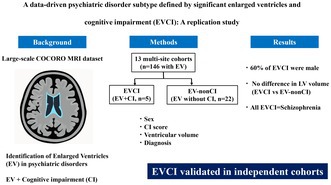 Figure 1
Peer Reviews
No public reviews on file for this paper yet. If you reviewed it on a platform where reviews are public (OpenReview, ICLR, NeurIPS, ICML), you can paste yours below so the community can read it here.
Videos
No videos yet. Explain this paper in a talk, walkthrough, or lecture? Add one.
Taxonomy
TopicsFunctional Brain Connectivity Studies · Schizophrenia research and treatment · Dementia and Cognitive Impairment Research