MedSlice: fine-tuned large language models for secure clinical note sectioning
Joshua Davis, Thomas Sounack, Kate Sciacca, Jessie M Brain, Brigitte N Durieux, Nicole D Agaronnik, Charlotta Lindvall

TL;DR
This paper introduces MedSlice, a pipeline using open-source large language models to automatically extract clinical note sections, offering a secure and cost-effective alternative to proprietary models.
Contribution
The novel contribution is a fine-tuned open-source LLM pipeline for clinical note sectioning that outperforms proprietary models in performance and privacy.
Findings
Fine-tuned Llama 3.1 8B achieved an F1 score of 0.92, outperforming GPT-4o in clinical note sectioning.
The model maintained high performance (F1 = 0.85) on an external test set, demonstrating robust generalizability.
Open-source models provide privacy advantages and cost-effectiveness compared to proprietary alternatives in clinical settings.
Abstract
Extracting sections from clinical notes is crucial for downstream analysis but is challenging due to variability in formatting and labor-intensive nature of manual sectioning. This study develops a pipeline for automated note sectioning using open-source large language models (LLMs), focusing on three sections: History of Present Illness, Interval History, and Assessment and Plan. We fine-tuned three open-source LLMs to extract sections using a curated dataset of 487 progress notes, comparing results relative to proprietary models (GPT-4o, GPT-4o mini). Internal and external validity were assessed via precision, recall, and F1 score. Fine-tuned Llama 3.1 8B (F1 = 0.92) outperformed GPT-4o. On the external validity test set, performance remained high (F1 = 0.85). While proprietary LLMs have shown promise, privacy concerns limit their utility in medicine; fine-tuned, open-source LLMs…
Genes, proteins, chemicals, diseases, species, mutations and cell lines named across the full text — each resolved to its canonical identifier and authoritative record.
Click any figure to enlarge with its caption.
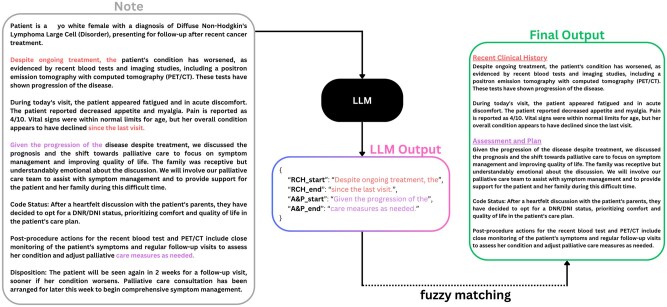 Figure 1
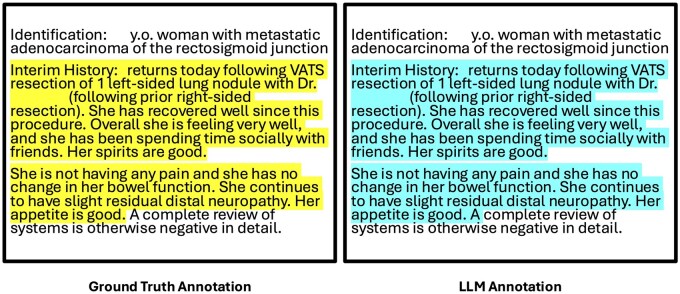 Figure 2
Peer Reviews
No public reviews on file for this paper yet. If you reviewed it on a platform where reviews are public (OpenReview, ICLR, NeurIPS, ICML), you can paste yours below so the community can read it here.
Videos
No videos yet. Explain this paper in a talk, walkthrough, or lecture? Add one.
Taxonomy
TopicsTopic Modeling · Handwritten Text Recognition Techniques · Biomedical Text Mining and Ontologies