Smart Ungulates: What Sheep and Goats' Performances in a Reversed‐Reward Contingency Task Tell Us About the Evolution of Cognitive Flexibility
Laurie Castro, Raymond Nowak, Valérie Dufour

TL;DR
Young goats outperform sheep in a cognitive task, showing greater cognitive flexibility and inhibitory control, which suggests they are good models for studying the evolution of these abilities.
Contribution
The study demonstrates cognitive flexibility in young goats and highlights ungulates as promising models for comparative cognition research.
Findings
Goats performed better than sheep in the reversed-reward contingency task.
Only younger goats solved the task, indicating cognitive flexibility is key.
Sheep did not exceed chance-level performance in the task.
Abstract
Cognitive flexibility and inhibitory control are core executive functions that enable animals to adapt their behaviour to variable environments. Although these abilities are extensively studied in primates, and despite a growing interest in ungulate cognition, research specifically targeting executive functions in ungulates remains limited. In this study, we compare the performance of domestic goats ( Capra hircus ) and sheep ( Ovis aries ) in a reversed‐reward contingency (RRC) task. This task is traditionally used to test inhibitory control (the ability to resist a prepotent response), but it should also involve cognitive flexibility (the ability to adapt to changed contingencies). Overall, goats performed better than sheep. Two young goats met the success criterion spontaneously, and two more succeeded following corrective procedures. No sheep exceeded chance‐level performance. Only…
Genes, proteins, chemicals, diseases, species, mutations and cell lines named across the full text — each resolved to its canonical identifier and authoritative record.
Click any figure to enlarge with its caption.
 Figure 1
 Figure 2
 Figure 3
 Figure 4
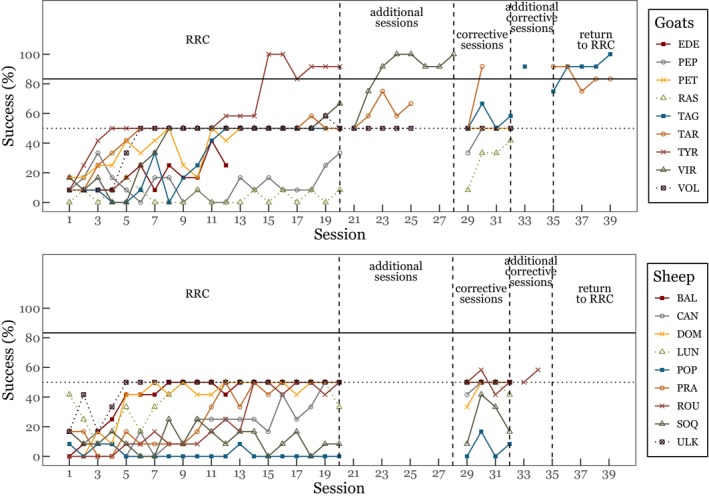 Figure 5
 Figure 6
 Figure 7
 Figure 8
 Figure 9
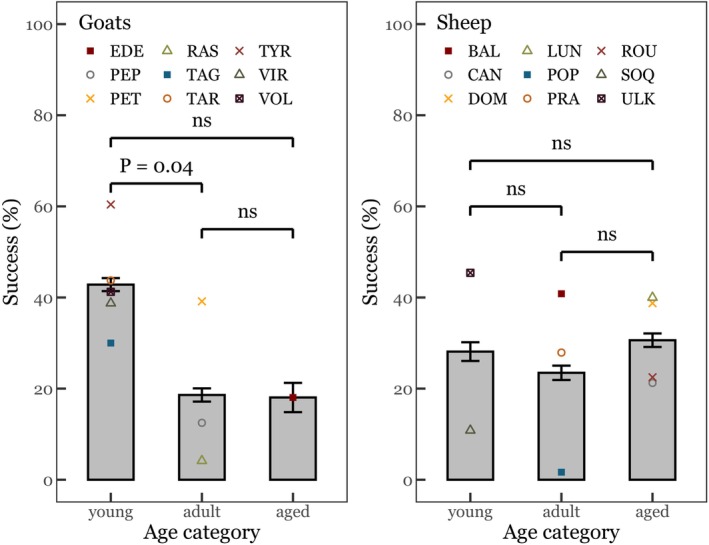 Figure 10
Peer Reviews
No public reviews on file for this paper yet. If you reviewed it on a platform where reviews are public (OpenReview, ICLR, NeurIPS, ICML), you can paste yours below so the community can read it here.
Videos
No videos yet. Explain this paper in a talk, walkthrough, or lecture? Add one.
Taxonomy
TopicsPrimate Behavior and Ecology · Neurotransmitter Receptor Influence on Behavior · Memory and Neural Mechanisms