Reliance on blue, green, and brown energy channels drives a shift in the trophic position of riparian spiders
Grégoire Saboret, Bastiaan J. W. Drost, Carmen Kowarik, Maja Ilić, Martin M. Gossner, Carsten J. Schubert

TL;DR
Riparian spiders' position in the food chain depends on the type of energy source they rely on, with implications for ecosystem stability and nutrient flow.
Contribution
The study introduces specific trophic discrimination factors for spiders and shows how energy channel use affects their trophic position.
Findings
Spiders utilizing the brown energy channel have the highest trophic position (TP ~4.1), followed by green (TP ~3.6) and blue (TP ~2.9).
Prey omnivory in green channels and decomposers in brown channels contribute to differences in spider trophic positions.
Basal nutritional quality increases from brown to green to blue energy sources, influencing food chain length and ecosystem dynamics.
Abstract
Understanding the mechanisms shaping food chain length (FCL) has long been central to food web ecology. FCL is a key determinant of stability, energy flow efficiency, and biodiversity maintenance, but there is an ongoing debate about its underlying drivers. It is particularly important in meta‐ecosystems, where predator trophic position (TP) is influenced by multiple energy channels. In this study, we focused on spiders in riparian ecosystems, which rely on resources linked to distinct energy channels: blue (algal herbivory), green (terrestrial herbivory), and brown (terrestrial detritivory). We applied nitrogen isotope analysis of amino acids to estimate the TP of both spiders and their prey. This method is a powerful tool for determining TP from a single sample and even allows for capturing decomposer trophic steps. However, the TP estimate requires special care for riparian spiders,…
Genes, proteins, chemicals, diseases, species, mutations and cell lines named across the full text — each resolved to its canonical identifier and authoritative record.
Click any figure to enlarge with its caption.
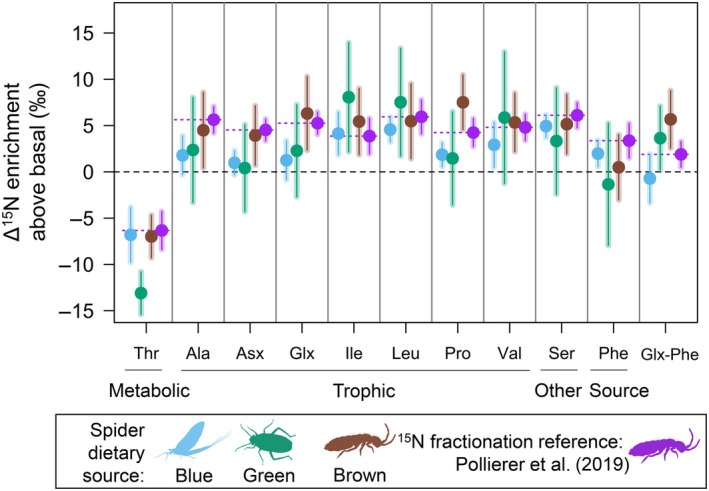 Figure 1
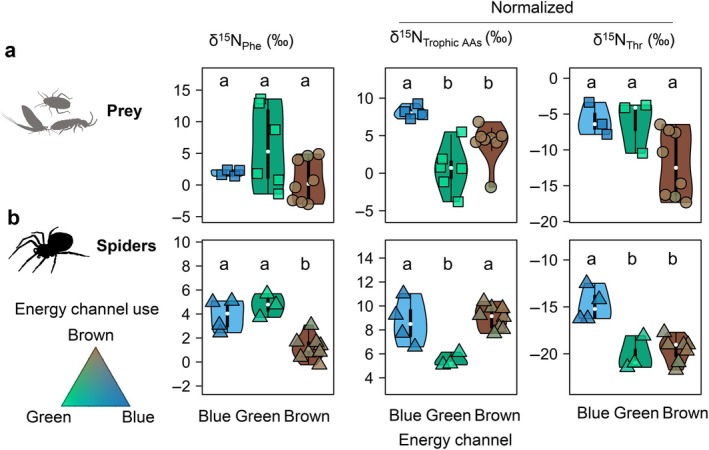 Figure 2
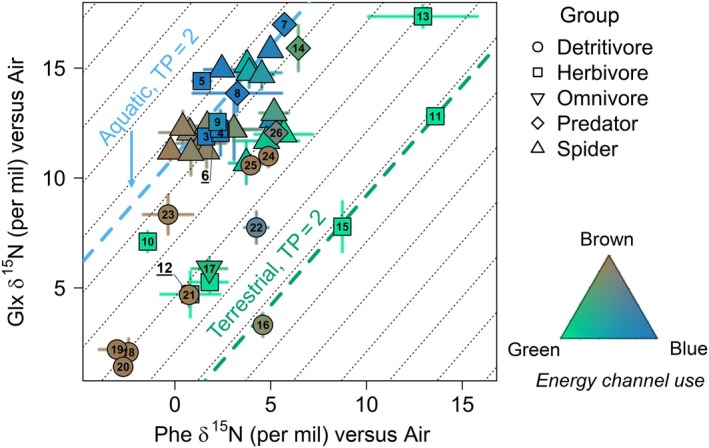 Figure 3
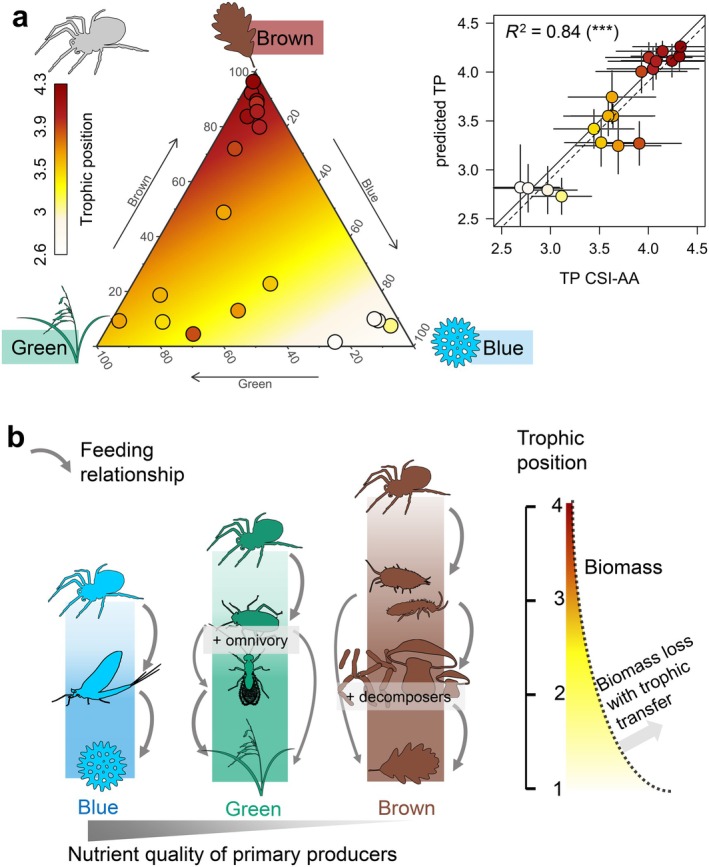 Figure 4
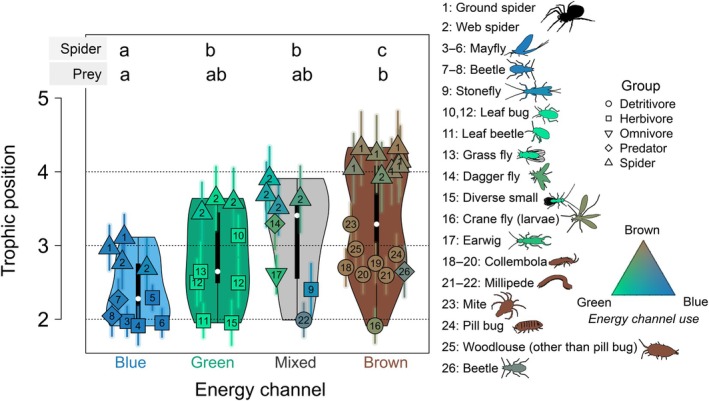 Figure 5
Peer Reviews
No public reviews on file for this paper yet. If you reviewed it on a platform where reviews are public (OpenReview, ICLR, NeurIPS, ICML), you can paste yours below so the community can read it here.
Videos
No videos yet. Explain this paper in a talk, walkthrough, or lecture? Add one.
Taxonomy
TopicsIsotope Analysis in Ecology · Freshwater macroinvertebrate diversity and ecology · Environmental DNA in Biodiversity Studies