Exhaled Carbon Monoxide Indicates Persistent Subgingival Dysbiosis After Periodontal Therapy
Sophie Koehlen, Inga Harks, Johannes Matern, Karola Prior, Peter Eickholz, Katrin Lorenz, Ti‐Sun Kim, Thomas Kocher, Jörg Meyle, Doğan Kaner, Yvonne Jockel‐Schneider, Dag Harmsen, Benjamin Ehmke, Sven Kleine Bardenhorst, Daniel Hagenfeld

TL;DR
Exhaled carbon monoxide levels may indicate ongoing subgingival bacterial imbalance after periodontal treatment, especially in smokers.
Contribution
The study shows that exhaled CO levels correlate with specific bacterial clusters post-therapy, offering a non-invasive monitoring tool.
Findings
Smokers showed significant declines in exhaled CO levels at 14 and 26 months post-therapy.
Higher CO levels after therapy were positively associated with subgingival dysbiosis dominated by Fusobacterium and Prevotella.
Every 10 ppm increase in CO correlated with a 16% increase in the abundance of an anaerobe-dominated bacterial cluster.
Abstract
To investigate whether exhaled carbon monoxide (CO) is dose‐dependently associated with subgingival polymicrobial clusters before and after non‐surgical periodontal therapy. We followed 163 adults with periodontitis, measuring CO before and at 2, 14 and 26 months after therapy. Subgingival plaque samples were analysed using 16S rRNA gene sequencing. We applied topic models and regression analysis, adjusted for age, sex, treatment group, pocket probing depth and plaque levels. Smokers had generally higher mean CO levels at every visit and showed significant declines at 14 and 26 months after therapy (p < 0.01). Before therapy, CO was not associated with dysbiosis; after therapy, higher levels were positively associated. In sensitivity analyses, self‐reported smoking status explained more variance in dysbiosis than CO alone, with only marginal gains when both were combined. Among…
Genes, proteins, chemicals, diseases, species, mutations and cell lines named across the full text — each resolved to its canonical identifier and authoritative record.
Click any figure to enlarge with its caption.
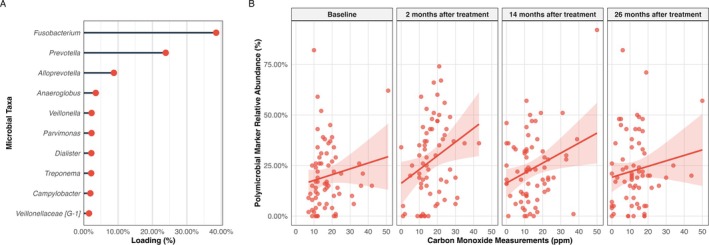 Figure 1
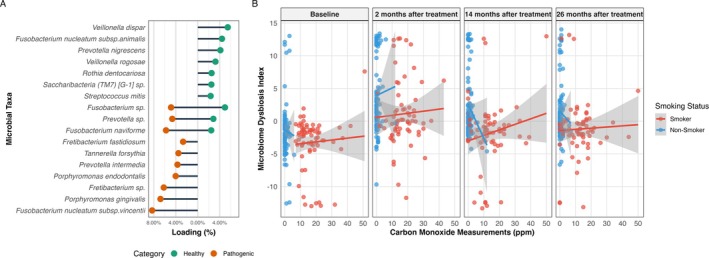 Figure 2
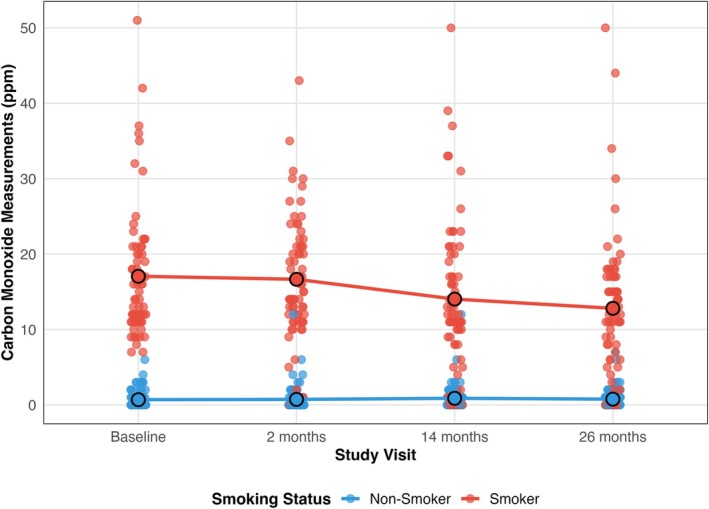 Figure 3
Peer Reviews
No public reviews on file for this paper yet. If you reviewed it on a platform where reviews are public (OpenReview, ICLR, NeurIPS, ICML), you can paste yours below so the community can read it here.
Videos
No videos yet. Explain this paper in a talk, walkthrough, or lecture? Add one.
Taxonomy
TopicsOral microbiology and periodontitis research · Oral Health Pathology and Treatment · Salivary Gland Disorders and Functions