Modeling Postoperative Nerve Regeneration Using Diffusion MRI: A Preclinical Study of a Novel Mathematical Approach
Isaac Manzanera Esteve, Ling Yan, Huseyin Karagoz, Ricardo Torres‐Guzman, Sara Chaker, Barite Gutama, Ronald M. Cornely, Benjamin Savitz, Andrew James, Noah Alter, Anthony Hoang, Anvith Reddy, Erin Abott, Ping Wang, Kezia Sharon Christopher, Richard Dortch, Wesley Thayer

TL;DR
This study uses diffusion MRI and a mathematical model to track nerve regeneration in rats, showing that it can predict recovery outcomes more effectively than current methods.
Contribution
A novel mathematical approach based on the Gompertz function is applied to diffusion MRI for monitoring nerve regeneration.
Findings
FA values at the distal section showed the strongest correlation with functional recovery (r = 0.84, p < 0.001).
Automated FA profile analysis can help distinguish successful from unsuccessful nerve recovery.
The method could enable early diagnosis and guide decisions for second repair surgeries.
Abstract
Nerve regeneration after injury must occur in a timely fashion to restore function. Current methods of assessment provide limited information following trauma, resulting in delayed management and suboptimal outcomes. In this study, we evaluated the ability of diffusion magnetic resonance imaging (MRI) and a mathematical model based on the Gompertz function to monitor nerve regeneration after injury and repair. Sprague Dawley rats were assigned to two treatment groups (sham = 2, cut, immediate repair = 7), and in vivo diffusion tensor imaging (DTI) was performed every 2 weeks until 12 weeks post‐surgery. Functional recovery was evaluated weekly over the same time period via the sciatic functional index (SFI). After injury, SFI and DTI‐derived fractional anisotropy (FA) values exhibited similar longitudinal trends and distinctions in both sham and cut/repair (C/R) cohorts. FA values at…
Genes, proteins, chemicals, diseases, species, mutations and cell lines named across the full text — each resolved to its canonical identifier and authoritative record.
Click any figure to enlarge with its caption.
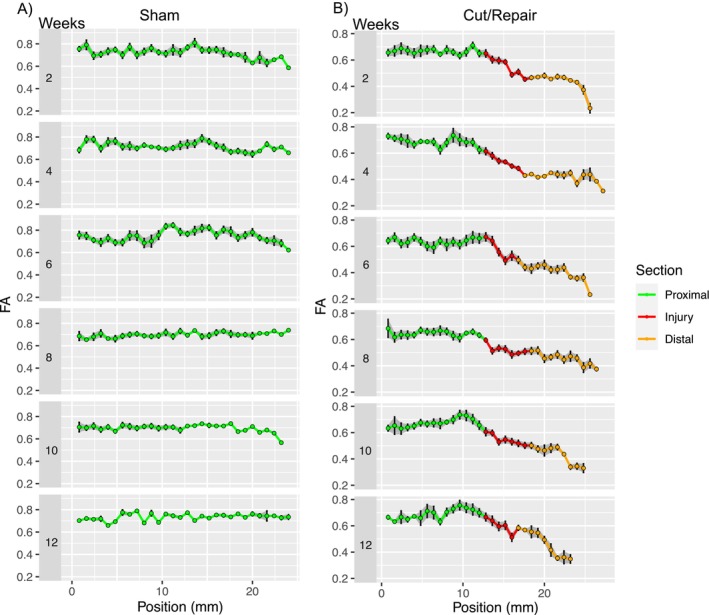 Figure 1
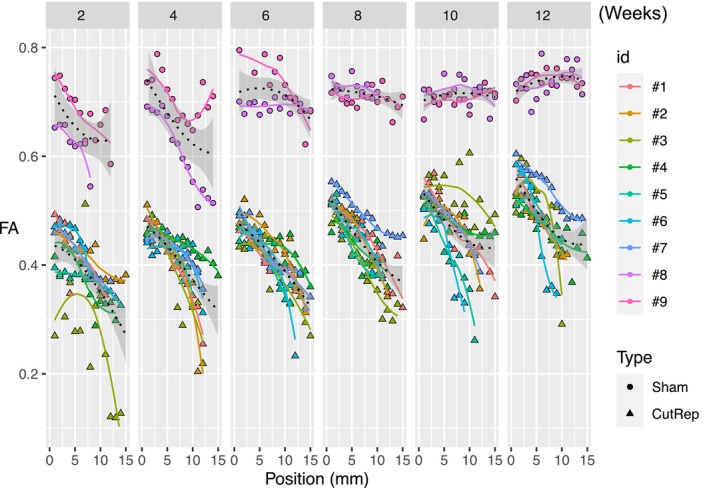 Figure 2
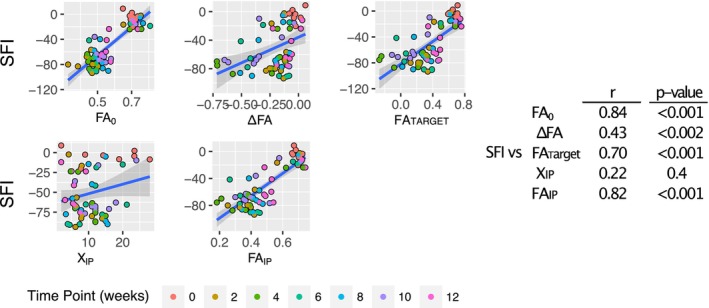 Figure 3
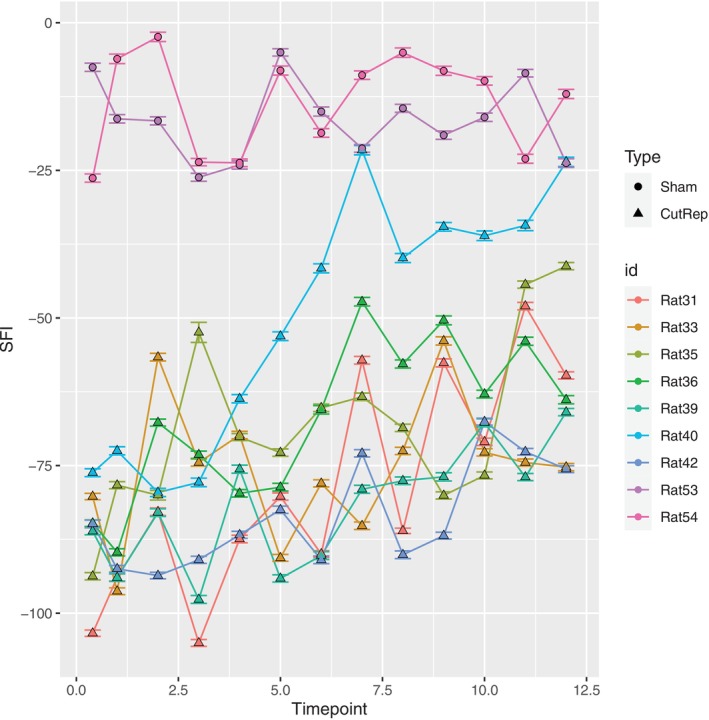 Figure 4
Peer Reviews
No public reviews on file for this paper yet. If you reviewed it on a platform where reviews are public (OpenReview, ICLR, NeurIPS, ICML), you can paste yours below so the community can read it here.
Videos
No videos yet. Explain this paper in a talk, walkthrough, or lecture? Add one.
Taxonomy
TopicsAdvanced Neuroimaging Techniques and Applications · Nerve injury and regeneration · Nerve Injury and Rehabilitation