Pharmacologic pitfalls in heart failure: A guide to drugs that may cause or exacerbate heart failure. A European Journal of Heart Failure expert consensus document
Amr Abdin, Johann Bauersachs, Magdy Abdelhamid, Suleman Aktaa, Hussam Al Ghorani, Antonio Bayes‐Genis, Jan Biegus, Michael Böhm, Javed Butler, Nicolas Girerd, Marco Metra, Wilfried Mullens, Hadi Skouri, Muthiah Vaduganathan, Seif El Hadidi, Giuseppe M.C. Rosano

TL;DR
This paper identifies medications that can worsen heart failure and provides guidance for clinicians to avoid harmful drug use in patients with heart failure.
Contribution
The paper offers a comprehensive, expert consensus on drugs that may cause or exacerbate heart failure, emphasizing clinical scenarios and management strategies.
Findings
Several drug classes, including antidiabetic agents and antiarrhythmics, may worsen heart failure.
Clinicians should review medication regimens to avoid iatrogenic harm in heart failure patients.
Individualized therapy and close monitoring are emphasized to prevent drug-induced deterioration.
Abstract
Heart failure (HF) exerts a global health burden, often complicated by polypharmacy due to the frequent coexistence of cardiovascular and non‐cardiovascular comorbidities. While guideline‐directed medical therapy and devices have significantly improved outcomes, a range of commonly prescribed medications may inadvertently worsen HF or precipitate decompensation. This expert consensus statement provides a comprehensive overview of drugs known to cause or exacerbate HF, offering practical guidance for clinicians to identify and avoid harmful pharmacologic exposures in this vulnerable population. The review examines the pathophysiological mechanisms, clinical evidence, and guideline‐based recommendations for several drug classes, including antidiabetic agents (e.g. thiazolidinediones, dipeptidyl peptidase‐4 inhibitors), antiarrhythmics (particularly Class I and III), calcium channel…
Genes, proteins, chemicals, diseases, species, mutations and cell lines named across the full text — each resolved to its canonical identifier and authoritative record.
Click any figure to enlarge with its caption.
 Figure 1
 Figure 2
 Figure 3
 Figure 4
 Figure 5
 Figure 6
 Figure 7
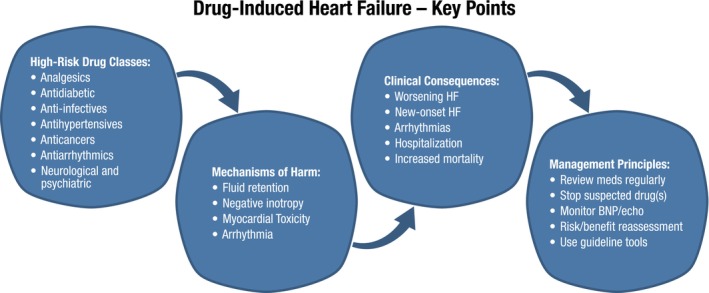 Figure 8
 Figure 9
 Figure 10
 Figure 11
 Figure 12
 Figure 13
 Figure 14
 Figure 15
 Figure 16
 Figure 17
 Figure 18
 Figure 19
 Figure 20
 Figure 21
 Figure 22
 Figure 23
 Figure 24
 Figure 25
 Figure 26
 Figure 27
 Figure 28
 Figure 29
 Figure 30
 Figure 31
 Figure 32
 Figure 33
 Figure 34
 Figure 35
 Figure 36
 Figure 37
 Figure 38
 Figure 39
 Figure 40
 Figure 41
 Figure 42
 Figure 43
 Figure 44
 Figure 45
 Figure 46
 Figure 47
 Figure 48
 Figure 49
 Figure 50
Peer Reviews
No public reviews on file for this paper yet. If you reviewed it on a platform where reviews are public (OpenReview, ICLR, NeurIPS, ICML), you can paste yours below so the community can read it here.
Videos
No videos yet. Explain this paper in a talk, walkthrough, or lecture? Add one.
Taxonomy
TopicsHeart Failure Treatment and Management · Cardiac Fibrosis and Remodeling · Diabetes Treatment and Management