Visual acuity outcomes up to 12 years and risk factors for visual impairment in a national cohort of extremely preterm born children – The Extremely Preterm Infants in Sweden Study (EXPRESS)
Despoina Tsamadou, Karin Källén, Abbas Al‐Hawasi, Ann Hellström, Gerd Holmström, Fatima Pedrosa‐Domellöf, Kristina Tornqvist, Ulrika Kjellström, Lisa B. Thorell, Lena Hellström‐Westas, Andreas Ohlin, Ulrika Ådén, Kerstin Hellgren

TL;DR
This study tracks visual acuity in extremely preterm children up to age 12 and identifies risk factors for visual impairment.
Contribution
The study provides longitudinal data on visual outcomes in extremely preterm children and identifies clinical risk factors for visual impairment.
Findings
At age 12, the mean visual acuity in extremely preterm children was lower than in full-term controls.
Early visual assessments at age 2.5 failed to identify most children with visual impairment.
Risk factors for visual impairment include low gestational age and intraventricular haemorrhage.
Abstract
The Extremely Preterm Infants in Sweden Study (EXPRESS) followed a national cohort of extremely preterm born (EPT, i.e. <27 weeks) children until 12 years of age. This study aimed to investigate the longitudinal development of visual acuity (VA) in children born EPT, explore the predictive value of early visual assessments, and evaluate risk factors for visual impairment at the age of 12 years. All 462 children born EPT in Sweden during April 2004–March 2007, and surviving to age 6.5 years, and full‐term born matched controls were invited to participate in the 12‐year follow‐up. VA was assessed at 12 years and the results were compared with values at 2.5 and 6.5 years. At age 12, 332 (72%) EPT survivors and 189 controls were examined. The mean VA in the EPT group was lower than in the control group (1.15, 95%CI [1.12–1.19] vs. 1.33, 95% CI [1.29–1.37]). Fifteen (4.5%) EPT had visual…
Genes, proteins, chemicals, diseases, species, mutations and cell lines named across the full text — each resolved to its canonical identifier and authoritative record.
Click any figure to enlarge with its caption.
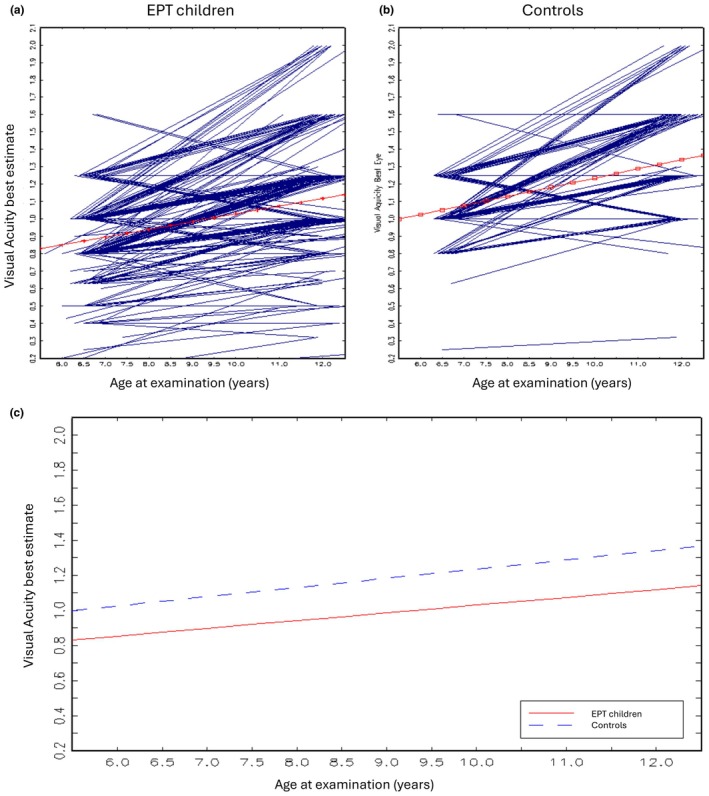 Figure 1
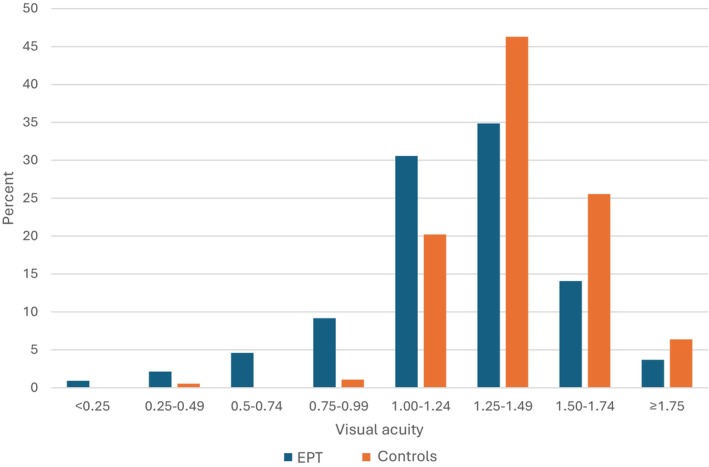 Figure 2
Peer Reviews
No public reviews on file for this paper yet. If you reviewed it on a platform where reviews are public (OpenReview, ICLR, NeurIPS, ICML), you can paste yours below so the community can read it here.
Videos
No videos yet. Explain this paper in a talk, walkthrough, or lecture? Add one.
Taxonomy
TopicsRetinopathy of Prematurity Studies · Neonatal Respiratory Health Research · Infant Development and Preterm Care