N‑Heterocyclic Carbene Stabilized Aluminum Alkyls and Their Reactivity toward NHC-Alanes
Stuart Burnett, Alan R. Kennedy, Catherine E. Weetman

TL;DR
Scientists synthesized new aluminum compounds using NHCs and studied their unexpected reactions.
Contribution
The synthesis and reactivity of NHC-stabilized aluminum alkyls were explored, revealing unexpected ligand scrambling instead of Al–Al bonding.
Findings
NHC-stabilized aluminum alkyls [NHCAlR3] were successfully synthesized.
Attempts to form Al–Al bonded species failed, resulting in R/H ligand scrambled complexes.
Mixed-ligand complexes were characterized using NMR and X-ray diffraction.
Abstract
Herein, we report the synthesis of several new NHC-stabilized aluminum alkyl species [NHCAlR3] (for NHC = ICy, R = Me, iBu; NHC = IMes and IDip, R = iBu) via coordination of the respective free carbene to AlMe3 or AliBu3. Attempts to access Al–Al bonded species (dialumanes) via reactions with the respective NHCAlH3 complexes did not yield the desired Al(II) complexes via R-H elimination, instead yielding the R/H ligand scrambled complexes NHCAlR2H and NHCAlRH2, respectively. These mixed-ligand species were characterized by 1H, 13C{1H}, and multinuclear NMR spectroscopy, with select cases characterized by single-crystal X-ray diffraction studies.
Genes, proteins, chemicals, diseases, species, mutations and cell lines named across the full text — each resolved to its canonical identifier and authoritative record.
Click any figure to enlarge with its caption.
 1
1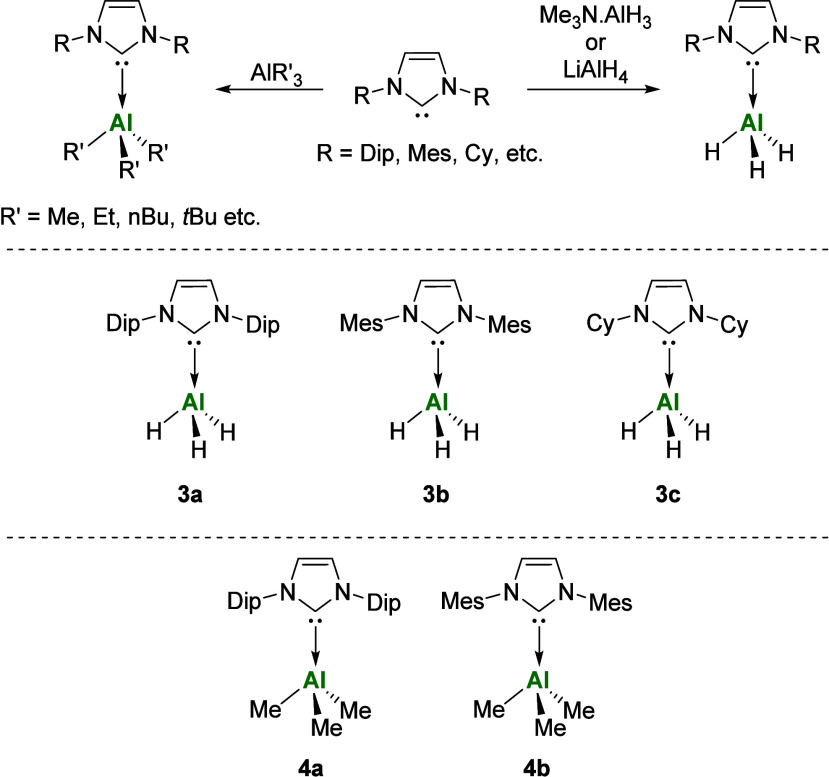 2
2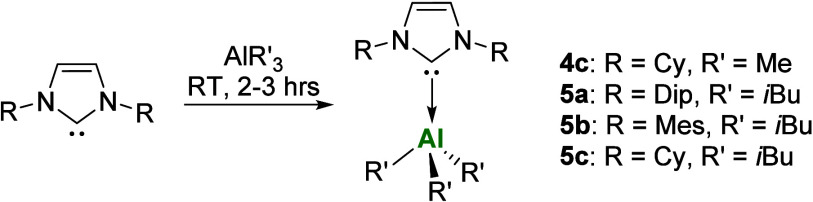 1
1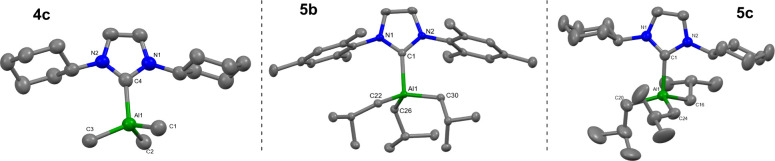 3
3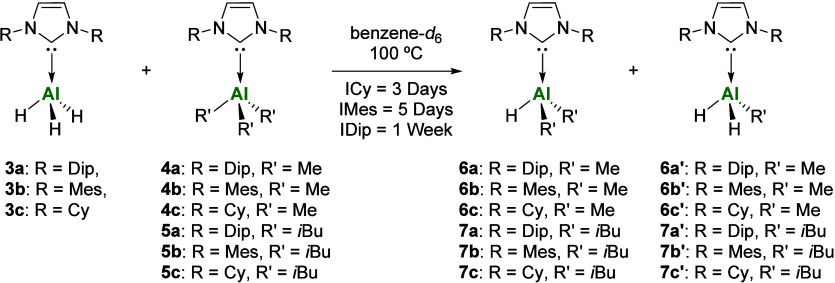 2
2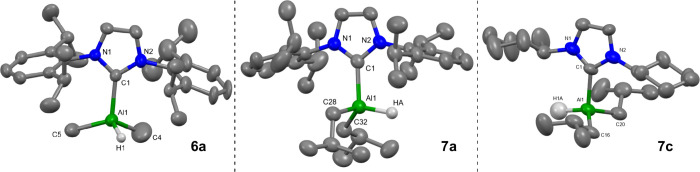 4
4- —University of Strathclyde10.13039/100008078
- —Engineering and Physical Sciences Research Council10.13039/501100000266
Peer Reviews
No public reviews on file for this paper yet. If you reviewed it on a platform where reviews are public (OpenReview, ICLR, NeurIPS, ICML), you can paste yours below so the community can read it here.
Videos
No videos yet. Explain this paper in a talk, walkthrough, or lecture? Add one.
Taxonomy
TopicsSynthesis and characterization of novel inorganic/organometallic compounds · N-Heterocyclic Carbenes in Organic and Inorganic Chemistry · Organoboron and organosilicon chemistry
Introduction
Over the last few decades, interest in the synthesis and reactivity of low oxidation-state aluminum species has surged. Landmark contributions in this area include Schnöckel’s tetrameric [(CpAl)4] (Cp = pentamethylcyclopentadiene);? Roesky’s monomeric, β-diketiminate stabilized Al(I) [(^Dip^NacNac)Al] 1 (^Dip^NacNac = HC(CMeN(Dip)); Dip = 2,6-diisopropylphenyl);? the isolation of nucleophilic Al(I) complexes by Aldridge and Goicoechea in 2018;? and monocoordinated, neutral Al(I) complexes from the Power? and the Liu? groups, respectively. Uhl's use of the bulky bistrimethylsilylmethyl ligand [CH(SiMe_3_)2]^−^ enabled the synthesis of the first crystallographically characterized dialumane containing an Al–Al single bond.? Since then, a plethora of Al(II) complexes featuring Al–Al bonds have been reported using a variety of bulky stabilizing ligands, including terphenyls pioneered by the Power group, ?−? ? ? ? ? diimido-based ligands by the groups of Yang and Fedushkin, ?−? ? ? ? ? ? and Cp ligands utilized by the Braunschweig and Arnold groups. ?−? ?
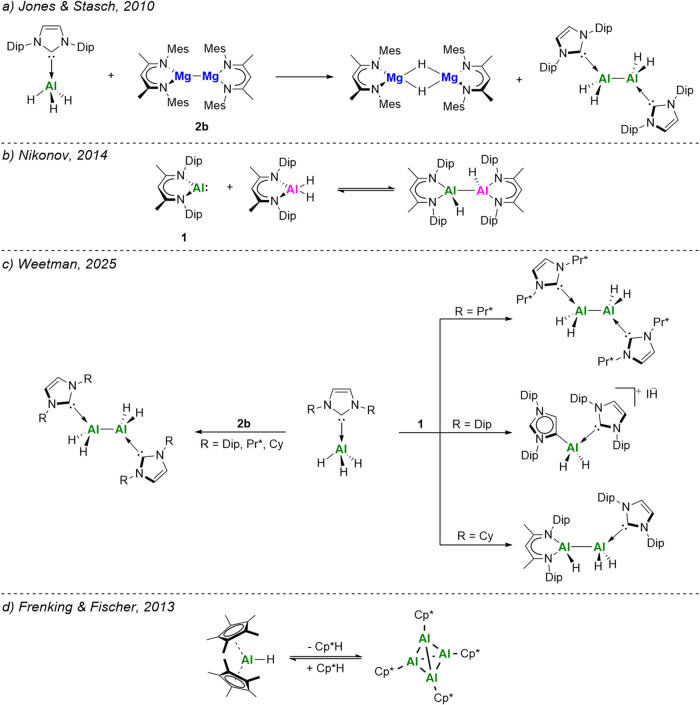
Despite these advances, the synthesis of low oxidation-state aluminum complexes has predominantly relied on the use of strong alkali metal-based reducing agents. Recently, several examples have demonstrated the feasibility of using alternative main group of reducing agents to yield such species. Jones and Stasch isolated the first examples of stable, neutral aluminum(II) hydride complexes (Figurea),? including the first example of a N-heterocyclic carbene (NHC) adduct of the parent dialane(4) via reduction of the Al(III) hydride species using Mg(I) (Mg(I) = [{(^Ar^NacNac)Mg}2] (Ar = Dip 2a, Mes 2b)). Similarly, Cowley and co-workers utilized Mg(I) to prepare a series of amidophosphine stabilized dihydrodialanes,? whereby varying the sterics of the donor ligand influences the Al–Al bond length and allowed for the detection of reversible reductive elimination processes. In 2014, Nikonov demonstrated that Roesky’s Al(I) could act as a stoichiometric reducing agent in reactions with a β-diketiminate stabilized Al(III) dihydride complex (Figureb),? affording the corresponding dihydrodialane [{(^Dip^NacNac)AlH}2], albeit existing in equilibrium with the aforementioned Al(I) and Al(III) starting materials. Building upon this, the Bakewell group introduced a series of symmetric and asymmetric dihydrodialanes, along with a masked dialumene species, via similar Al(I) reduction of amidinate and β-diketiminate Al(III) dihydrides.? More recently, our group has similarly investigated the use of both Mg(I) and Al(I) as stoichiometric reducing agents toward various NHC-alanes (Figurec).? Reactions with Mg(I) dimer (2b) exclusively yielded the expected dialane complexes [{NHCAlH_2_}2] (NHC = IPr*, IDip, ICy), while use of Al(I) gave rise to, depending on the steric demand of the NHC, an NHC-dialane (with IPr*), a cationic abnormal aluminum dihydride (with IDip), or an asymmetric mixed-ligand dialane (with ICy).
(a–c) Reported usage of low oxidation-state main group complexes as reducing agents. (d) Synthesis of [(CpAl)4] via thermally induced reductive elimination.*
Although NHC-stabilized aluminum complexes have been known for some time (vide infra), research on this compound class has grown significantly in recent years. In 2017, the Inoue group reported the first example of an NHC-stabilized, neutral AlAl doubly bonded species,? which was shown to initiate both stoichiometric and catalytic reduction of CO_2_.? The Radius group has reported on various NHC-ligated Al(III) and Al(II) species, ?−? ? with a particular emphasis on the application of these compounds in ring opening/expansion? and decarbonization of carbene ring systems.? While catalytic applications of NHC–aluminum species remain limited to two reported casesamine–borane dehydrocoupling ?,? and the aforementioned CO_2_ reductionthe prospect of employing aluminum in catalysis is compelling, given its natural abundance and low cost. As such, exploration of alternative synthetic routes to obtaining reactive, low oxidation-state aluminum species represents a worthwhile goal.
While recent advancements with stoichiometric main group reducing agents has opened new avenues in low oxidation-state aluminum chemistry, most known systems still rely on classical alkali metal-based reductants, and further work investigating alternative routes is still needed. Inspired by a 2013 report by Fischer et al.,? where they reported a novel synthetic route to [(CpAl)4] via thermally induced reductive elimination of CpH from Cp*_2_AlH (Figured), we sought to extend this methodology toward the synthesis of NHC-stabilized Al(II) complexes, specifically investigating reactions of NHC-stabilized aluminum(III) alkyls and hydrides in an effort to yield dialumanes without the use of external reducing agents.
Results
and Discussion
First reported by Arduengo in 1992,? NHC-aluminum hydride complexes are typically synthesized via addition of the respective free NHC to solutions of Me_3_N·AlH_3_.? Formation of NHC-aluminum alkyl complexes typically follows a similar route (Figure). ?,?
Reported synthesis of the NHCAlH3 and NHCAlR3 complexes (top). Selected examples of NHCAlH3 (middle) and NHCAlR3 (bottom) complexes relevant to this work.
This method was employed to extend the library of reported NHCAlR_3_ complexes. Addition of AliBu_3_ to hexane solutions of the free NHC’s IDip, IMes, and ICy affords the corresponding aluminum alkyl adducts IDipAliBu_3_ 5a, IMesAliBu_3_ 5b, and ICyAliBu_3_ 5c, respectively (Scheme). Similarly, the addition of AlMe_3_ to solutions of ICy affords the expected ICyAlMe_3_ 4c complex.
Synthesis of NHC-Aluminum Alkyl Complexes 4c and 5a–c
5a and 5b were isolated as colorless crystalline solids from concentrated hexane solution in excellent yields of 77 and 79%, respectively, while 4c and 5c were isolated as red/orange solids in lower yields of 29 and 41%, respectively. Complexes 4c and 5a–c were spectroscopically characterized by ^1^H and ^13^C{^1^H} NMR spectroscopy, exhibiting resonances in agreement with their expected structure. The ^13^C{^1^H} carbenic carbon resonances for 5a–c were all extremely weak while 4c was not observed at all; however, this can be assigned via 2D NMR methods (Figures S4 and S5). The carbenic carbon resonances (4c: 173.9 ppm; 5a: 181.8 ppm; 5b: 179.3 ppm; 5c: 173.9 ppm; cf. IDipAlMe_3_ 4a: 181.1 ppm; IMesAlMe_3_ 4b: 178.5 ppm) fall expectedly upfield from the respective free carbene resonances consistent with coordination to an aluminum center (cf. IDip 220.6 ppm;? IMes 219.7 ppm;? ICy 212.0 ppm?). The downfield trend in the Al-CH_2_ chemical shifts from 5a–c (5a: −0.35 ppm, 5b: −0.28 ppm, 5c: 0.47 ppm) indicates weaker σ-donation and lower basicity of the ligand from IDip
IMes > ICy. This trend was similarly noted by Garcia? and Barron ?,? for related NHC- and phosphine-stabilized aluminum complexes.
Complex 4c displays an Al-CH_3_ resonance at −0.10 ppm, following the trend mentioned above (IDipAlMe_3_ 4a: −0.86 ppm; IMesAlMe_3_ 4b: −0.78 ppm). Both ICy-stabilized species 4c and 5c have notable downfield shifts of the Al–CH substituent compared with free AlMe_3_ (−0.35 ppm)? and AliBu_3_ (0.29 ppm),? respectively. This is surprising as coordination to the Lewis basic ICy would typically result in an upfield shift due to the σ-donor nature of the ligand; however, this can be explained by intramolecular hydrogen bonding between the Al–CH and the ligand N–CH as confirmed by NOESY NMR spectroscopy for 4c and 5c (Figures S6 and S22). Additionally, the Al–CH and N–CH distances in the solid-state structures (e.g., 4c: 2.216 Å, 2.296 Å; 5c: 2.110 Å, 2.283 Å) are shorter than the combined van der Waals radii indicating a strong interaction in both cases.?
Complexes 4c and 5a–c show good solution state thermal stabilityheating benzene-d 6 solutions to 100 °C for 3 days shows no noticeable decomposition of the respective compounds. Solid-state structures of 4c, 5b, and 5c were obtained via single-crystal X-ray diffraction (SC-XRD) analysis (Figure). The C_carbene_-Al bond lengths (4c: 2.0860(3) Å; 5b: 2.1337(12) Å; and 5c: 2.1075(17) Å) are consistent with previously reported NHC-stabilized aluminum alkyl complexes? (cf. for IDipAlMe_3_ 4a C_carbene_-Al: 2.1030(3) Å; IMesAlMe_3_ 4b C_carbene_-Al: 2.0984(16) Å). As expected upon NHC-coordination, the Al–C_R_ bond lengths (4c: 1.997(3), 1.999(3), and 2.003(3) Å; 5b: 2.0139(12), 2.0203(12), and 2.0018(12) Å; 5c: 2.0163(17), 2.014(2), and 2.009(2) Å) increase in comparison with uncoordinated AlMe_3_ (1.957(3) Å)? and the terminal Al–C bonds in dimeric AliBu_3_ (1.972(3) and 1.983(4) Å).?
Molecular structures (50% thermal ellipsoids) of 4c (left), 5b (middle), and 5c (right). Only one molecule of 4c is shown. Hydrogen atoms and minor disorder in 5c have been omitted for clarity. Selected bond lengths (Å) and angles (°): Complex 4c: Al1–C1: 1.997(3), Al1–C2: 1.999(3), Al1–C3: 2.003(3), Al1–C4: 2.086(3), Al2–C19: 2.005(3), Al2–C20: 2.002(3), Al2–C21: 1.996(3), Al2–C22: 2.086(3); N1–C4: 1.368(3), N2–C4: 1.359(3); C1–Al1–C4: 107.27(12), C2–Al1–C4: 102.79(12), C3–Al1–C4: 110.37(12). Complex 5b: Al1–C1:2.1337(12), Al1–C22: 2.0139(12), Al1–C26: 2.0203(12), Al1–C30: 2.0018(12), N1–C1: 1.3615(15), N2–C1: 1.3647(15); C22–Al1–C1: 109.19(5), C26–Al1–C1: 100.72(5), C30–Al1–C1: 101.69(5). Complex 5c: Al1–C1: 2.1075(17), Al1–C16: 2.0163(17), Al1–C20: 2.014(2), Al1–C24: 2.009(2), N1–C1: 1.356(2), N2–C1: 1.363(2); C1–Al1–C16: 102.83(7), C1–Al1–C20: 110.33(8), C1–Al1–C24: 105.98(8).
Targeting dialumane formation, 4a–c and 5a–c were combined with the corresponding NHCAlH_3_ complex 3a–c in a J. Young NMR tube. No change in the ^1^H NMR spectra was noted in any of the reactions over the course of 3 days at ambient temperature. Subsequent heating of reaction mixtures to 100 °C and monitoring by ^1^H NMR spectroscopy shows conversion of starting materials to at least two new NHC-containing species. For the least sterically hindered ICy reactions (3c + 4c and 3c + 5c), no further conversion of starting materials is observed after 3 days at 100 °C, with approximate NMR conversions of 62% for 3c + 4c and 85% for 3c + 5c. Only slight shifts in the resonances attributed to the products from both reactions are observed in the resulting ^1^H NMR spectra, suggestive of solution-state structures similar to those of 3c, 4c, and 5c. Particularly informative are the new Al-CH resonances observed in each reactionfor 3c + 4c, a new triplet at −0.05 ppm and a doublet at −0.08 ppm are present, while for 3c + 5c, three new doublets at 0.41, 0.53, and 0.58 ppm and a doublet of triplets at 0.61 ppm are now observed, all of which are suggestive of coupling between an Al-CH moiety and potentially a new Al–H group. SC-XRD analysis of colorless crystals grown from the reaction between 3c and 5c revealed the nature of one of these species. Instead of yielding the desired dialumane, the reaction in fact forms mixed alkyl/hydride complexes of the form ICyAliBu_2_H 7c and ICyAliBuH_2_ 7c′, arising via thermally induced alkyl/hydride scrambling processes (Scheme). The molecular structure of 7c showed poor-quality data precluding detailed structural analysis; however, it does provide confirmation of its connectivity (Figure).
Synthesis of NHC-Aluminum Alkyl/Hydride Complexes
Molecular structures (50% thermal ellipsoids) of 6a (left), 7a (middle), and 7c (right). Only one molecule of 7a is shown. Hydrogen atoms (except for Al–H groups) and minor disorder in 6a and 7b have been omitted for clarity. Selected bond lengths (Å) and angles (°): Complex 6a: Al1–C1: 2.094(2), Al1–C4: 1.939(5), Al1–C5: 1.963(3), Al1–H1: 1.550(19), N1–C1: 1.358(3), N2–C1: 1.356(3); C1–Al1–H1: 110.9(7), C1–Al1–C4: 108.87(17), C1–Al1–C5: 111.47(10). Complex 7a: Al1–C1: 2.101(4), Al–C28: 2.003(4), Al1–C32: 1.997(4), Al1-HA: 1.56(3), N1–C1: 1.361(5), N2–C1: 1.366(4); C1–Al1–HA: 103.9(12), C1–Al1–C28: 103.94(15), C1–Al1–C32: 114.28(16). Bond lengths for complex 7c are included only for reference: Al1–H1A: 1.64(12), Al1–C1: 2.086(10), Al1–C16: 2.002(15), Al1–C20: 1.997(16).
The assignment of the ^1^H NMR spectrum from the reaction between 3c and 4c suggests similar mixed species, i.e., ICyAlMe_2_H 6c and ICyAlMeH_2_ 6c′ are formed, with the triplet at −0.05 ppm arising from coupling between the lone Al-CH_3_ group and the two Al–H substituents in 6c′, while the doublet at −0.08 ppm is assigned to the two Al-CH_3_ groups in 6c arising from coupling to the adjacent Al–H. No resonances for the carbenic carbon centers in 6c and 6c′ could be observed in the reaction mixture ^13^C{^1^H} NMR spectrum, though weak coupling was observed in the ^1^H–^13^C HMBC NMR spectra at 172.8 and 173.7 ppm.
As expected, the more sterically demanding IMes- and IDip-stabilized reactions require extended heating times to achieve similar (approximate) conversion rates: IMes3b + 4b: 5 days, 82% conversion; 3b + 5b: 5 days, 98% conversion; IDip3a + 4a: 1 week, 76% conversion; 3a + 5a: 1 week, > 99% conversion. Similar Al-CH_3_ and Al-CH_2_ resonances were observed in the resulting ^1^H NMR spectra of these reactions as were observed for the ICy-stabilized mixtures, again suggestive of mixed alkyl/hydride aluminum species (see SI for full NMR assignment).
For both IDip reactions (3a and 4a/5a), colorless crystals were grown from concentrated benzene-d 6 reaction mixtures that were suitable for SC-XRD, yielding solid-state structures IDipAlMe_2_H 6a and IDipAliBu_2_H 7a (Figure). It is worth noting IDipAliBu_2_H 7a has been previously synthesized by Radius and co-workers? via addition of diisobutylaluminum hydride to free IDip. While this was never structurally characterized by X-ray diffraction, their solution-state NMR assignment matches one set of resonances obtained from the reaction of 3a and 7a. Both complexes crystallize in the monoclinic P2_1_/c space group, with 7a containing 2 molecules in the asymmetric unit. Both contain distorted tetrahedral aluminum centers similar to that observed in 7c. The observed C_carbene_-Al bond lengths in 6a and 7a are slightly shorter than the corresponding trialkyl species (6a 2.094(2) Å vs 4a 2.103(3) Å;? 7a 2.101(4) Å vs 5a 2.1337(13) Å), with the Al–H bond lengths (6a 1.550(19) Å; 7a 1.560(3) Å) concurrently longer than those in IDipAlH_3_ 3a (1.527(15), 1.546(17), and 1.510(17) Å).?
Conclusions
In summary, we have synthesized a series of NHC-stabilized aluminum alkyl complexes and studied their reactivity with corresponding NHCAlH_3_ complexes. Instead of the intended R-H elimination to yield new dialumanes, thermally induced alkyl/hydride scrambling occurs yielding mixed NHC-aluminum complexes of the form NHCAlR_2_H and NHCAlRH_2_, respectively. These reaction mixtures have been studied by solution-state NMR spectroscopy, with select examples characterized by SC-XRD.
Supplementary Material
The reference list from the paper itself. Each links out to its DOI / PubMed record.
- 1Dohmeier C.Robl C.Tacke M.Schnöckel H.The Tetrameric Aluminum(I) Compound [{Al(Η5-C 5Me 5)}4]Angew. Chem., Int. Ed.19913056456510.1002/anie.199105641 · doi ↗
- 2Cui C.Roesky H. W.Schmidt H. G.Noltemeyer M.Hao H.Cimpoesu F.Synthesis and Structure of a Monomeric Aluminum(I) Compound [{HC(C Me N Ar)2}Al] (Ar = 2,6–i Pr 2C 6H 3): A Stable Aluminum Analogue of a Carbene Angew. Chem., Int. Ed.2000394274427610.1002/1521-3773(20001201)39:23<4274::AID-ANIE 4274>3.0.CO;2-K 29711904 · doi ↗ · pubmed ↗
- 3Hicks J.Vasko P.Goicoechea J. M.Aldridge S.Synthesis, Structure and Reaction Chemistry of a Nucleophilic Aluminyl Anion Nature 2018557929510.1038/s 41586-018-0037-y 29662211 · doi ↗ · pubmed ↗
- 4Queen J. D.Lehmann A.Fettinger J. C.Tuononen H. M.Power P. P.The Monomeric Alanediyl:Al Ar i Pr 8 (Ar i Pr 8 = C 6H–2,6-(C 6H 2 −2,4,6-Pr i 3)2–3,5-Pr i 2): An Organoaluminum(I) Compound with a One-Coordinate Aluminum Atom J. Am. Chem. Soc.2020142205542055910.1021/jacs.0c 1022233226797 · doi ↗ · pubmed ↗
- 5Zhang X.Liu L. L.A Free Aluminylene with Diverse σ-Donating and Doubly σ/π-Accepting Ligand Features for Transition Metals Angew. Chem., Int. Ed.202160270622706910.1002/anie.20211197534614275 · doi ↗ · pubmed ↗
- 6Uhl W.Tetrakis[bis(trimethylsilyl)methyl]dialan(4), eine Verbindung mit AluminiumAluminium-Bindung Z. Für Naturforschung B 1988431113111810.1515/znb-1988-0905 · doi ↗
- 7Queen J. D.Power P. P.Comproportionation of a Dialuminyne with Alane or Dialane Dihalides as a Clean Route to Dialuminenes Chem. Commun.202259434610.1039/D 2CC 05646 A 36412144 · doi ↗ · pubmed ↗
- 8Wehmschulte R. J.Ruhlandt-Senge K.Olmstead M. M.Hope H.Sturgeon B. E.Power P. P.Reduction of a Tetraaryldialane to Generate Aluminum-Aluminum π-Bonding Inorg. Chem.1993322983298410.1021/ic 00066 a 002 · doi ↗