Postmarket Safety Actions for Novel Oncology Drugs Granted FDA’s Accelerated Approval
Maryam Mooghali, Joshua D. Wallach, Aaron P. Mitchell, Joseph S. Ross, Reshma Ramachandran

TL;DR
This study analyzes safety actions taken after FDA's fast-tracked approval of new cancer drugs.
Contribution
It provides insights into postmarket safety measures for oncology drugs with accelerated approval.
Findings
Postmarket safety actions were frequently required for these drugs.
Some drugs faced restrictions or warnings due to safety concerns.
The study highlights the importance of continued monitoring after accelerated approval.
Abstract
This cross-sectional study examines postmarket safety actions for novel oncology drugs that received accelerated Food and Drug Administration (FDA) approval.
Genes, proteins, chemicals, diseases, species, mutations and cell lines named across the full text — each resolved to its canonical identifier and authoritative record.
Click any figure to enlarge with its caption.
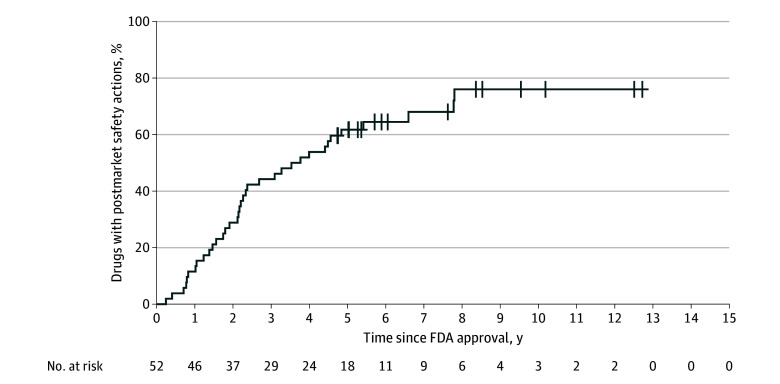 Figure
| FDA postmarketing safety actions | No. (%) (N = 52) | ||||
|---|---|---|---|---|---|
| All oncology drugs granted accelerated approval | Accelerated approval status, drugs with initial accelerated approval indication | ||||
| Converted to traditional approval (n = 33) | Withdrawn from the market (n = 11) | Unchanged regulatory status (n = 8) | |||
| Any postmarketing safety action | |||||
| No | 16 (30.8) | 7 (21.2) | 5 (45.5) | 4 (50.0) | .14 |
| Yes | 36 (69.2) | 26 (78.8) | 6 (54.5) | 4 (50.0) | |
| Time to first safety action, median (IQR) y | 2.2 (1.3-3.8) | 2.0 (1.1-2.6) | 3.6 (2.5-4.3) | 3.9 (2.9-5.4) | |
| Warnings and precautions | |||||
| No | 19 (36.5) | 7 (21.2) | 8 (72.7) | 4 (50.0) | .006 |
| Yes | 33 (63.5) | 26 (78.8) | 3 (27.3) | 4 (50.0) | |
| No. of warnings and precautions, median (IQR) | 2 (1-3) | 2 (1-3) | 1 (1-3) | 2 (1-2) | |
| Boxed warning | |||||
| No new postmarketing boxed warning | 46 (88.5) | 29 (87.9) | 9 (81.8) | 8 (100.0) | .58 |
| Existing boxed warning on approval | 8 (17.4) | 4 (13.8) | 3 (33.3) | 1 (12.5) | |
| No boxed warning on approval | 38 (82.6) | 25 (86.2) | 6 (66.7) | 7 (87.5) | |
| New postmarketing boxed warning | 6 (11.5) | 4 (12.1) | 2 (18.2) | 0 | |
| Existing boxed warning on approval | 4 (66.7) | 2 (50.0) | 2 (100.0) | 0 | |
| No boxed warning on approval | 2 (33.3) | 2 (50.0) | 0 | 0 | |
| Drug safety communication | |||||
| No | 48 (92.3) | 30 (90.9) | 10 (90.9) | 8 (100.0) | >.99 |
| Yes | 4 (7.7) | 3 (9.1) | 1 (9.1) | 0 | |
| No. of drug safety communications, median (IQR) | 1 (1-1) | 1 (1-2) | 1 (1-1) | NA | |
| Safety related withdrawal | |||||
| No | 50 (96.2) | 32 (97.0) | 10 (90.9) | 8 (100.0) | .60 |
| Yes | 2 (3.8) | 1 (3.0) | 1 (9.1) | 0 | |
Peer Reviews
No public reviews on file for this paper yet. If you reviewed it on a platform where reviews are public (OpenReview, ICLR, NeurIPS, ICML), you can paste yours below so the community can read it here.
Videos
No videos yet. Explain this paper in a talk, walkthrough, or lecture? Add one.
Taxonomy
TopicsStatistical Methods in Clinical Trials · Biomedical Ethics and Regulation · Advanced Causal Inference Techniques
Introduction
The US Food and Drug Administration (FDA) grants accelerated approval to drugs intended for serious or life-threatening conditions, allowing earlier patient access based on pivotal trials using surrogate markers as primary endpoints.^1^ More than 80% of accelerated approvals are for oncology drugs.^2^ Given uncertain efficacy at approval, FDA requires postmarket studies to confirm benefit.^1,2^ However, safety monitoring is also important to ensure that predicted benefits outweigh risks. Drugs approved through FDA’s expedited pathways, including accelerated approval, are more frequently associated with postmarketing safety actions than those approved via standard pathways,^3,4^ but more contemporaneous estimates are lacking. We examined FDA’s postmarketing safety actions for novel oncology drugs granted accelerated approval.
Methods
In this cross-sectional study, we used the Drugs@FDA database to identify and characterize all oncology drugs granted accelerated approval from 2011 to 2020, allowing at least 4 subsequent years for FDA safety actions. Using FDA’s Project Confirm, we determined whether accelerated approval indications were converted to traditional approval or withdrawn from market. We identified FDA’s postmarketing safety actions, including warnings and precautions, boxed warnings, safety communications, and safety-related withdrawals, as of April 30, 2025 (eMethods in Supplement 1). Next, we reviewed subsequent approval packages to determine whether drugs with postmarketing safety actions later received accelerated approval for supplemental indications. Lastly, we reviewed initial accelerated approval letters to determine whether there were safety-related postmarketing requirements under FDA’s authority designated by section 505(o) of the Federal Food, Drug, and Cosmetic Act and whether safety issues were to be examined as part of accelerated approval postmarketing requirement.
Fisher exact and χ^2^ tests were performed in RStudio version 2023.09.1 + 494 (Posit), with 2-tailed P < .05 considered statistically significant. The Yale School of Medicine institutional review board deemed this study exempt from review because it utilized publicly available data and did not require ethics approval or patient consent, in accordance with 45 CFR S46. We followed the Strengthening the Reporting of Observational Studies in Epidemiology (STROBE) reporting guideline.
Results
From 2011 to 2020, FDA granted accelerated approval to 52 novel oncology drugs, including 35 (67.3%) small molecules and 17 (32.7%) biologics; 22 (42.3%) were first-in-class, 45 (86.5%) designated as orphan drugs, and 36 (69.2%) designated as breakthrough therapies. Of these 52 drugs, 36 (69.2%) experienced any FDA postmarketing safety action, including 33 (63.5%) new warnings and precautions, 6 (11.5%) new boxed warnings, 4 (7.7%) drug safety communications, and 2 (3.8%) safety-related market withdrawals (Table). Median (IQR) time from approval to first safety action was 2.2 (1.3-3.8) years (Figure). Of the 36 drugs with postmarketing safety actions, 9 (25%) subsequently received accelerated approval for additional indications.
Oncology Drugs Granted FDA Accelerated Approval From 2010 to 2020 With Postmarket Safety ActionsNumber at risk indicates the number of drugs remaining under observation for potential safety actions at each time point, from the date of accelerated approval until the occurrence of a safety action or end of follow-up.
Drugs with accelerated approval postmarketing requirements that included safety analyses were more likely to have postmarketing safety actions than those without (92.3% [12 of 13] vs 61.5% [24 of 39]; P = .04), but there was no difference between those with and without safety-related postmarketing requirements (76.3% [29 of 38] vs 50.0% [7 of 14]; P = .09). There were no statistical differences in overall frequency of postmarketing safety action based on updated regulatory status, nor any individual safety action, except for warnings and precautions (63.5% [33 of 52] vs. 36.5% [19 of 52]; P = .006).
Discussion
Among novel oncology drugs granted FDA’s accelerated approval from 2011 to 2020, two-thirds were associated with postmarketing safety actions, mostly additions of warnings and precautions, occurring at a median of 2 years after approval. Most serious safety actions were infrequent but must be interpreted amid uncertain benefit, as many oncology drugs granted accelerated approval lack confirmation of clinical benefit even after conversion to traditional approval.^5^ Drugs with safety analyses as part of their accelerated approval postmarketing requirements had higher rates of safety actions, suggesting that proactive surveillance may facilitate harm detection, particularly given the small sample size and short follow-up of pivotal studies supporting accelerated approvals.^6^ Study limitations include reliance on publicly available data and lack of a contemporaneous comparator group of oncology drugs receiving traditional approval. Although current FDA’s surveillance systems detect many safety concerns, our findings underscore the need to strengthen safety monitoring alongside efforts to confirm clinical benefit to improve accelerated approval program, particularly considering their uncertain efficacy and vulnerability of the target population.
The reference list from the paper itself. Each links out to its DOI / PubMed record.
- 1US Food and Drug Administration. Accelerated approval. Updated February 24, 2023. Accessed June 1, 2025. https://www.fda.gov/patients/fast-track-breakthrough-therapy-accelerated-approval-priority-review/accelerated-approval
- 2Beakes-Read G, Neisser M, Frey P, Guarducci M. Analysis of FDA’s accelerated approval program performance December 1992-December 2021. Ther Innov Regul Sci. 2022;56(5):698-703. doi:10.1007/s 43441-022-00430-z 35900722 PMC 9332089 · doi ↗ · pubmed ↗
- 3Downing NS, Shah ND, Aminawung JA, . Postmarket safety events among novel therapeutics approved by the US Food and Drug Administration between 2001 and 2010. JAMA. 2017;317(18):1854-1863. doi:10.1001/jama.2017.515028492899 PMC 5815036 · doi ↗ · pubmed ↗
- 4Mostaghim SR, Gagne JJ, Kesselheim AS. Safety related label changes for new drugs after approval in the US through expedited regulatory pathways: retrospective cohort study. BMJ. 2017;358:j 3837. doi:10.1136/bmj.j 383728882831 PMC 5588044 · doi ↗ · pubmed ↗
- 5Tibau A, Romano A, Liu ITT, Han J, Cliff ERS, Kesselheim AS. Assessing outcomes emerging after conversion to regular approval for cancer drug indications granted accelerated approval, 1992-2021. J Natl Cancer Inst. 2025;117(10):2103-2111. doi:10.1093/jnci/djaf 19540690366 · doi ↗ · pubmed ↗
- 6Wallach JD, Ramachandran R, Bruckner T, Ross JS. Comparison of duration of postapproval vs pivotal trials for therapeutic agents granted US Food and Drug Administration accelerated approval, 2009-2018. JAMA Netw Open. 2021;4(11):e 2133601. doi:10.1001/jamanetworkopen.2021.3360134751764 PMC 8579231 · doi ↗ · pubmed ↗