Polygonatum dabieshanense (Asparagaceae), a new species from the Dabieshan Mountains, Anhui and Henan provinces, China

Abstract
Genes, proteins, chemicals, diseases, species, mutations and cell lines named across the full text — each resolved to its canonical identifier and authoritative record.
Click any figure to enlarge with its caption.
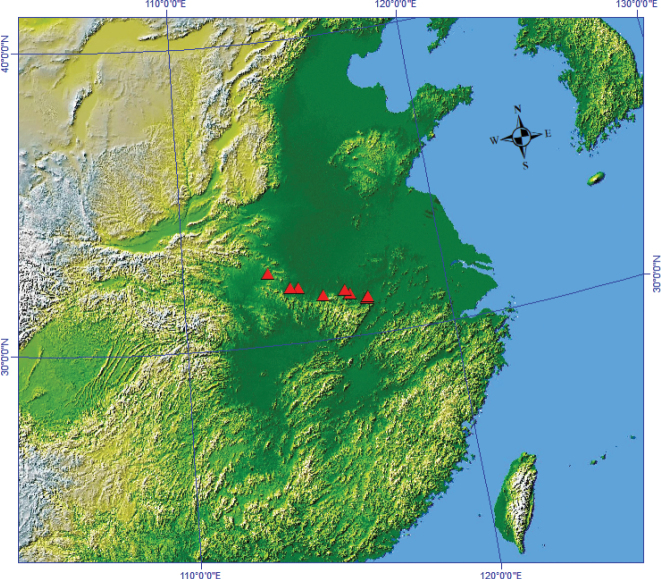 Figure 1
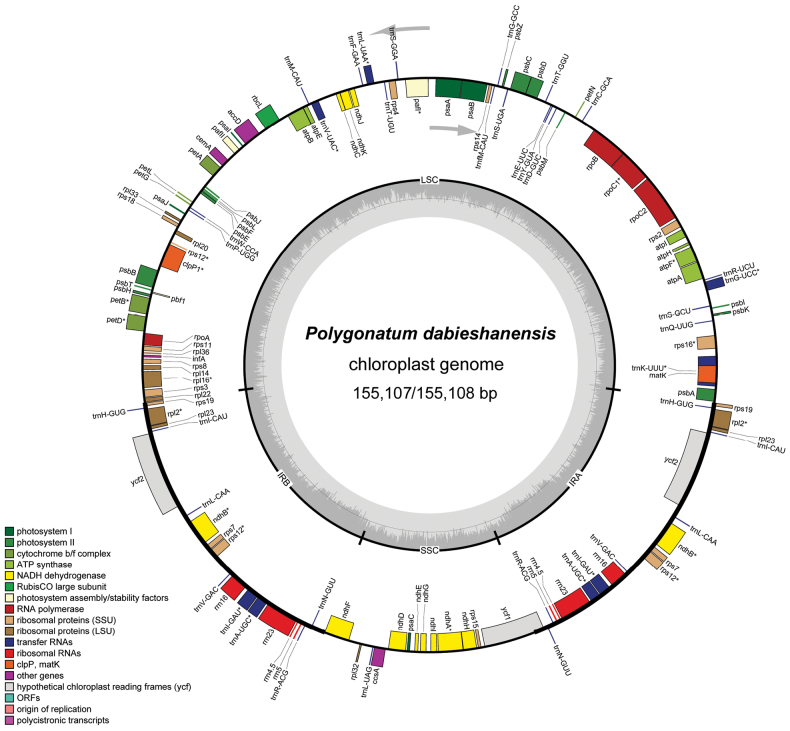 Figure 2
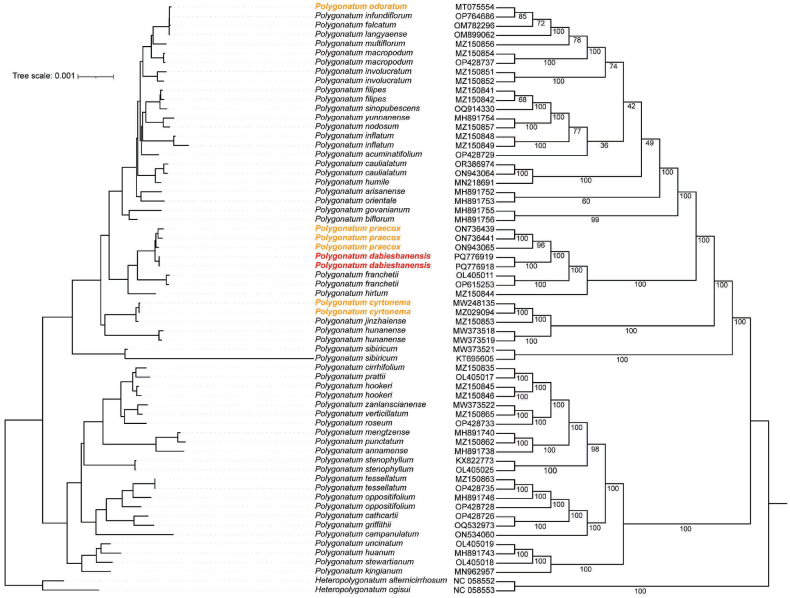 Figure 3
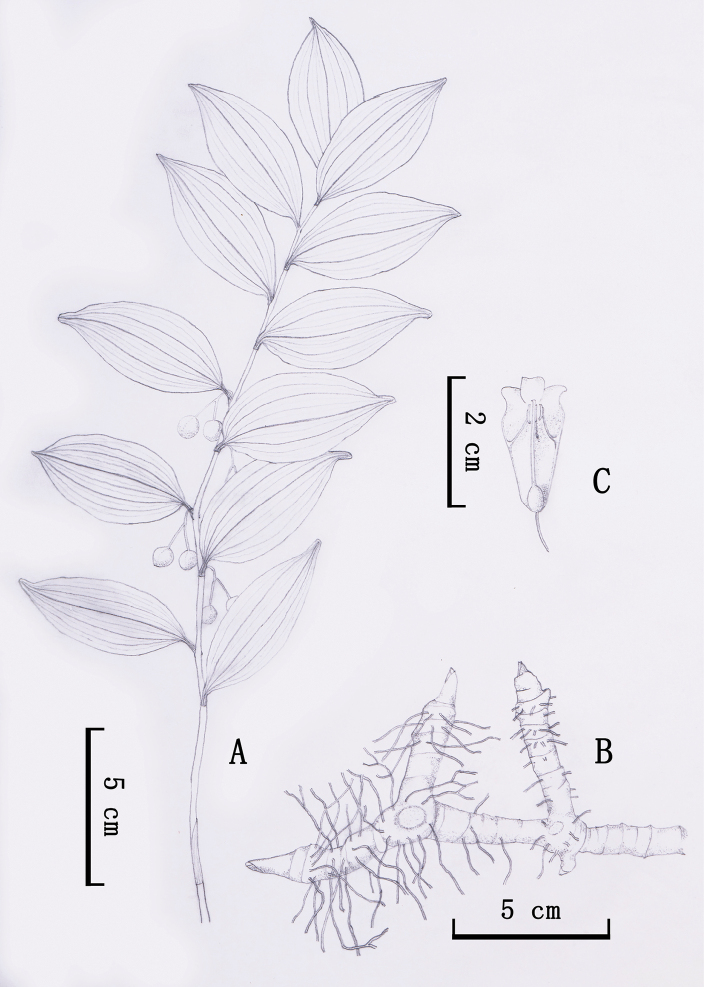 Figure 4
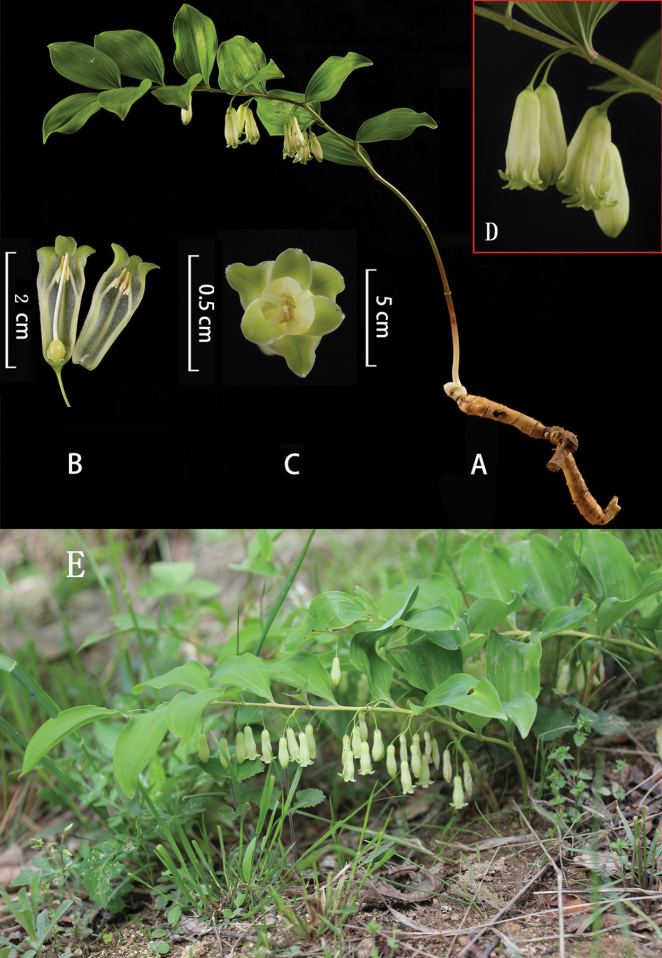 Figure 5
| Species name | Collection site | Voucher number | GenBank number |
|---|---|---|---|
|
| Longmensi, Tongcheng, Anqing City, Anhui Province, China | Song 1DBSHJ | |
|
| Nanyueshan, Huoshan, Luan city, Anhui Province, China | Song 2DBSHJ |
|
|
| Jigongshan, Shihe, Xinyang City, Henan Province, China | Song 3DBSHJ | |
|
| Tongbaishan, Tongbai, Nanyang City, Henan Province, China | Song 4DBSHJ |
|
|
| Shimenchong, Shucheng, Luan City, Anhui Province, China | Song 5DBSHJ | |
|
| Hongshigu, Jinzhai, Luan City, Anhui Province, China | Song 6DBSHJ | |
|
| Huangbaishan, Shangcheng, Xinyang City, Henan Province, China | Song 7DBSHJ | |
|
| Xiaojilongshan, Luoshan, Xinyang City, Henan Province, China | Song 8DBSHJ |
| Characteristic |
|
|
|
|
|---|---|---|---|---|
| Total length (bp) | 155107–155108 | 155,121–155,256 | 155512–155816 | 154468 |
| GC% | 37.7%–37.7% | 37.7%–37.7% | 37.7%–37.8% | 37.8% |
| 84016–84017 | 84,017–85,225 | 84618–84462 | 83417 | |
| 18445 | 18,458–18,474 | 18292–18440 | 18457 | |
| IR length (bp) | 26323 | 26,318–26,323 | 26379 | 26297 |
| Total genes | 132 | 132 | 132 | 132 |
| Protein-coding genes | 86 | 86 | 86 | 86 |
| rRNA genes | 8 | 8 | 8 | 8 |
| tRNA genes | 38 | 38 | 38 | 38 |
| Characters |
|
|
|
|
|---|---|---|---|---|
| Rhizome | terete, 1.0–2.0 cm thick, yellow | moniliform,1.6–2.8 cm thick, yellow | gingeriform, 1.5–3.0 cm thick, yellow | terete, 0.5–1.0 cm thick, white |
| Stem | 30–70 cm, terete | 30–85 cm, terete | 40–105 cm, terete | 25–65 cm, upper part angled |
| Leaves | blade elliptic | blade oblong-lanceolate | blade oblong-lanceolate | blade elliptic |
| Inflorescence | raceme, 1–2(–3) flowered | raceme, 1–3(–4) flowered | umbel-like, 3–7(–14) flowered | raceme, 1–3(–5) flowered |
| Filament | cylindrical and extending inwardly, smooth, and glabrous | cylindrical and extending inwardly, smooth, and glabrous | papillose or shortly cottony, apex slightly dilated or saccate-convex | cylindrical and extending inwardly, smooth or verruculose |
| Inserted position of filament | filaments inserted near the distal 1/2 of the perianth tube | filaments inserted near the distal 1/3 of the perianth tube | filaments inserted near the distal 1/3 of the perianth tube | filaments inserted near the distal 1/2 of the perianth tube |
| Corolla | white, lobes excurved | green, lobes excurved | green, lobes excurved | white, lobes slightly excurved |
| Berries | blue-black, 0.8–1.0 cm | black, 1.2–1.5 cm | black, 0.9–1.0 cm | blue-black, 0.7–1.0 cm |
| Seed | 2–4 | 9–15 | 3–9 | 7–9 |
| Flower phenology | March to April | March to April | April to May | March to April |
- —National Key Research and Development Program of China 501100012166 http://doi.org/10.13039/501100012166
Peer Reviews
No public reviews on file for this paper yet. If you reviewed it on a platform where reviews are public (OpenReview, ICLR, NeurIPS, ICML), you can paste yours below so the community can read it here.
Videos
No videos yet. Explain this paper in a talk, walkthrough, or lecture? Add one.
Taxonomy
TopicsPlant and Fungal Species Descriptions · Plant Diversity and Evolution · Genomics and Phylogenetic Studies
Introduction
The genus Polygonatum Mill. (Asparagaceae: Polygonateae) is the largest genus within its tribe (Tang 1978; Chen and Tamura 2000). Plants of the genus Polygonatum are widely distributed across the northern temperate, northern subtropical, and frigid zones, with the highest diversity observed from the Himalayas to northern East Asia (Meng et al. 2014; Wang et al. 2016; Xia et al. 2022). Globally, there are over 80 species, of which more than 40 species are native to China, making it the center of distribution and diversification (Yang et al. 2022). In Traditional Chinese Medicine, Polygonati Rhizoma is derived from the dried rhizomes of several species of Polygonatum (Chinese Pharmacopoeia Commission 2020). Polygonati Rhizoma serves both as a medicinal herb and a food, possessing properties that tonify qi, nourish yin, strengthen the spleen, lubricate the lungs, and benefit the kidneys. Furthermore, over 20 additional species of Polygonatum are used medicinally in various regions (Zhao et al. 2022). Therefore, Polygonatum represents an important group of medicinal plants with high medicinal and edible value.
Polygonatum has received great attention from plant taxonomists, and its classification has been controversial. The most commonly used characteristics to distinguish species within Polygonatum include leaf arrangement, filament thickness, flower size, shape, and color, leaf type, and bract size and texture, among others (Baker 1875; Tamura et al. 1997; Chen and Tamura 2000; Meng et al. 2014; Wang et al. 2016). Additionally, molecular identification methods have been extensively applied in the taxonomic identification of Polygonatum. For instance, Tamura employed PCR amplification of the chloroplast gene trnK fragment to analyze the phylogenetic relationships among 14 species and one variety of Polygonatum, three species of Disporopsis Hance, and one species of Heteropolygonatum M.N.Tamura & Ogisu. The results were consistent with earlier taxonomic treatments and supported the separation of Polygonatum from Disporopsis and Heteropolygonatum (Tamura et al. 1997). With the advent of next-generation high-throughput sequencing technology, whole plastome sequencing has become cheaper and more efficient than ever, leading to the generation of an increasing amount of chloroplast genome data. Xia et al. (2022) conducted maximum likelihood (ML) and Bayesian inference (BI) analyses using 36 plastome sequences from 20 Polygonatum species and two Heteropolygonatum species, as well as 57 plastomes from 52 other outgroup species of Asparagaceae downloaded from GenBank (Xia et al. 2022; Floden and Schilling 2018). The results strongly supported the monophyly of Polygonatum and its sister relationship with Heteropolygonatum.
During surveys of wild germplasm resources of Polygonatum in eastern China, we collected several specimens of a plant that appeared to represent an undescribed taxon. These plants are characterized by alternate leaves, terete rhizomes, and greenish-white flowers measuring 1.5–2.0 cm in length. The species closely resembles P. odoratum and is often misidentified as that species in the field. However, it differs from P. odoratum in several morphological and phenological traits, including filament position (inserted near the distal one-half of the perianth tube, glabrous, and lacking apical saccate swellings), flowering period (early March to early April), and inflorescence type (racemose). Based on detailed morphological and phenological observations, chloroplast genome sequencing, and phylogenetic analyses, we confirmed that this taxon represents a previously overlooked species. Accordingly, we report the results of our investigations and herein describe and illustrate this new species, Polygonatum dabieshanense sp. nov.
Materials and methods
Population sampling
The new species was sampled at four locations during key developmental stages, including initiation of growth (February), flowering (March–April), and fruiting (April–October) in 2022 (Fig. 1; Table 1). A total of 65 individuals representing 47 Polygonatum species were included in this study, with eight individuals sampled for the new species. Chloroplast DNA (cpDNA) sequences of the new species were generated through sequencing, whereas cpDNA sequences of other species were obtained from the NCBI database. In addition, cpDNA sequences of two Heteropolygonatum species, H. alternicirrhosum and H. ogisui (accession numbers NC_058552 and NC_058553), were selected as outgroups.
Table 1.: Basic characteristics of chloroplast genomes of Polygonatum dabieshanense.
Distribution map of Polygonatum dabieshanense.
Genome sequencing, assembly, and annotation
Two genomic DNA samples of the newly discovered species were extracted from silica-gel-dried leaves using the Tiangen DNAsecure Plant Kit (DP320). After extraction, whole-genome sequencing was performed on the BGISEQ–500 sequencing platform by Hefei Biodata Biotechnologies Inc. The chloroplast genome of Polygonatum dabieshanense was filtered and assembled using fastp (Chen et al. 2018) and SPAdes version 3.10.0 (Bankevich et al. 2012), respectively. Annotation of the chloroplast DNA (cpDNA) genome of P. dabieshanense was carried out using GeSeq (Tillich et al. 2017) and BLASTx (Gish and States 1993). The cpDNA sequences of P. dabieshanense were deposited in GenBank under accession numbers PQ776919 and PQ776918. The plastid genome map was generated using OGDRAW (Greiner et al. 2019). Basic characteristics of the chloroplast genomes of P. dabieshanense, P. praecox Ying Feng Hu & J.W.Shao, P. cyrtonema Hua, and P. odoratum (Mill.) Druce were analyzed and visualized in Geneious (Table 2).
Table 2.: Basic characteristics of cpDNAs of P. dabieshanense, P. praecox, P. cyrtonema, and P. odoratum.
Phylogenetic analysis
To elucidate the phylogenetic relationships of the putative new species and its related taxa, plastome sequence data for Polygonatum species, including more than eight chloroplast genomes of P. odoratum publicly available in GenBank, together with those of the outgroup species Heteropolygonatum alternicirrhosum (Hand.-Mazz.) Floden and H. ogisui, were downloaded from GenBank. A preliminary maximum likelihood (ML) phylogenetic tree (Suppl. material 1) was constructed using FastTree version 2.1.10 under the GTR+GAMMA substitution model. Node support was evaluated using 1,000 site-likelihood resamplings to calculate local support values, and reliability was further assessed using the Shimodaira–Hasegawa (SH) test (Price et al. 2010). The preliminary ML analysis revealed that P. odoratum samples did not form a monophyletic clade. Instead, some samples clustered with P. caulialatum, others with P. falcatum A.Gray and P. infundiflorum Y.S.Kim, B.U.Oh & C.G.Jang, and one with P. multiflorum (L.) All. This pattern of polyphyly is most likely attributable to misidentification of voucher specimens, as P. odoratum should phylogenetically group only with P. caulialatum S.R.Yi.
To address this issue, a rigorous sampling-screening procedure was implemented. First, wild P. odoratum specimens were re-sampled across their natural distribution range in China, subjected to detailed morphological verification following the diagnostic characters provided by Chen and Tamura (2000), and sequenced for their chloroplast genomes. The resulting sequence was deposited in GenBank under accession number PX404798 and used as a taxonomic reference standard. Second, all P. odoratum plastome sequences obtained from GenBank were re-evaluated, and only those that clustered with the reference P. odoratum sequence (PX404798) in the preliminary ML tree were retained. Samples showing ambiguous or conflicting phylogenetic placements were excluded from further analyses.
The final phylogenetic analysis was conducted using a curated dataset comprising 65 individuals representing 47 Polygonatum species, including two individuals of the new species, verified P. odoratum samples, and representatives of morphologically similar species such as P. praecox and P. cyrtonema. Heteropolygonatum alternicirrhosum and H. ogisui M.N.Tamura & J.M.Xu were designated as outgroups. The ML tree was reconstructed using the same methodology described above. To further confirm the robustness of the inferred phylogenetic relationships, a BI tree was also generated using MrBayes v3.2.7 (Ronquist et al. 2012). Bayesian analyses were performed using Markov chain Monte Carlo (MCMC) sampling for 100,000 generations. The nucleotide substitution model GTR+F+I+G4, previously selected using ModelFinder, was applied in the BI analysis.
Results and discussion
The complete chloroplast genome sequences of the four samples of Polygonatum dabieshanense ranged from 155,107 to 155,108 bp in length (Fig. 2), whereas those of Polygonatum praecox ranged from 155,115 to 155,256 bp (Hu et al. 2022). Both species possessed a typical quadripartite structure, comprising inverted repeat region A (IRa), inverted repeat region B (IRb), a large single-copy region (LSC), and a small single-copy region (SSC). A comprehensive summary of the distinctive features and statistical analyses of their cpDNAs is presented in Table 2.
Plastid genome map of P. dabieshanense B.X.Han,S.Y.Yi & X.W.Song, sp. nov.
The two specimens of the putatively new species, originating from two distinct populations in different provinces, were clustered into a monophyletic clade with robust bootstrap support (BS) of 100%. Notably, this emerging species exhibited a sister-taxon relationship with P. praecox, also supported by a BS value of 100%. Despite this phylogenetic proximity, substantial morphological divergence, particularly in rhizome characters, was observed between the new species and P. praecox (Table 3). Intriguingly, the new species did not share a sister-taxon relationship with the other two morphologically similar species, namely P. odoratum and P. caulialatum (Fig. 3). Furthermore, although the new species displayed the closest morphological resemblance to P. odoratum, a significant genetic divergence was observed between them in terms of evolutionary relationships.
Table 3.: Comparison of P. dabieshanense, P. praecox, P. cyrtonema, and P. odoratum.
Phylogenetic relationships of the new species and its related species in Polygonatum based on complete chloroplast genomes. It includes the maximum likelihood tree (ML tree, left) and Bayesian inference tree (BI tree, right) constructed using 47 representative species, with H. alternicirrhosum and H. ogisui as outgroup taxa. Numbers on the branches indicate bootstrap support values from the ML and BI analyses. The phylogenetic position of P. dabieshanense is highlighted in pink, P. praecox in red, and P. odoratum in blue. GenBank accession numbers are shown after the species names.
Taxonomic treatment
Polygonatum
dabieshanense
Taxon classificationPlantaeAsparagalesAsparagaceae
B.X.Han, S.Y.Yi & X.W.Song sp. nov.
D484BDD6-BD82-5839-8861-41C3271B284B
urn:lsid:ipni.org:names:77374666-1
Diagnosis.
The new species similar to P. praecox, P. cyrtonema, and P. odoratum. It differs from P. praecox in having a terete rhizome, white corolla, 2–4 seeds; differs from P. cyrtonema in having a terete rhizome, white corolla, filament cylindrical and extending inwardly, smooth, and glabrous, 2–4 seeds; differs from P. odoratum in having a yellow rhizome, upper part angled stem, 2–4 seeds.
Polygonatum dabieshanense B.X.Han, S.Y.Yi & X.W.Song, sp. nov. A. Habit; B. Rhizome; C. Flower. Drawn by Tao Xu.
Type.
China • Anhui Province: Luan City, Huoshan County, Mt. Nanyueshan, 12 Mar 2022, Song SXW220312 (holotype: ACM; isotype: PE).
Polygonatum dabieshanense B.X.Han, S.Y.Yi & X.W.Song, sp. nov. A. Plants; B, C. Flowers; D. Inflorescence; E. Habitat. Photos by Tao Xu.
Description.
Rhizome terete, 1.0–2.0 cm thick. Stem arching, 30–70 cm, glabrous, and terete. Leaves 10–18, alternate; petiole short or nearly sessile; leaf blade elliptic, 5.0–7.0 × 3.5–5.0 cm, apex usually short mucro. Inflorescences raceme, 1–2(3) flowered; peduncle 1.0–1.5 cm; bracteoles borne on the middle part of pedicel, subulate, 0.5–1.5 mm, or absent. Flowers pendulous, pedicel 0.5–1.0 cm long. Perianth white, campanulate-cylindrical, 1.5–2.0 cm long; lobes 2–3 mm long, excurved. Filaments inserted near the distal 1/2 of the perianth tube, cylindrical and extending inwardly, 2.5–5.0 mm long, smooth, apex without saccate-convex. Anthers 3.0–3.5 mm long. Ovary 3–5 mm in diam. Berries blue-black, 0.8–1.0 cm in diam, 2–4 seeded.
Phenology.
Growth initiated in February, flowering in March–April, and fruiting in April–October.
Distribution and habitat.
Primarily in moist, deciduous, bamboo forests and broad-leaved forests, 150–1000 meters; documented on the slopes of Dabieshan Mountains, in Anhui and Henan Provinces.
Etymology.
Derived from the name of the Dabieshan Mountains, where Polygonatum dabieshanense was discovered.
Chinese name.
大别山黄精 (da bie shan huang jing)
Morphological comparison.
Morphological comparisons between the new taxon and other Polygonatum species revealed that it is most similar to P. praecox, P. cyrtonema, and P. odoratum. However, it can be distinguished from P. praecox, P. cyrtonema, and P. odoratum by distinct features of the rhizome, leaves, stem, inflorescence, filament, corolla, and flowering phenology (Table 3).
Supplementary Material
XML Treatment for Polygonatum dabieshanense
The reference list from the paper itself. Each links out to its DOI / PubMed record.
- 1Baker JG (1875) Revision of the genera and species of Asparagaceae. (Continued.).Botanical Journal of the Linnean Society 14(80): 547–632. 10.1111/j.1095-8339.1875.tb 00640.x · doi ↗
- 2Bankevich A Nurk S Antipov D Gurevich AA Dvorkin M Kulikov AS Lesin VM Nikolenko SI Pham S Prjibelski AD Pyshkin AV Sirotkin AV Vyahhim N Tesler G Alekseyev MA Pevzner PA (2012) SP Ades: A new genome assembly algorithm and its applications to single-cell sequencing.Journal of Computational Biology : A Journal of Computational Molecular Cell Biology 19(5): 455–477. 10.1089/cmb.2012.002122506599 PMC 3342519 · doi ↗ · pubmed ↗
- 3Chen X-Q Tamura MN (2000) Polygonatum Mill. In: Wu ZY Raven PH (Eds) Flora of China (Vol.24). Science Press, Beijing & Missouri Botanical Garden Press, Beijing/St. Louis, 225–235.
- 4Chen S Zhou Y Chen Y Gu J (2018) fastp: An ultra-fast all-in-one FASTQ preprocessor. Bioinformatics (Oxford, England) 34(17): i 884–i 890. 10.1093/bioinformatics/bty 560PMC 612928130423086 · doi ↗ · pubmed ↗
- 5Chinese Pharmacopoeia Commission (2020) Pharmacopoeia of the People’s Republic of China (Part I), 2020 Ed.China Pharmaceutical Science and Technology Press, Beijing, 946 pp.
- 6Floden A Schilling EE (2018) Using phylogenomics to reconstruct phylogenetic relationships within tribe Polygonateae (Asparagaceae), with a special focus on Polygonatum.Molecular Phylogenetics and Evolution 129: 202–213. 10.1016/j.ympev.2018.08.01730195040 · doi ↗ · pubmed ↗
- 7Gish W States DJ (1993) Identification of protein coding regions by database similarity search.Nature Genetics 3(3): 266–272. 10.1038/ng 0393-2668485583 · doi ↗ · pubmed ↗
- 8Greiner S Lehwark P Bock R (2019) Organellar Genome DRAW (OGDRAW) version 1.3.1: Expanded toolkit for the graphical visualization of organellar genomes. Nucleic Acids Research 47(W 1): W 59–W 64. 10.1093/nar/gkz 238PMC 660250230949694 · doi ↗ · pubmed ↗