Concentration-Response Relationships of the Non-enzymatic Scavenging Activity of Ethyl Pyruvate Against Multiple Free Radicals
Yomi Demura, Shigekiyo Matsumoto, Kazue Ogata, Kira Bacal, Takaaki Kitano, Osamu Tokumaru

TL;DR
This study shows how ethyl pyruvate can scavenge various free radicals in a concentration-dependent way, suggesting it may help protect against oxidative stress.
Contribution
The paper provides new concentration-response data for ethyl pyruvate's non-enzymatic scavenging activity against multiple free radicals.
Findings
Ethyl pyruvate scavenged six free radicals with varying reaction rate constants.
It did not scavenge tert-butyl peroxyl radical, tert-butyl hydroperoxide, DPPH, or tyrosyl radical.
The activity suggests ethyl pyruvate may protect against oxidative stress through free radical scavenging.
Abstract
Background Pyruvate is a metabolic intermediate of energy metabolism that connects glycolysis and the tricarboxylic acid cycle. It also acts as an antioxidant, although it is unstable in solution. Ethyl pyruvate is a derivative of pyruvate with stability and lipid solubility and has been reported to have antioxidative activity. This study aimed to illustrate the concentration-response relationships of the non-enzymatic scavenging activity of ethyl pyruvate against multiple free radicals in vitro. Methodology Eight kinds of free radicals and singlet oxygen were generated in sample tubes. The direct scavenging activities of ethyl pyruvate against free radicals were evaluated by electron spin resonance spectroscopy using the spin-trapping method. Reaction rate constants were estimated from half-maximal inhibitory concentrations of concentration-response relationships. Results Ethyl…
Genes, proteins, chemicals, diseases, species, mutations and cell lines named across the full text — each resolved to its canonical identifier and authoritative record.
Click any figure to enlarge with its caption.
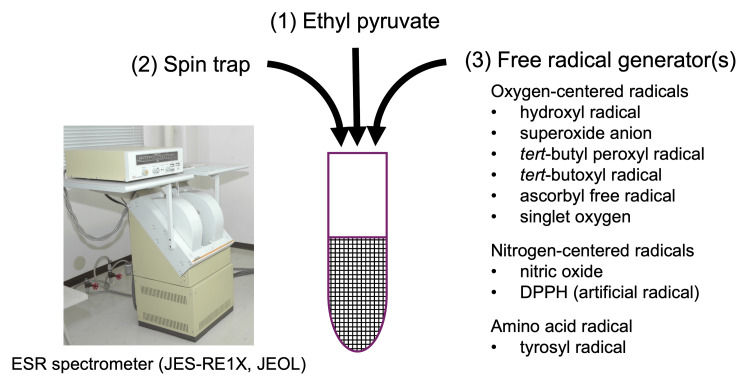 Figure 1
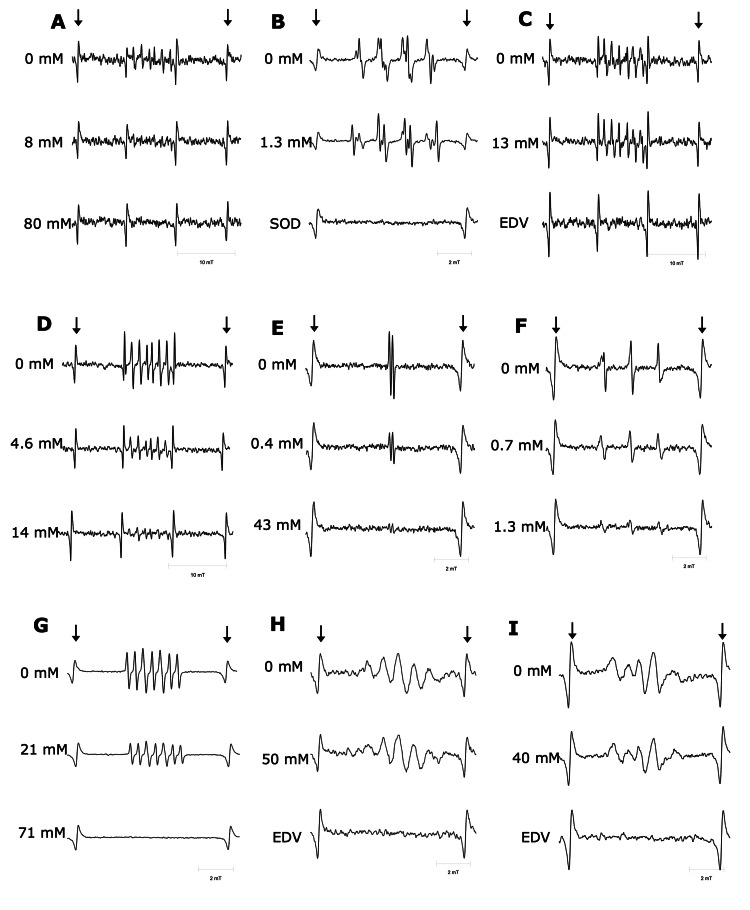 Figure 2
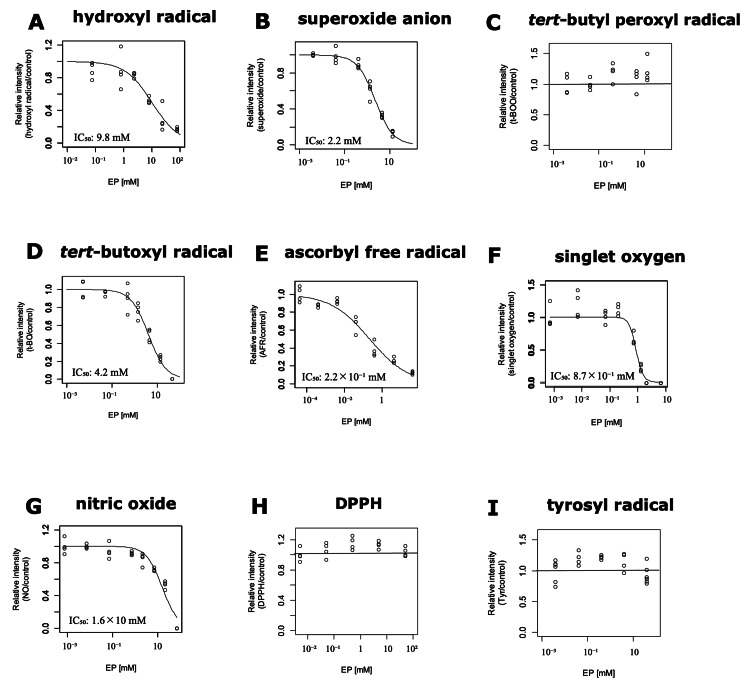 Figure 3
| Free radical species | Precursor/Sensitizer | Spin trap/Quencher |
| Hydroxyl radical | 0.4% hydrogen peroxide + UV 4 s | 0.33 mM CYPMPO |
| Superoxide anion | 0.04 mM hypoxanthine + 0.02 U/mL xanthine oxidase | 6.4 × 10² mM DMPO |
|
| 80 mM | 5.0 mM CYPMPO |
|
| 1.4 mM AAPH + UV 4 s | 3.8 mM CYPMPO |
| Ascorbyl free radical | 0.26 mg/ml sodium ascorbate + 42% DMSO | ― |
| Singlet oxygen | 0.17 mM Acid Red + 500-600 nm light 60 s | 1.7 mM 4-OH TEMP |
| Nitric oxide | 140 μM NOC7 | 14 μM carboxy-PTIO |
| DPPH | 15 μM DPPH | ― |
| Tyrosyl radical | 0.11 mM myoglobin + 0.002% hydrogen peroxide | 6.0 × 10² mM DMPO |
| Free radical species | htfc (mT) aH, aN, aP | IC50 (mM) | Reaction rate constants | P-value | |
| relative value | absolute value (M-1s-1) | ||||
| Hydroxyl radical | 1.37, 1.37, 4.88 | 9.8 ± 1.6 | 3.4×10⁻² × kCYPMPO | 1.4 × 10⁸ | <0.01 |
| Superoxide anion | 1.15, 1.42, 0.13 (AγH) | 2.2 ± 0.2 | 2.9×10² × kDMPO | 4.6 × 10³ | <0.01 |
| tert-Butyl peroxyl radical | 1.35, 1.45, 5.05 | ― | ― | ― | ― |
| tert-Butoxyl radical | 1.24, 1.36, 4.80 | 4.2 ± 0.4 | 0.91 × kCYPMPO | ― | <0.01 |
| Ascorbyl free radical | 0.186, ―, ― | 0.22 ± 0.05 | 0.77 × kEdv | ― | <0.01 |
| Singlet oxygen | ―, 1.50, ― | 0.87 ± 0.06 | 0.19 × k4-OH_TEMP | ― | <0.01 |
| Nitric oxide | aN1 0.981, aN2 0.445 | 16 ± 2 | 8.6 × 10⁻⁴ × kcPTIO | 8.6 | <0.01 |
| DPPH | ―, 0.903, ― | ― | ― | ― | ― |
| Tyrosyl radical | ― | ― | ― | ― | ― |
Peer Reviews
No public reviews on file for this paper yet. If you reviewed it on a platform where reviews are public (OpenReview, ICLR, NeurIPS, ICML), you can paste yours below so the community can read it here.
Videos
No videos yet. Explain this paper in a talk, walkthrough, or lecture? Add one.
Taxonomy
TopicsElectron Spin Resonance Studies · Vitamin C and Antioxidants Research · Free Radicals and Antioxidants
Introduction
Pyruvate (2-oxopropanoic acid) is a metabolic intermediate of energy metabolism. It connects the glycolysis and the tricarboxylic acid cycle as the final product of the former and the initial substrate for the latter. It also functions as a neuroprotective agent in vivo, acting as an antioxidant and free radical scavenger [1-3]. However, pyruvate is unstable in solution, making it difficult to use in clinical settings.
Ethyl pyruvate (ethyl 2-oxopropanoate) is a derivative of pyruvate with stability and lipid solubility. It also has antioxidative effects [4-7]. Our research group previously reported that ethyl pyruvate directly scavenges hydroxyl radicals [8]. Kładna et al. [9] reported its removal effect on reactive oxygen species by inhibiting chemiluminescent signals generated from superoxide anion in a dose-dependent manner. However, it has not yet been reported in detail whether ethyl pyruvate has direct (non-enzymatic) scavenging activity against other free radicals.
Therefore, we hypothesized that ethyl pyruvate would scavenge multiple kinds of free radicals, contributing to its antioxidative activity. The present study aimed to demonstrate the non-enzymatic scavenging activities of ethyl pyruvate against multiple free radical species and to illustrate its concentration-dependent properties.
Materials and methods
Materials
We purchased ethyl pyruvate, tert-butyl hydroperoxide, and 2,2-diphenyl-1-picrylhydrazyl (DPPH) from Sigma-Aldrich (St. Louis, MO, USA). 5,5-dimethyl-1-pyrroline-N-oxide (DMPO), N-methyl-3-(1-methyl-2-hydroxy-2-nitrosohydrazino)-1-propanamine (NOC7), and 2-(4-carboxypheyl)-4,4,5,5-tetramethylimidazole-1-oxyl 3-oxide (carboxy-PTIO) were the products of Dojindo (Kumamoto, Japan). 5-(2,2-dimethyl-1,3-propoxy cyclophosphoryl)-5-methyl-1-pyrroline N-oxide (CYPMPO) was purchased from Mikuni Pharmaceutical Industrial (Osaka, Japan). Sodium ascorbate, dimethyl sulfoxide, and hydrogen peroxide were the products of Wako Pure Chemical Industries (Osaka, Japan). 2-2’-Azobis (2-amidinopropane) dihydrochloride (AAPH), Acid Red 94, and 4-hydroxy-2,2,6,6-tetramethylpiperidine (4-OH TEMP) were commercially available from Tokyo Chemical Industry (Tokyo, Japan). Ethyl pyruvate and other reagents were dissolved in ultrapure water prepared in our laboratory (ORGANO PX-0060μ-000, Tokyo, Japan). DPPH was dissolved in 100% ethanol.
Electron spin resonance spectrometry
Electron spin resonance (ESR) spectrometry was conducted as previously described [10-14]. Free radicals were detected using an X-band ESR spectrometer (JES-RE1X, JEOL, Tokyo, Japan). The data were analyzed offline with the operation software WIN-RAD ver.1.20b (Radical Research Inc, Tokyo, Japan). The ultraviolet (UV) or visible (VIS) light was produced by a 200 W medium-pressure mercury/xenon arc, and guided through a quartz light guide into the ESR sample cavity. Free radicals were produced in disposable glass micro-hematocrit capillary tubes (CS-HMT-502, Kimble Chase, Vineland, NJ, USA). The typical instrument settings were as follows: room temperature (23℃); frequency 9.45 GHz with 100-kHz modulation; modulation width, 0.1 mT; time constant, 0.1 s; center field, 335.8 mT; sweep width, 7.5 mT; sweep time, 1 min; microwave power, 4 mW.
Table 1 details the generation and trapping methods for the eight free radical species and singlet oxygen [10-14]. The reaction mixture (Figure 1) was composed of three parts: the subject drug (ethyl pyruvate), a spin-trap, and free radical generator(s). First, the spin-trap was added to the drug, followed by the addition of the free radical generator(s). Exactly 60 s after the free radical generator(s) was (were) added to the mixture, ESR measurement was started at each experiment. Briefly, hydroxyl radicals were generated by UV irradiation of hydrogen peroxide and trapped with CYPMPO. Superoxide anions were generated by the mixture of hypoxanthine and xanthine oxidase and trapped with DMPO. The tert-butyl peroxyl radical was generated by UV irradiation of tert-butyl hydroperoxide and trapped with CYPMPO. The tert-butoxyl radical was produced by UV irradiation of 3 mM AAPH and trapped with CYPMPO. Ascorbyl free radicals were studied by adding 99% dimethyl sulfoxide to sodium ascorbate [15]. Singlet oxygen was produced by VIS light irradiation of Acid Red 94 with its quencher, 4-OH TEMP. Nitric oxide was generated from NOC7 and reacted with carboxy-PTIO. DPPH was resolved in 100% ethanol. The tyrosyl radical was produced with hemoglobin and hydrogen peroxide and trapped with DMPO. Times from the generation of free radicals to the ESR measurement were strictly controlled so that they were kept constant (60 s) throughout the experiments.
Experimental procedures.First, ethyl pyruvate (1) and a spin trap (2) were mixed in a test tube. Exactly 60 s after the addition of the free radical generator(s) (3), ESR measurement was started.ESR: electron spin resonance
Ratios of heights of ESR signals of target free radicals to those of Mn^2+^ were calculated. Then ratios were standardized by the control ESR signal with no ethyl pyruvate added.
Calculation of half-maximal inhibitory concentration
Data were nonparametrically fitted to the following Cheng-Prusoff’s sigmoid curve [16] to estimate concentration-response relationships.
\begin{document}y = \frac{1}{1+(\frac{x}{a})^b}\end{document}
where a gives the estimation of half-maximal inhibitory concentration (IC_50_), x is the final concentration of ethyl pyruvate (M), and y is the observed free radical activity relative to the control. The Cheng-Prusoff’s sigmoid curve has been used by our laboratory in a series of studies on free radical scavenging activity of various drugs [10-14]. Despite its simple equation, it has successfully estimated the IC_50_ that always well matched the observed data.
Estimation of reaction rate constants
According to a kinetic competition model [17], the following competitive reactions occur in the reaction mixture:
spin trap + free radical \begin{document}\rightarrow\end{document} spin-adduct
ethyl pyruvate + free radical \begin{document}\rightarrow\end{document} ethyl-puruvate-radical
Given kspin trap and kethyl pyruvate are the second-order rate constants of the respective reactions above, kethyl pyruvate is expressed as follows:
\begin{document}k_{\text{ethyl pyruvate}}=\frac{\left[ \text{spin trap} \right]}{\mathrm{IC}_{50}}k_{\text{spin trap}}\end{document}
kspin trap used were as follows: kCYPMPO for hydroxyl radical 4.2 × 10^9^ M^-1^ s^-1^ [15], kDMPO for superoxide anion 16 M^-1^ s^-1 ^[15], and kcPTIO for nitric oxide 1.01 × 10^4^ M^-1^ s^-1^ [16]. Because kCYPMPO for tert-butyl peroxyl radical and tert-butoxyl radical have not been reported, kethyl pyruvate for those free radicals was presented as relative values to kCYPMPO.
Statistical analysis
Statistical tests were conducted using the statistical software R ver.4.2.1 (https://www.R-project.org/). Values are presented as means (95% confidence intervals). The level of significance was 0.05.
Results
The ESR spectra of the spin adducts for each radical examined are shown in Figure 2. Each spectrum was assigned to the corresponding free radical by the hyperfine splitting constants (Table 2).
ESR spectra of free radicals.ESR spectra of hydroxyl radical (A), superoxide anion (B), tert-butyl peroxyl radical (C), tert-butoxyl radical (D), ascorbyl free radical (E), singlet oxygen (F), nitric oxide (G), DPPH (H), and tyrosyl radical (I). Final concentrations of ethyl pyruvate are shown on the left side of each panel.DPPH: 2,2-diphenyl-1-picrylhydrazyl; EDV: edaravone; ESR: electron spin resonance
Hydroxyl radical
Ethyl pyruvate scavenged hydroxyl radicals as the concentration increased (Figure 2A). As shown in Figure 3A, ethyl pyruvate scavenged hydroxyl radicals in a concentration-dependent manner. By fitting the data to the Cheng-Prusoff’s equation [16], IC_50_ was determined to be 9.8 (95% confidence interval = 8.2-11.4) mM (p < 0.01). Using known kCYPMPO = 4.2 × 10^9^ M^-1^s^-1^ for hydroxyl radical [18] and [CYPMPO] = 0.33 mM, kethyl pyruvate was estimated to be 1.4 × 10^8^ M^-1^s^-1^ (kethyl pyruvate/kCYPMPO = 3.4 × 10^-2^).
Concentration-response curves of non-enzymatic scavenging activity of ethyl pyruvate against free radicals and singlet oxygen.Ethyl pyruvate concentration-dependently scavenged hydroxyl radical (A), superoxide anion (B), tert-butoxyl radical (D), ascorbyl free radical (E), singlet oxygen (F), and nitric oxide (G). However, it did not show radical-scavenging activity against tert-butyl peroxyl radical (C), DPPH (H), and tyrosyl radical (I). Signals on both ends of each spectrum are those of the external standard of Mn2+.DPPH: 2,2-diphenyl-1-picrylhydrazyl
Superoxide anion
As shown in Figure 2B, ethyl pyruvate scavenged superoxide anion as the concentration increased. Superoxide anion was scavenged concentration-dependently by ethyl pyruvate (Figure 3B). By fitting the data to Cheng-Prusoff’s equation [16], IC_50_ was calculated to be 2.2 (2.0-2.4) mM (p < 0.01). Using kDMPO = 16 M^-1^s^-1^ for superoxide anion [18] and [DMPO] = 6.4 × 10^2^ mM, kethyl pyruvate was estimated to be 4.6 × 10^3^ M^-1^s^-1^ (kethyl pyruvate/kDMPO = 2.9 × 10^2^).
tert-butyl peroxyl radical
Ethyl pyruvate did not scavenge tert-butyl peroxyl radicals at all (Figures 2C, 3C). As a positive control, 4.4 mM edaravone scavenged tert-butyl peroxyl radicals as previously reported [10] (Figure 2C).
tert-butoxyl radical
As the concentration of ethyl pyruvate increased, the ESR signal of tert-butoxyl radical reduced (Figure 2D). Ethyl pyruvate significantly scavenged tert-butoxyl radical in a concentration-dependent manner (Figure 3D). IC_50_ was calculated to be 4.2 (3.8-4.6) mM (p < 0.01). kethyl pyruvate/kCYPMPO was estimated to be 9.1 × 10^-1^. As the absolute value of kCYPMPO has not been reported, kethyl pyruvate was presented as a relative value.
Ascorbyl free radical
Figure 2E shows that ethyl pyruvate scavenges ascorbyl free radicals as its concentration increases. Figure 3E illustrates the concentration-dependent scavenging activity of ethyl pyruvate against ascorbyl free radicals. Fitting the data to the Cheng-Prusoff’s equation demonstrated IC_50_ = 0.22 (0.17-0.27) mM (p < 0.01), which was equivalent to 0.77 × kedaravone [10].
Singlet oxygen
Singlet oxygen was scavenged as the concentration of ethyl pyruvate increased (Figure 2F). By fitting the data plotted in Figure 3F to Cheng-Prusoff’s equation [10], IC_50_ was calculated to be 0.87 (0.81-0.93) mM (p < 0.01). kethyl pyruvate/k4-OH TEMP was estimated to be 0.19.
Nitric oxide
Ethyl pyruvate scavenged nitric oxide in a concentration-dependent manner (Figure 2G). By fitting the data plotted in Figure 3G to Cheng-Prusoff’s equation [10], IC_50_ was calculated to be 16 (14-18) mM (p < 0.01). Using kcPTIO for nitric oxide of 1.01 × 10^4^ M^-1^ s^-1^ [19] and [cPTIO] = 0.014 mM, kethyl pyruvate was estimated to be 8.6 M^-1^s^-1^ (kethyl pyruvate/kcPTIO = 8.6 × 10^-4^).
DPPH
Ethyl pyruvate did not scavenge DPPH, an artificial free radical, at all (Figures 2H, 3H). As a positive control, 5 mM edaravone scavenged DPPH as previously reported [10] (Figure 2H).
Tyrosyl radical
Ethyl pyruvate did not scavenge tyrosyl radicals at all (Figures 2I, 3I). 4 mM Edaravone, a positive control, scavenged tyrosyl radical [11] (Figure 2I).
Discussion
In the present study, there were only three players in a test tube: free radicals, spin traps, and ethyl pyruvate; the observed reaction occurred without enzymes. Thus, it was demonstrated that ethyl pyruvate non-enzymatically scavenged five kinds of free radicals and singlet oxygen out of the nine investigated in a non-enzymatic concentration-dependent manner.
Ethyl pyruvate, a stable and low-toxic derivative of pyruvate, has various pharmacological activities, including anti-inflammation, antioxidative stress, antiapoptosis, and antifibrosis [7-9,20]. As for anti-inflammatory effects, while it reduced the activation of nuclear factor kappa-B expression, ethyl pyruvate potentiated nuclear factor erythroid 2-associated factor 2 and downstream antioxidative molecules [21-23]. Ethyl pyruvate decreased the inflammatory responses by improving the T-helper 17/regulatory T cells imbalance [24]. Ethyl pyruvate also promoted growth arrest-specific gene 6/Axl signaling activation, which contributes to the immune restoration after the intracerebral hemorrhage mouse model, attenuating brain injury and enhancing neuroprotective effect [25].
Concerning antioxidative effects, Kładna et al. reported that ethyl pyruvate scavenged free radicals, including hydroxyl radical, superoxide anion, and nitric oxide [9]. However, they investigated the activity of ethyl pyruvate on the generation of reactive oxygen species by chemiluminescent signals, but not on its scavenging activity against free radicals [9]. Thus, it is still unclear which free radical species ethyl pyruvate directly scavenges.
Tokumaru et al. demonstrated that ethyl pyruvate was neuroprotective from the standpoint of energy metabolism; the recovery of phosphocreatine after ischemia/reperfusion was significantly improved when brain slices were superfused with artificial cerebrospinal fluid with ethyl pyruvate [8]. Intracellular pH was less acidic with ethyl pyruvate. They also reported that ethyl pyruvate scavenged hydroxyl radicals. However, concentration-dependency was not clearly illustrated; neither IC_50_ nor reaction rate constant was estimated at that time. In the present study, the concentration-dependency was illustrated for multiple species of free radicals, and the reaction rate constants were estimated for the first time. Ethyl pyruvate scavenges superoxide anion, which occurs at the most upstream stage of ischemia-reperfusion injury, and hydroxyl radical, which is one of the most harmful free radicals in vivo. Therefore, it would be expected that ethyl pyruvate could be used to suppress the oxidative stress and cell damage that occur downstream of these chain reactions.
It should also be noted that, compared with edaravone, ethyl pyruvate showed weaker scavenging activity against nitric oxide, which has a number of physiological effects in vivo, including dilation of vessels. This might indicate a possible benefit; i.e., the use of ethyl pyruvate might not interfere with the physiological effects of nitric oxide in vivo.
Ascorbate is a water-soluble antioxidant and is located at the most downstream of the oxidative chain reactions [26]. Unpaired electrons of free radicals produced intracellularly are transferred extracellularly via vitamin E in the cell membrane. Ascorbate acts as a donor of single reducing equivalents cycling between ascorbate and ascorbyl free radical, which makes ascorbate itself a free radical scavenger. Because ascorbyl free radical reacts preferentially with other radicals, making it not only a free radical scavenger but also a terminator of free radical chain reactions [27]. Thus, ascorbyl free radical is considered the final product of the chain reaction of oxidative stress and free radicals. Ethyl pyruvate could act as an antioxidant by scavenging not only the most upstream (i.e., superoxide anion) but also the most downstream products (i.e., ascorbyl free radical) of the chain reaction, with equivalent reaction rates to those of edaravone [10].
Although singlet oxygen is not a free radical but a reactive oxygen species, the scavenging activity of ethyl pyruvate was investigated. Singlet oxygen is generated in the skin by irradiation of photosensitizers by UV light in sunlight. Humans have no enzyme to eliminate singlet oxygen in the way that superoxide dismutase eliminates superoxide anions. Carotenoids are one of the major antioxidants to eliminate singlet oxygen [28,29]. The present result of the concentration-dependent scavenging activity of ethyl pyruvate against singlet oxygen could suggest possible clinical applications, such as the prevention of membrane lipid peroxidation.
tert-butoxyl radical and tert-butyl peroxyl radical are experimental reagents used to simulate alkoxyl radical and peroxyl radical of the oxidation chain reaction of lipids, including low-density lipoprotein-cholesterol. Ethyl pyruvate scavenged tert-butoxyl radical, suggesting that ethyl pyruvate might be preventive of the oxidative chain reaction of lipids. Meanwhile, it did not scavenge tert-butyl peroxyl radical. These results would suggest that the antioxidative activity of ethyl pyruvate might be limited, compared with that of edaravone, which scavenges both lipid radicals concentration-dependently [10,11].
Tyrosyl radical is the initial step of the cyclooxygenase reaction [30]. As ethyl pyruvate did not scavenge tyrosyl radical, its antioxidative and anti-inflammatory activities might be limited compared to edaravone, which directly scavenges tyrosyl radical [11].
The present study has some limitations. First, the possible influence of intracellular and intramitochondrial electrolytes, proteins, and other metabolites on scavenging activity was not considered. Second, the authors were only able to obtain absolute reaction rate constants for some of the free radicals examined. Third, the study was conducted only in vitro, and no in vivo experiments were included; there have been many in vivo studies reported supporting the antioxidative and anti-inflammatory activity of ethyl pyruvate. For the same reason, no interference with mitochondria was discussed where reactive oxygen species are generated in vivo. Future research must be conducted under conditions close to those of a living body.
Conclusions
Ethyl pyruvate is a stable derivative of a metabolic intermediate of energy metabolism, which is reported to have antioxidative activities. In addition to its action through intracellular enzymatic pathways, we have demonstrated its direct non-enzymatic scavenging activity of ethyl pyruvate against specific species of free radicals, including hydroxyl radical and superoxide anion. It is speculated that some part of the antioxidative activity of ethyl pyruvate might be attributable to its direct non-enzymatic free radical scavenging activity. It would be possible that ethyl pyruvate could be clinically applied to prevent, for example, perioperative complications attributable to oxidative stress, such as perioperative arrhythmia and postoperative cognitive dysfunction. Ethyl pyruvate could protect patients from oxidative stress through not only enzymatic but also non-enzymatic pathways, as well as supplementing energy substrate.
The reference list from the paper itself. Each links out to its DOI / PubMed record.
- 1Pyruvate prevents ischemia-reperfusion mucosal injury of rat small intestine Am J Surg Cicalese L Lee K Schraut W Watkins S Borle A Stanko R 971001711996855415910.1016/S 0002-9610(99)80081-6 · doi ↗ · pubmed ↗
- 2Pyruvate improves cerebral metabolism during hemorrhagic shock Am J Physiol Heart Circ Physiol Mongan PD Capacchione J Fontana JL West S Bünger R 064281200110.1152/ajpheart.2001.281.2.H 85411454591 · doi ↗ · pubmed ↗
- 3Effects of pyruvate administration on infarct volume and neurological deficits following permanent focal cerebral ischemia in rats Brain Res González-Falcón A Candelario-Jalil E García-Cabrera M León OS 1799020031456832310.1016/s 0006-8993(03)03378-x · doi ↗ · pubmed ↗
- 4Ethyl pyruvate preserves cardiac function and attenuates oxidative injury after prolonged myocardial ischemia J Thorac Cardiovasc Surg Woo YJ Taylor MD Cohen JE 1262126912720041511598110.1016/j.jtcvs.2003.11.032 · doi ↗ · pubmed ↗
- 5Ethyl pyruvate enhances ATP levels, reduces oxidative stress and preserves cardiac function in a rat model of off-pump coronary bypass Heart Lung Circ Taylor MD Grand TJ Cohen JE 25311420051635224810.1016/j.hlc.2004.12.021 · doi ↗ · pubmed ↗
- 6Exogenous ethyl pyruvate versus pyruvate during metabolic recovery after oxidative stress in neonatal rat cerebrocortical slices Anesthesiology Zeng J Liu J Yang GY Kelly MJ James TL Litt L 63064010720071789346010.1097/01.anes.0000281898.01966.1e · doi ↗ · pubmed ↗
- 7Protective effect of ethyl pyruvate against myocardial ischemia reperfusion injury through regulations of ROS-related NLRP 3 inflammasome activation Oxid Med Cell Longev Jun JH Shim JK Oh JE Shin EJ Shin E Kwak YL 4264580201920193072888510.1155/2019/4264580 PMC 6343167 · doi ↗ · pubmed ↗
- 8Neuroprotective effects of ethyl pyruvate on brain energy metabolism after ischemia-reperfusion injury: a 31P-nuclear magnetic resonance study Neurochem Res Tokumaru O Kuroki C Yoshimura N 7757853420091898544810.1007/s 11064-008-9871-x · doi ↗ · pubmed ↗