A novel robotic traction system for endoscopic submucosal dissection – achieving en bloc resection of an extensive laterally spreading tumor in the lower rectum
Zhiyong Zhai, Chongju Bao, Wanjun Li, Chao Yang, Wei Gong

Abstract
Genes, proteins, chemicals, diseases, species, mutations and cell lines named across the full text — each resolved to its canonical identifier and authoritative record.
Click any figure to enlarge with its caption.
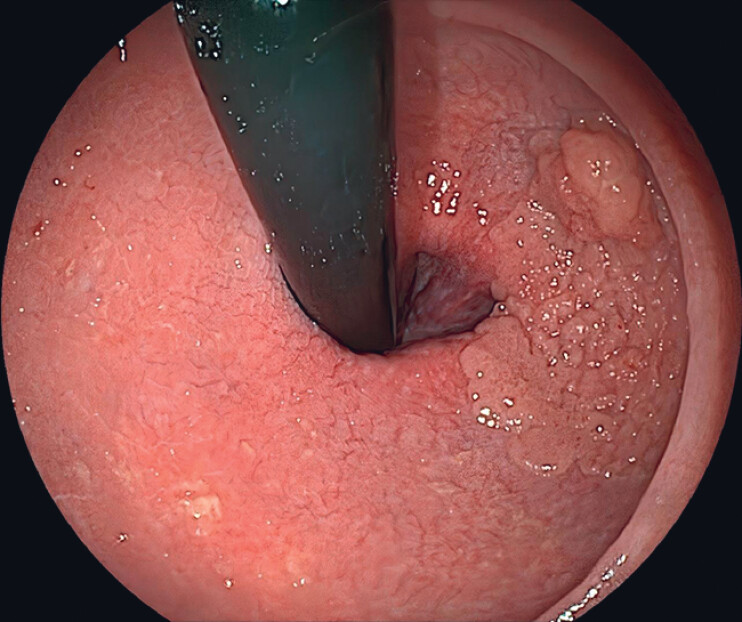 Fig. 1
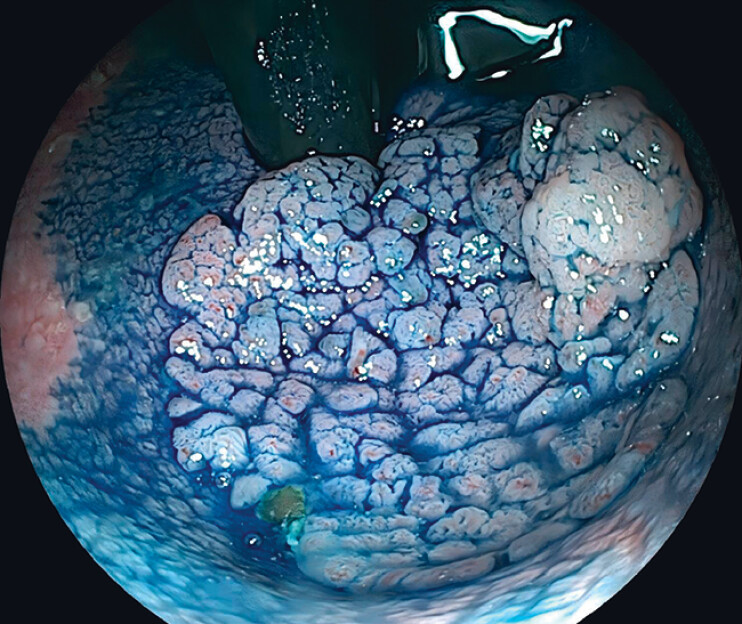 Fig. 2
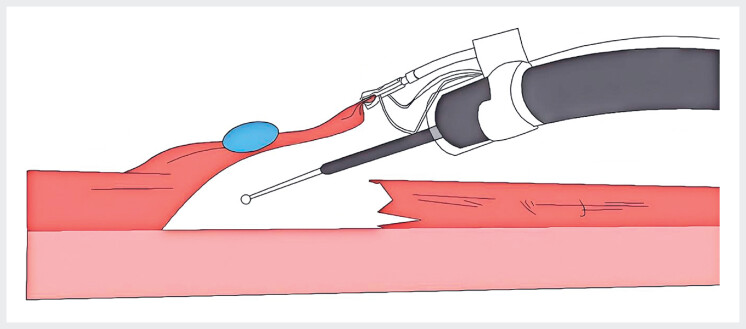 Fig. 3
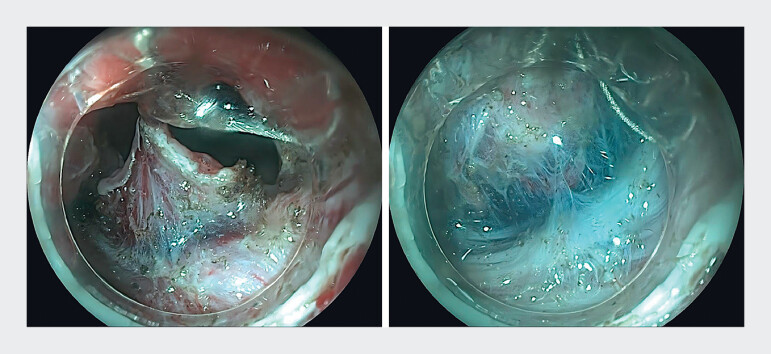 Fig. 4
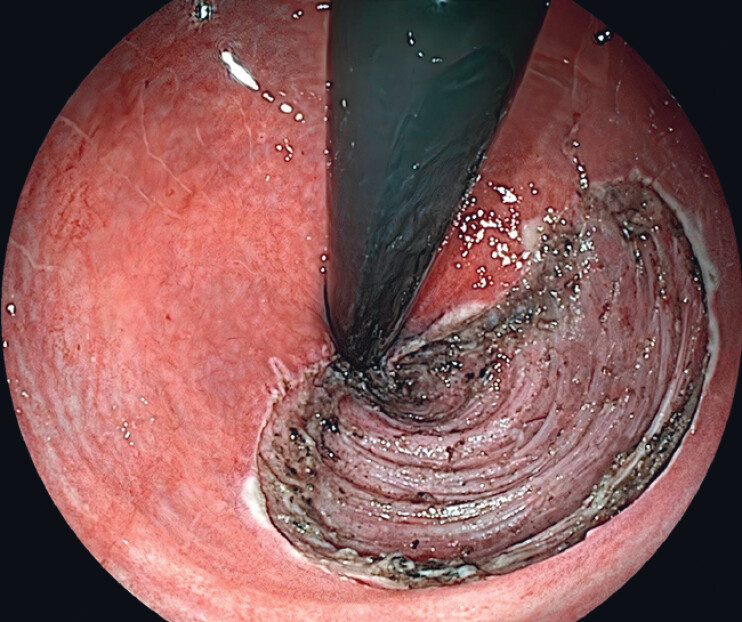 Fig. 5
Peer Reviews
No public reviews on file for this paper yet. If you reviewed it on a platform where reviews are public (OpenReview, ICLR, NeurIPS, ICML), you can paste yours below so the community can read it here.
Videos
No videos yet. Explain this paper in a talk, walkthrough, or lecture? Add one.
Taxonomy
TopicsGastric Cancer Management and Outcomes · Gastrointestinal Tumor Research and Treatment · Esophageal Cancer Research and Treatment
Colonoscopy revealed a 5.5 × 4.0 cm laterally spreading tumor in the lower rectum near the anal verge, with a well-demarcated line and relatively regular nodules ( Fig. 1 ). Indigo carmine staining displayed a glandular pattern consistent with Kudo type IV pits ( Fig. 2 ), and endoscopic submucosal dissection (ESD) was deemed feasible.
A laterally spreading tumor (5.5 cm × 4.0 cm) with Parisian Type 0-IIa in the lower rectum.
Indigo carmine staining displayed a glandular pattern consistent with Kudo type IV pits.
Given the lesion’s large size, location in the lower rectum, and rich vascularity, submucosal layer visualization was expected to be suboptimal during dissection, elevating the risks of intraoperative bleeding and incomplete resection. To overcome these challenges, the EndoFaster robotic traction system was employed ( Fig. 3 ). Following submucosal injection and circumferential mucosa incision using a hybrid knife, the device’s white soft hood was attached to the endoscope tip. Grasping forceps were fixed at the 12 o’clock direction to grasp the lesion edge, providing upward traction. The submucosal layer was in full exposure and blood vessels were clearly visible ( Fig. 4 ). The operation progressed with an antegrade approach from the anal to the oral side. By dynamically adjusting the position of the forceps, they can exert a controlled pulling force in multiple directions, which allowed precise electrocoagulation hemostasis and systematic dissection. Finally, the lesion was successfully completely removed ( Fig. 5 ). The total duration of the submucosal dissection was significantly reduced to approximately 30 minutes, with no intraoperative complications ( Video 1 ).
The scheme of the EndoFaster robotic traction system.
With robot-assisted traction, the submucosal layer was in full exposure (left) and blood vessels were clearly visible (right).
The lesion was successfully completely removed.
A novel robotic traction system for endoscopic submucosal dissection – achieving en bloc resection of an extensive laterally spreading tumor in the lower rectum.Video 1
Compared with conventional traction methods (e.g. dental floss 1 2 and figure-of-eight clip 3 4 ), EndoFaster enables multiple-position and multiple-angle traction due to its flexibility, which improves dissection efficiency for large lesions in anatomically challenging locations, increases en bloc resection rates, and reduces intraoperative complications, as evidenced by its successful use in a gastric angle lesion by Cui et al. 5 in 2024. Our presented case further exemplifies these advantages and marks its first application in colorectal ESD in China. EndoFaster facilitates ESD procedures, enhancing their safety and thereby offering a novel strategy for colorectal ESD. More cases and a longer follow-up are required to validate the advantages of this technique.
Endoscopy_UCTN_Code_TTT_1AQ_2AD_3AD
The reference list from the paper itself. Each links out to its DOI / PubMed record.
- 1Tsuji K Yoshida N Nakanishi H Recent traction methods for endoscopic submucosal dissection World J Gastroenterol 2016225917592610.3748/wjg.v 22.i 26.591727468186 PMC 4948268 · doi ↗ · pubmed ↗
- 2Mizutani H Ono S Ohki D Recent Development of Techniques and Devices in Colorectal Endoscopic Submucosal Dissection Clin Endosc 20175056256810.5946/ce.2017.10829207854 PMC 5719918 · doi ↗ · pubmed ↗
- 3Yoshida M Takizawa K Nonaka S Conventional versus traction-assisted endoscopic submucosal dissection for large esophageal cancers: a multicenter, randomized controlled trial (with video)Gastrointest Endosc 20209155650031445039 10.1016/j.gie.2019.08.014 · doi ↗ · pubmed ↗
- 4Libânio D Pimentel-Nunes P Bastiaansen B Endoscopic submucosal dissection techniques and technology: European Society of Gastrointestinal Endoscopy (ESGE) Technical Review Endoscopy 20235536138910.1055/a-2031-087436882090 · doi ↗ · pubmed ↗
- 5Cui C Lu X Zuo XL Endoscopic submucosal dissection of early gastric angle cancer by using a simplified robot-assisted device for traction Endoscopy 20245601 E 49E 5010.1055/a-2227-646538232771 PMC 10794087 · doi ↗ · pubmed ↗