Endoscopic replacement of a transgastric feeding tube in advanced oropharyngeal cancer with esophageal obstruction using transgastrostomy endoscopy
Ahmed Alwali, Clemens Eissner, Imad Kamaleddine, Clemens Schafmayer

Abstract
Genes, proteins, chemicals, diseases, species, mutations and cell lines named across the full text — each resolved to its canonical identifier and authoritative record.
Click any figure to enlarge with its caption.
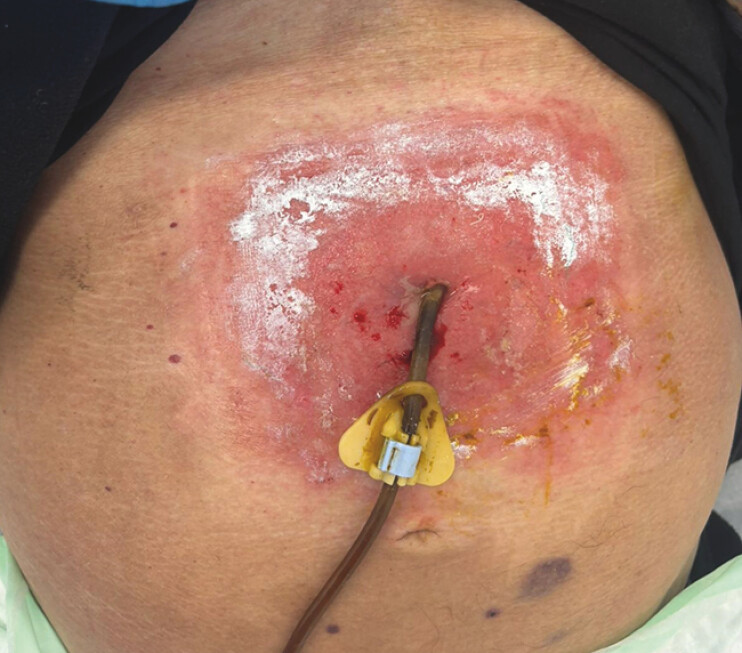 Fig. 1
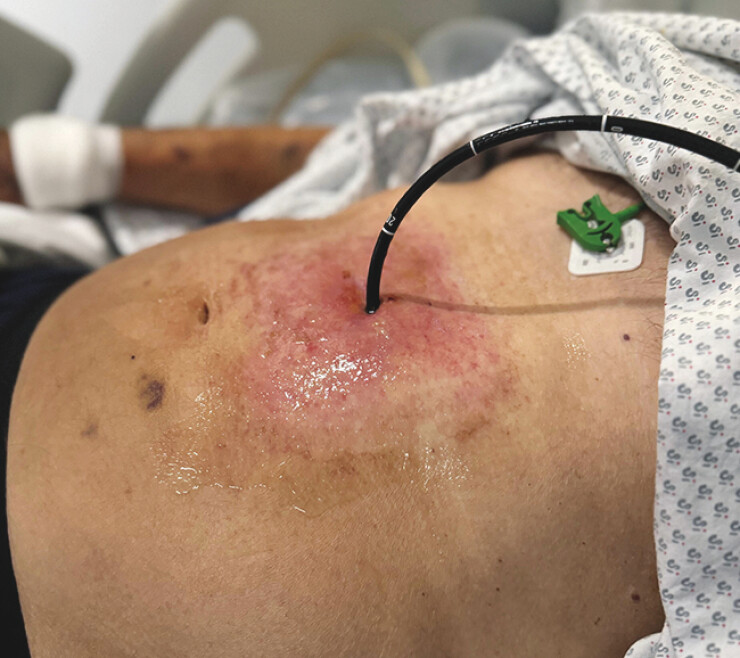 Fig. 2
Peer Reviews
No public reviews on file for this paper yet. If you reviewed it on a platform where reviews are public (OpenReview, ICLR, NeurIPS, ICML), you can paste yours below so the community can read it here.
Videos
No videos yet. Explain this paper in a talk, walkthrough, or lecture? Add one.
Taxonomy
TopicsEsophageal and GI Pathology · Esophageal Cancer Research and Treatment · Clinical Nutrition and Gastroenterology
A 78-year-old man with advanced oropharyngeal cancer presented with a therapy-resistant wound infection at the site of a previously placed percutaneous endoscopic gastrostomy (PEG). The infection required PEG-tube removal, performed using the cut-and-push technique. Owing to complete esophageal obstruction, conventional transoral endoscopic re-insertion of a new PEG was not feasible. ( Fig. 1 ).
An infected gastrostomy site with purulent discharge and abdominal wall phlegmon.
A slim nasal gastroscope was advanced through the gastrostomy tract to access the stomach ( Fig. 2 ). Under direct endoscopic visualization, a new gastric puncture was performed in an unaffected region, followed by gastropexy and PEG reinsertion via the push technique. The procedure was carried out under sterile conditions without any complication ( Video 1 ).
A trans-gastrostomy endoscopic approach using a nasal gastroscope through the gastrostomy tract to access the stomach.
A trans-gastrostomy endoscopic approach in a patient with complete esophageal obstruction. The nasal gastroscope was introduced via the gastrostomy tract, and a new PEG was safely placed under direct visualization.Video 1
Trans-gastrostomy PEG placement is a valuable alternative in patients with complete esophageal obstruction where conventional access is impossible. Careful patient selection and strict adherence to sterile technique enable the safe reinsertion of a PEG at a new gastric site, avoiding the need for surgical gastrostomy.
This case illustrates the feasibility and safety of trans-gastrostomy endoscopy for PEG replacement in complex anatomical situations and highlights its role as a minimally invasive salvage technique.
Endoscopy_UCTN_Code_TTT_1AO_2AK