Endoscopic ultrasound-guided portal pressure gradient assessment of acute hemodynamic response to intravenous propranolol
Rafael Romero-Castro, Enrique Silva-Albarellos, Lourdes Grandes-Santamaria, Isabel Carmona-Soria, Victoria Alejandra Jimenez-Garcia, Manuel Rodriguez-Tellez, Ángel Caunedo-Álvarez

Abstract
Genes, proteins, chemicals, diseases, species, mutations and cell lines named across the full text — each resolved to its canonical identifier and authoritative record.
Click any figure to enlarge with its caption.
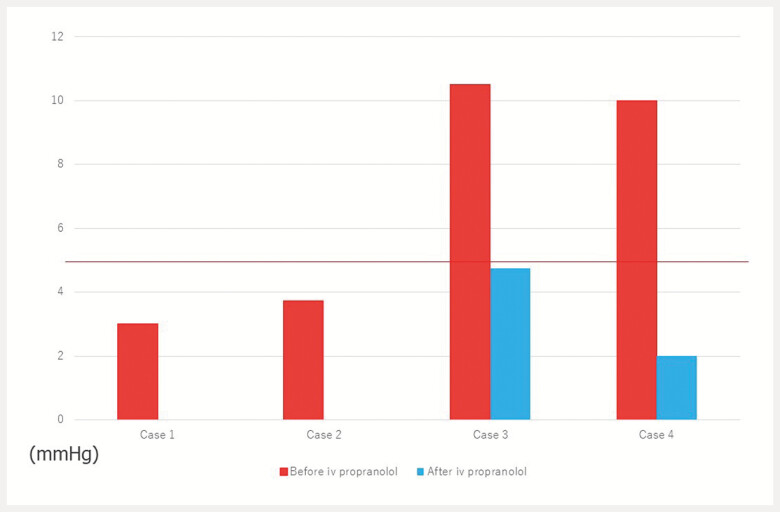 Fig. 1
| Patient | Age | Sex | Etiology | Child-Pugh | MELD | Liver stiffness (kPa) | Platelets (g/L) | EUS-PPGm before iv ropranolol | EUS-PPGm after iv propranolol |
| Abbreviation: EUS-PPGm, endoscopic ultrasound-guided portal pressure gradient measurement. | |||||||||
| 1 | 60 | Male | Alcohol | B8 | 12 | 75 | 164.000 | 3 mmHg | Not indicated |
| 2 | 67 | Female | Alcohol | A5 | 8 | 19 | 108.000 | 3.75 mmHg | Not indicated |
| 3 | 60 | Male | Metabolic | A5 | 7 | 29 | 170.000 | 10.5 mmHg | 4.75 mmHg (55% reduction) |
| 4 | 65 | Female | Alcohol | B9 | 11 | 26,5 | 147.000 | 10 mmHg | 2 mmHg (80% reduction) |
Peer Reviews
No public reviews on file for this paper yet. If you reviewed it on a platform where reviews are public (OpenReview, ICLR, NeurIPS, ICML), you can paste yours below so the community can read it here.
Videos
No videos yet. Explain this paper in a talk, walkthrough, or lecture? Add one.
Taxonomy
TopicsAnesthesia and Sedative Agents · Acute Kidney Injury Research · Liver Disease and Transplantation
The development of portal hypertension is a critical hallmark in chronic liver diseases. The hepatic venous pressure gradient (HVPG) is the gold-standard method to diagnose and quantify portal hypertension and the hemodynamic response to drug therapy. An acute hemodynamic response to intravenous propranolol assessed with the HVPG predicts adverse liver-related events 1 . However, the HVPG is not recommended in routine clinical care due to its drawbacks 2 . Non-invasive tests (NITs) are used in daily clinical practice to stratify the risk of clinically significant portal hypertension 2 . Nevertheless, NITs are not recommended for assessing hemodynamic changes in portal hypertension 2 . Moreover, there is a gray-zone where patients affected with metabolic associated liver diseases, obesity or mixed etiologies could be misclassified by NITs 3 . The endoscopic ultrasound-guided portal pressure gradient measurement (EUS-PPGm) has been accurately compared to the HVPG and can directly obtain the real portal vein pressure 4 .
We determine the acute hemodynamic response to intravenous propranolol with EUS-PPGm in a case of a series of four patients ( Table 1 ). The procedure was performed as previously reported, taking into account several tips and tricks to avoid non-reliable results 5 .
: Table 1 Data and results.
Following baseline EUS-PPGm, 0.15 mg/kg of body weight, propranolol was administered intravenously by continuous infusion in 10 minutes. The second EUS-PPGm was repeated 15 minutes later targeting the same vessels with the same angle of the needle and position of the echoendoscope as in the baseline EUS-PPGm procedure ( Video 1 ).
EUS-guided portal pressure gradient assessment of the acute hemodynamic response to intravenous propranolol.Video 1
A significant reduction of PPG in two patients ( Fig. 1 ), treated with intravenous propranolol, was observed (10.5 mmHg to 4.75 mmHg [55%] and 10 mmHg to 2 mmHg [80%], respectively). In the other two patients, the first EUS-PPGm was normal. So, a second EUS-PPG measurement was not performed avoiding further unnecessary therapy with beta-blockers. No adverse events were observed.
EUS-guided assessment of the portal pressure gradient after intravenous administration of propranolol. EUS, endoscopic ultrasound.
EUS-PPGm can assess acute hemodynamic changes after intravenous administration of propranolol.
Endoscopy_UCTN_Code_TTT_1AS_2AD
The reference list from the paper itself. Each links out to its DOI / PubMed record.
- 1Hofer BS Simbrunner B Bauer DJM Acute hemodynamic response to propranolol predicts bleeding and nonbleeding decompensation in patients with cirrhosis Hepatol Commun 202262569258035808889 10.1002/hep 4.2021 PMC 9426394 · doi ↗ · pubmed ↗
- 2de Franchis R Bosch J Garcia-Tsao G Baveno VII - Renewing consensus in portal hypertension J Hepatol 20227695997410.1016/j.jhep.2021.12.02235120736 PMC 11090185 · doi ↗ · pubmed ↗
- 3Mendizabal M Cançado GGL Albillos A Evolving portal hypertension through Baveno VII recommendations Ann Hepatol 20242910118010.1016/j.aohep.2023.10118037984701 · doi ↗ · pubmed ↗
- 4Sun X Ni HB Xue J Bibliometric-analysis visualization and review of non-invasive methods for monitoring and managing the portal hypertension Front Med (Lausanne)2022996031610.3389/fmed.2022.96031636186776 PMC 9520322 · doi ↗ · pubmed ↗
- 5Romero-Castro R Carmona-Soria I Jiménez-García VA Endoscopic ultrasound-guided portal pressure gradient measurement: improving safety and overcoming technical difficulties Endoscopy 20235501 E 878E 88010.1055/a-2109-066637442167 PMC 10344626 · doi ↗ · pubmed ↗