Cutaneous Melanocytic Tumor With CRTC1::TRIM11 Fusion: A Case Report
Ngoc Nguyen, Nathan Silvera, Jagadeesh Kumar

TL;DR
A rare skin tumor with a CRTC1::TRIM11 fusion is reported, emphasizing the need for molecular testing to distinguish it from more aggressive cancers.
Contribution
This case expands the clinical understanding of CMTCT and highlights the importance of molecular analysis in diagnosis.
Findings
The tumor exhibited atypical epithelioid cells and was confirmed as melanocytic via SOX-10 and MITF positivity.
Molecular testing confirmed a CRTC1::TRIM11 fusion, distinguishing it from malignant melanoma and CCS.
Complete excision and follow-up suggest a favorable outcome with proper diagnosis.
Abstract
Cutaneous melanocytic tumor with CRTC1::TRIM11 fusion (CMTCT) is a rare and recently recognized melanocytic neoplasm with fewer than 50 reported cases. These tumors can be diagnostically challenging due to overlapping histologic features with malignant melanoma and clear cell sarcoma (CCS). This report adds to the limited literature by describing a 50-year-old male with an atypical inflamed cystic lesion on the shin. Biopsy revealed a dermal proliferation of atypical epithelioid cells within a desmoplastic stroma. Immunohistochemistry was positive for SRY-box transcription factor 10 (SOX-10) and microphthalmia-associated transcription factor (MITF), confirming melanocytic differentiation. Due to morphologic overlap with CCS, the specimen was referred for advanced molecular analysis, which confirmed a CRTC1::TRIM11 fusion. The lesion was completely excised, and the patient underwent…
Genes, proteins, chemicals, diseases, species, mutations and cell lines named across the full text — each resolved to its canonical identifier and authoritative record.
Click any figure to enlarge with its caption.
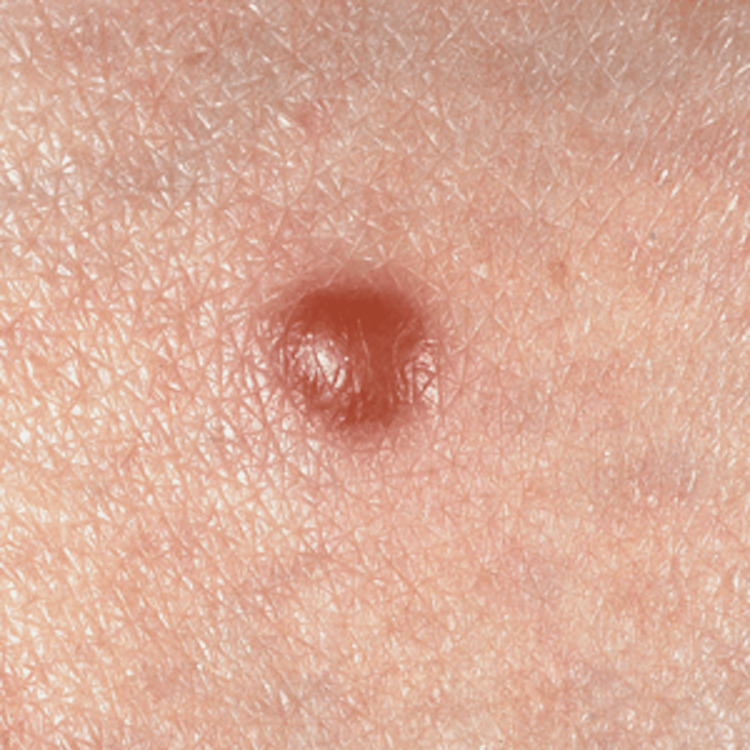 Figure 1
Peer Reviews
No public reviews on file for this paper yet. If you reviewed it on a platform where reviews are public (OpenReview, ICLR, NeurIPS, ICML), you can paste yours below so the community can read it here.
Videos
No videos yet. Explain this paper in a talk, walkthrough, or lecture? Add one.
Taxonomy
TopicsCutaneous Melanoma Detection and Management · Melanoma and MAPK Pathways · Cutaneous lymphoproliferative disorders research
Introduction
Cutaneous melanocytic tumor with CRTC1::TRIM11 fusion (CMTCT) is a rare and emerging entity with fewer than 50 reported cases to date [1]. These tumors are diagnostically challenging due to their overlapping histologic and immunophenotypic features with other melanocytic lesions, particularly cutaneous clear cell sarcoma (CCS), which was previously referred to as melanoma of soft parts. This report describes an atypical presentation of CMTCT and adds to the limited body of literature on this rare entity. We highlight its diagnostic complexities, clinical implications, and the importance of molecular testing for accurate classification.
Case presentation
A 50-year-old male presented to the clinic with a soft cystic lesion on his left shin. The lesion was large and inflamed. It measured 2.5 cm in diameter and 1.5 cm above the skin surface (Figure 1). It was asymptomatic but cosmetically concerning. Given the cystic appearance, incision and drainage were attempted, but yielded no fluid. A 5-mm punch biopsy was then performed.
A 2.5-cm, round, soft, red to flesh-colored, well-circumscribed papule on the anterior shin of a 50-year-old man.
Histopathological evaluation demonstrated a dermal tumor composed of atypical epithelioid cells clustered within a desmoplastic stroma. Immunohistochemical staining was positive for SRY-box transcription factor 10 (SOX-10) and microphthalmia-associated transcription factor (MITF), supporting melanocytic differentiation. Due to diagnostic challenges and resemblance to CCS, the specimen was sent to the National Institutes of Health/National Cancer Institute for further molecular analysis, including methylation profiling and DNA and RNA sequencing. RNA sequencing confirmed a CRTC1::TRIM11 fusion, establishing the diagnosis of CMTCT. The lesion was completely excised, and the patient was referred to the Johns Hopkins multidisciplinary surgical and medical oncology clinic. Given the lack of information on the long-term clinical course of CMTCT, the patient continued with close follow-up and dermatologic surveillance.
Discussion
Cutaneous melanocytic tumors with CRTC1::TRIM11 fusion often present as a slow-growing dermal or subcutaneous nodule, most commonly found on the extremities, followed by the trunk [2-3]. It affects a broad age range, with a median age of 43, and has no apparent gender predilection [1]. Grossly, CMTCT appears as a single well-circumscribed flesh-colored nodule but may exhibit inflammation or secondary changes that create a misleading clinical impression. Histologically, CMTCT is composed of atypical epithelioid, ovoid, and spindled cells clustered within a desmoplastic stroma. These cells are usually arranged in nests, bundles, or fascicles and contain prominent nucleoli with abundant pink cytoplasm [1].
CCS is the closest histologic mimic of CMTCT. CCS is a spindle cell neoplasm that generally arises in deep soft tissue but can occur intradermally [1]. Historically termed malignant melanoma of soft parts due to its morphologic and immunohistochemical similarities, CCS is now recognized as distinct from melanoma. It most often affects the extremities of adolescents and young adults and follows a slow but aggressive course, with a 20-year survival rate of approximately 10% and frequent recurrences and nodal metastases. CCS can be distinguished from CMTCT by its deeper anatomic location, multinucleated giant cells, and occasional clear cell morphology [1-2].
In a series of 40 CMTCT cases, half were initially misdiagnosed as CCS until genetic testing confirmed the diagnosis of CMTCT [1]. This underscores the importance of molecular characterization in distinguishing between the two entities. CMTCT is defined by a CRTC1::TRIM11 in-frame translocation, while CCS harbors either EWSR1::ATF1 or EWSR1::CREB1 cytogenetic translocations [1]. Routine melanoma-focused next-generation sequencing (NGS) panels do not typically include CRTC1 or TRIM11, so diagnosis often requires targeted RNA sequencing or fusion-based NGS assays [2]. Awareness of CMTCT can guide appropriate testing and facilitate prompt diagnosis.
Currently, CMTCT is treated with complete surgical excision. Definitive treatment guidelines have not been well established due to the novelty of the tumor [4]. Most cases follow an indolent course; however, the tumor has the potential to metastasize [1,4]. Reported cases include local recurrence, metastasis to regional lymph nodes, lung metastases, and aggressive clinical behavior in a subset of patients [5-6]. Due to the unpredictable nature and the scarcity of long-term data, regular and long-term dermatologic follow-up is necessary to elucidate the prognosis of this rare neoplasm.
Conclusions
This case describes an atypical cystic presentation of CMTCT in a middle-aged male, adding to the growing body of literature and expanding its recognized clinical spectrum. Dermatologists and dermatopathologists should remain alert to CMTCT and its potential mimics. Maintaining a high index of suspicion when evaluating ambiguous cutaneous lesions, along with prompt consideration of molecular testing, is essential to ensure accurate diagnosis. Given the absence of standardized management guidelines and variable clinical presentation of CMTCT, treatment should be individualized. The long-term clinical course of CMTCT is unclear, and vigilant surveillance is critical for the timely detection of recurrence or metastasis.
The reference list from the paper itself. Each links out to its DOI / PubMed record.
- 1Cutaneous melanocytic tumor with CRTC 1::TRIM 11 translocation: an emerging entity analyzed in a series of 41 cases Am J Surg Pathol Hanna J Ko JS Billings SD 145714664620223599357810.1097/PAS.0000000000001952 · doi ↗ · pubmed ↗
- 2Cutaneous melanocytic tumor with CRTC 1::TRIM 11 fusion: a case report Diagn Pathol Duan R He X Ma X Huang F Hu X 81920243818458610.1186/s 13000-023-01437-2PMC 10770898 · doi ↗ · pubmed ↗
- 3Dermal melanocytic tumor with CRTC 1-TRIM 11 fusion: report of two additional cases with review of the literature of an emerging entity J Cutan Pathol Parra O Bridge JA Busam KJ Shalin SC Linos K 9159244820213358618310.1111/cup.13984 · doi ↗ · pubmed ↗
- 4Utilization of single nucleotide polymorphism array in prognostication of cutaneous melanocytic tumor with CRTC 1::TRIM 11 fusion JAAD Case Rep Humen S Khan A Weston G 50526420254093363410.1016/j.jdcr.2025.07.002PMC 12418849 · doi ↗ · pubmed ↗
- 5CRTC 1::TRIM 11 cutaneous tumor: an update with local recurrence and lung metastasis in a pediatric patient J Cutan Pathol Vest BE Berrebi KG Stone MS Sargen MR Gerami P 1811835120243794491310.1111/cup.14556 PMC 11340804 · doi ↗ · pubmed ↗
- 6Cutaneous melanocytic tumour with CRTC 1::TRIM 11 fusion in a case with recurrent local lymph node and distant pulmonary metastases at early stage: aggressive rather than indolent?Histopathology Yang L Yin Z Wei J 3683718220233617751610.1111/his.14812 · doi ↗ · pubmed ↗