Development of a clinical tool to identify patients with early inflammatory arthritis at high risk of employment loss: analysis from the National Early Inflammatory Arthritis Audit
Ed Alveyn, Katie Bechman, Maryam Adas, Paul Amlani-Hatcher, Mini Dey, Sarah Gallagher, Mark Gibson, Bethan Jones, Daksh Mehta, Sam Norton, Elizabeth Price, Mark Russell, Karen Walker-Bone, Elizabeth MacPhie, James Galloway

TL;DR
A new tool was developed to identify patients with early inflammatory arthritis who are at high risk of losing their jobs, based on factors like occupation, age, and mental health.
Contribution
The study introduces a risk stratification tool using routinely collected clinical data to predict employment loss in early inflammatory arthritis patients.
Findings
Manual workers had a higher risk of employment loss compared to non-manual workers.
A risk score incorporating age, occupation, musculoskeletal burden, and mental health effectively stratified patients into low, medium, and high-risk groups.
The tool demonstrated good discrimination and calibration, with high-risk patients having nearly 20% employment loss.
Abstract
Work disability is an early consequence of inflammatory arthritis. Preventive interventions exist but access is limited, highlighting the need for risk stratification. We aimed to develop a tool using routinely collected data to identify patients at greatest risk of employment loss. This cohort study used data from the National Early Inflammatory Arthritis Audit. Patients ≥16 years with early inflammatory arthritis (EIA), enrolled May 2018–April 2025, employed at diagnosis and with three-month follow-up were included. The outcome was self-reported employment loss at 3 months. Predictors were occupation (manual vs non-manual), age, sex, disease activity (DAS28 > 5.1), mental health (anxiety/depression) and musculoskeletal burden (MSKHQ ≤25v > 25). Employment loss was modelled using Poisson regression. Model discrimination, calibration and bootstrap validation were assessed. A risk score…
Genes, proteins, chemicals, diseases, species, mutations and cell lines named across the full text — each resolved to its canonical identifier and authoritative record.
Click any figure to enlarge with its caption.
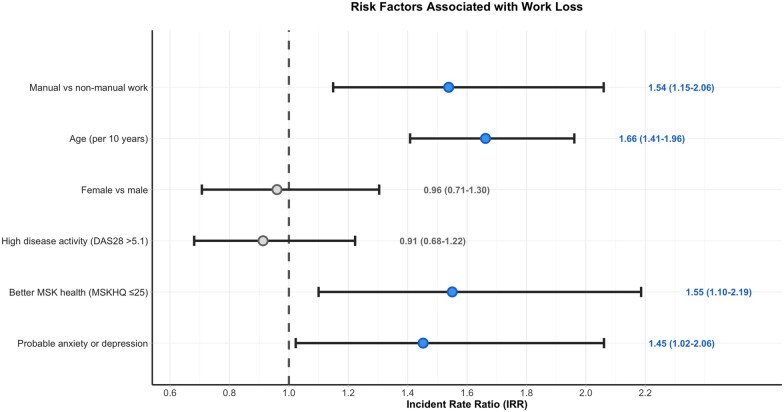 Figure 1
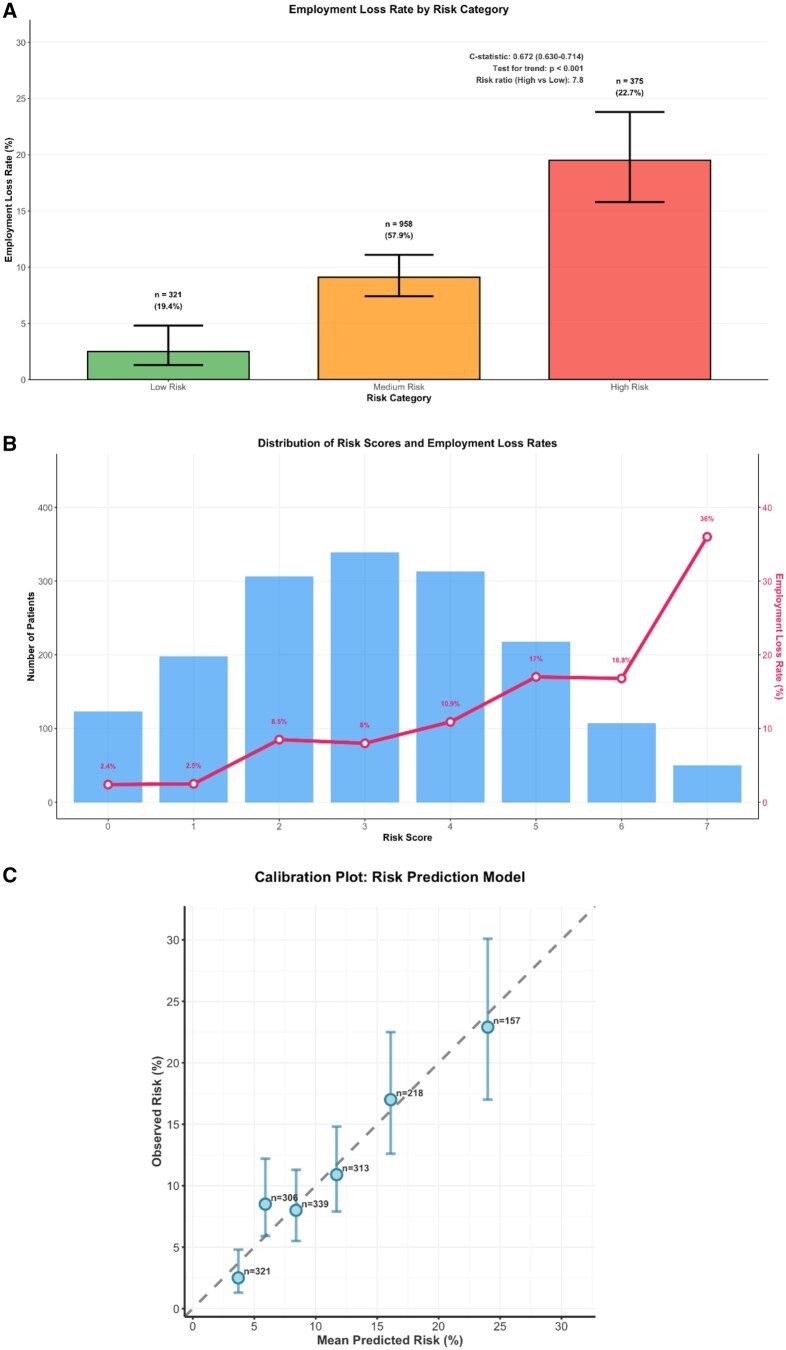 Figure 2
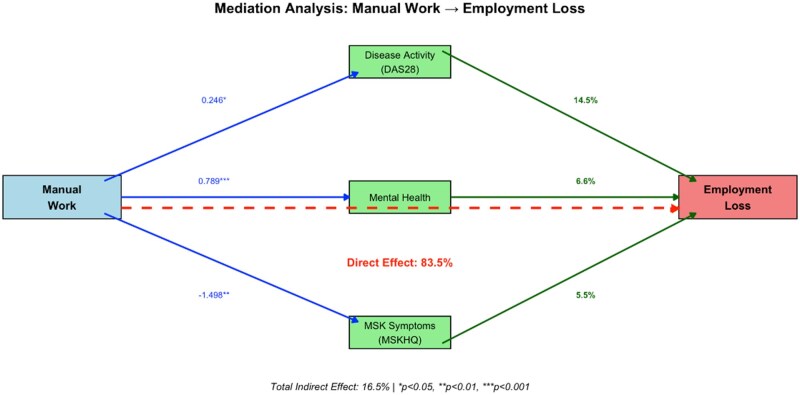 Figure 3
Peer Reviews
No public reviews on file for this paper yet. If you reviewed it on a platform where reviews are public (OpenReview, ICLR, NeurIPS, ICML), you can paste yours below so the community can read it here.
Videos
No videos yet. Explain this paper in a talk, walkthrough, or lecture? Add one.
Taxonomy
TopicsRheumatoid Arthritis Research and Therapies · Spondyloarthritis Studies and Treatments · Workplace Health and Well-being