Social support profiles and their association with sociodemographic and mental health characteristics among treatment-seeking adults in Arabic-speaking countries
Rayan El-Haj-Mohamad, Jana Stein, Nadine Stammel, Yuriy Nesterko, Birgit Wagner, Maria Böttche, Christine Knaevelsrud

TL;DR
This study explores how perceived social support from family, friends, and others affects mental health and quality of life among treatment-seeking adults in Arabic-speaking countries.
Contribution
The study identifies distinct social support profiles and their associations with mental health outcomes in Arabic-speaking populations.
Findings
Five distinct social support profiles were identified, with varying levels of psychopathological symptoms and quality of life.
Individuals with multi-source social support showed lower symptom severity and better quality of life compared to those with limited support.
Social support perception varies by country stability, with more stable countries reporting higher perceived support.
Abstract
High prevalences of mental disorders have been found among people from Arabic-speaking countries. Perceived social support has often been identified as a significant factor in the development of mental disorders, and the social environment is especially important with respect to treatment-seeking. However, the extent to which different sources of perceived social support are associated with mental health remains unclear. This cross-sectional study examined latent profiles based on perceived social support from different sources, and examined their relationship with sociodemographic characteristics, psychopathological symptom severity, and quality of life (QoL). The sample consisted of N = 5,977 treatment-seeking adults from different Arabic-speaking countries. Latent profile analysis was performed to identify subgroups of individuals based on perceived social support from family,…
Genes, proteins, chemicals, diseases, species, mutations and cell lines named across the full text — each resolved to its canonical identifier and authoritative record.
Click any figure to enlarge with its caption.
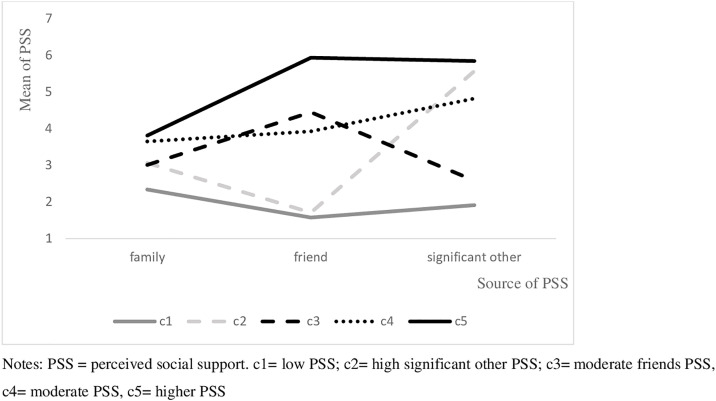 Figure 1
 Figure 2
 Figure 3
 Figure 4
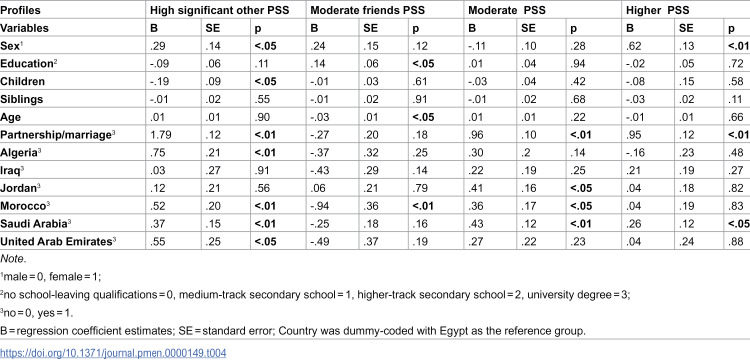 Figure 5
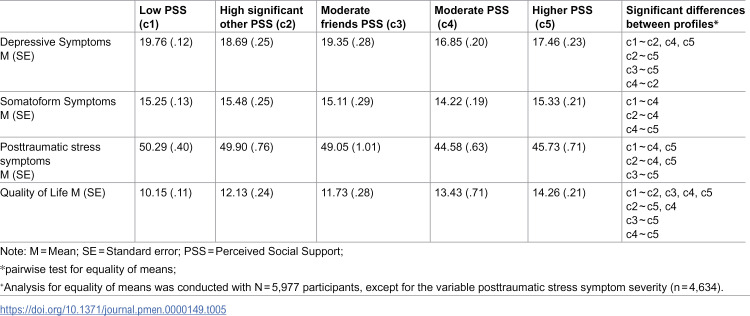 Figure 6
Peer Reviews
No public reviews on file for this paper yet. If you reviewed it on a platform where reviews are public (OpenReview, ICLR, NeurIPS, ICML), you can paste yours below so the community can read it here.
Videos
No videos yet. Explain this paper in a talk, walkthrough, or lecture? Add one.
Taxonomy
TopicsMental Health Treatment and Access · Health disparities and outcomes · Child and Adolescent Psychosocial and Emotional Development