Religiousness, sexual orientation, and depression among emerging adults in U.S. higher education: Findings from the Healthy Minds Study
Hans Oh, G. Tyler Lefevor, Edward B. Davis, Anna Zhu, Yaofang Hu, Trevor A. Pickering, Ai Koyanagi, Lee Smith

TL;DR
This study explores how religiousness affects depression in young adults in U.S. higher education, finding that the protective effects of religion may be weaker for sexual minorities.
Contribution
The study reveals that the mental health benefits of religiousness vary by sexual orientation and religious affiliation among emerging adults.
Findings
Higher religious importance was associated with lower odds of depression among heterosexual Christian and Muslim students.
The protective effect of religiousness was weaker or absent for sexual minority students, depending on their religious affiliation.
Among some religious groups, like Buddhists and Mormons, religiousness was linked to higher depression odds for bisexual students.
Abstract
Religiousness has long been found beneficial for mental health, although its protective effects may be attenuated for sexual minorities. We sought to examine the associations between religiousness and depression and whether these associations were moderated by religious affiliation and/or sexual orientation. We analyzed the dataset (N = 103,161 undergraduate and graduate students) from the Healthy Minds Study (2020-2021), which was an online survey administered at 140 higher education institutions across the United States. We used multivariable logistic regression to examine the associations between religiousness (religious affiliation and importance) and depression, adjusting for age, gender identity, and race/ethnicity. We tested for effects moderated by religious affiliation and/or sexual orientation. Associations between religious importance and depression varied across sexual…
Genes, proteins, chemicals, diseases, species, mutations and cell lines named across the full text — each resolved to its canonical identifier and authoritative record.
Click any figure to enlarge with its caption.
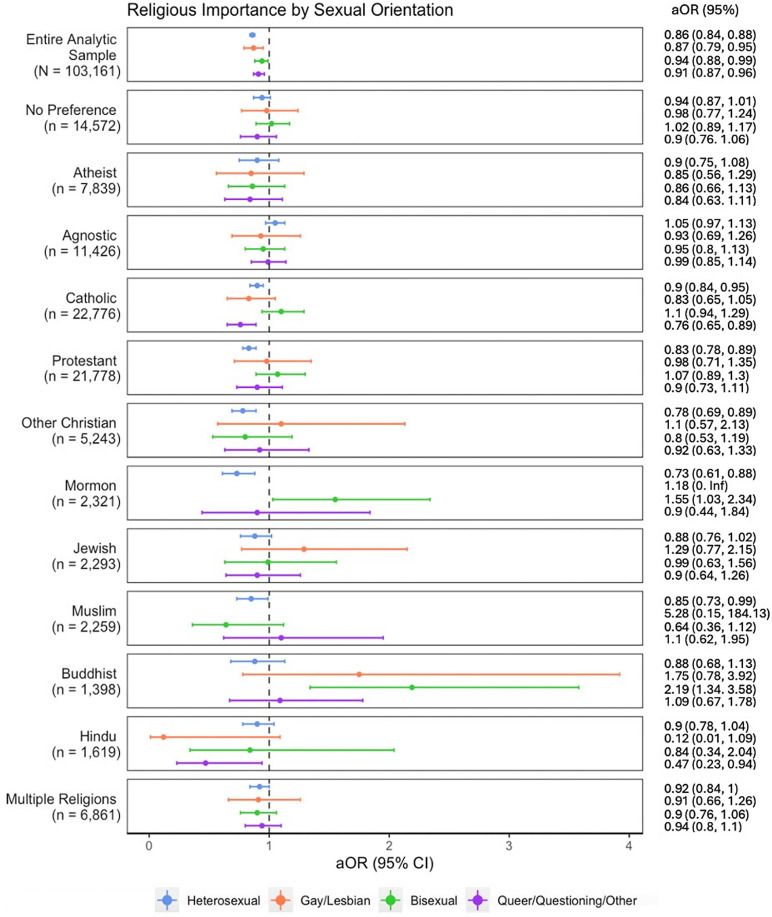 Figure 1
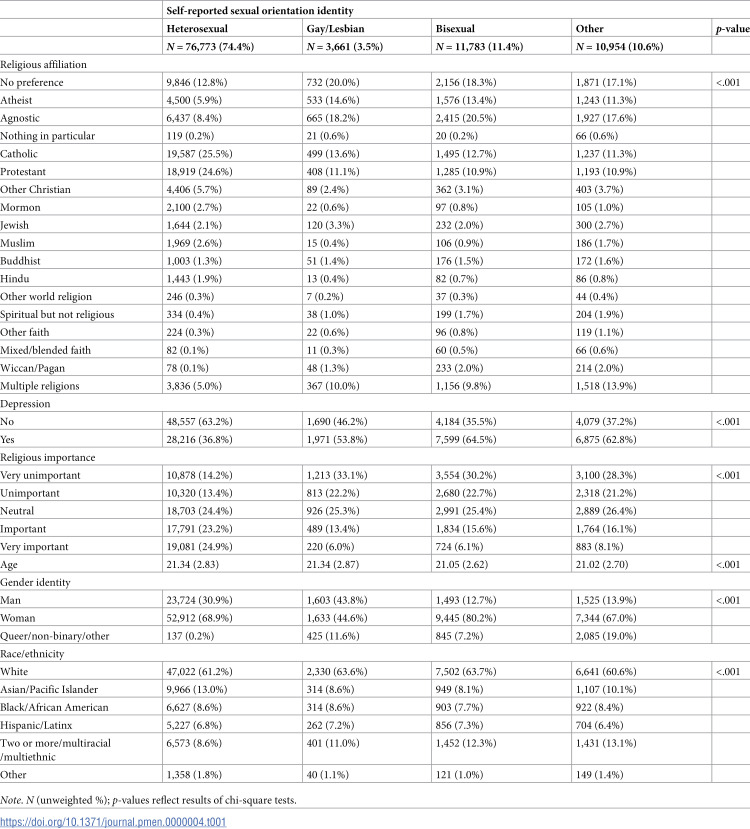 Figure 2
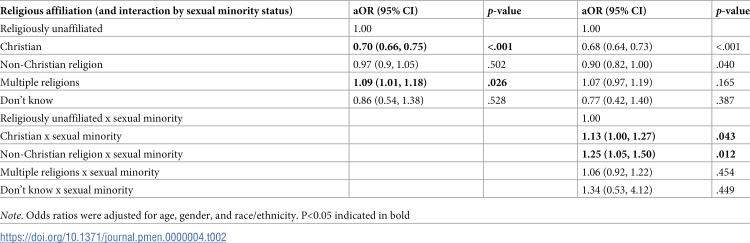 Figure 3
Peer Reviews
No public reviews on file for this paper yet. If you reviewed it on a platform where reviews are public (OpenReview, ICLR, NeurIPS, ICML), you can paste yours below so the community can read it here.
Videos
No videos yet. Explain this paper in a talk, walkthrough, or lecture? Add one.
Taxonomy
TopicsReligion, Spirituality, and Psychology · Racial and Ethnic Identity Research · Religion and Society Interactions