Moving beyond cumulative exposure scores: Profiles of adverse life experiences and associations with mental health outcomes among emerging adults
Cynthia M. Navarro Flores, Sara R. Berzenski

TL;DR
This study explores how different patterns of adverse life experiences affect mental health in young adults, finding that specific combinations of adversity are linked to worse outcomes than a general measure of cumulative stress.
Contribution
The study introduces a person-centered approach to identify distinct profiles of adverse life experiences and their unique associations with mental health outcomes.
Findings
Five distinct profiles of adverse life experiences were identified using Latent Class Analysis.
High Adversity and Child Maltreatment and Adult Victimization profiles were linked to the worst mental health outcomes.
The study highlights the importance of examining specific adversity patterns rather than cumulative exposure scores.
Abstract
Emerging adulthood is a period associated with increases in mental health problems, with those who have faced adverse life experiences (ALEs; adversity experienced during childhood and adulthood) being at greater risk for poor mental health outcomes. Experiencing multiple ALEs is associated with worse outcomes; however, limited research exists that looks at how patterns of ALEs relate to various mental health outcomes among emerging adults. The present study sought to understand patterns of co-occurring ALEs and their relationship to symptom severity of various mental health outcomes (e.g., depression, anxiety, substance use) by utilizing a person-centered approach (i.e., Latent Class Analysis; LCA). Data from 442 emerging adults from a university in Southern California were analyzed using Latent Class Analysis to identify various classes of ALEs. Analysis of variance with…
Genes, proteins, chemicals, diseases, species, mutations and cell lines named across the full text — each resolved to its canonical identifier and authoritative record.
Click any figure to enlarge with its caption.
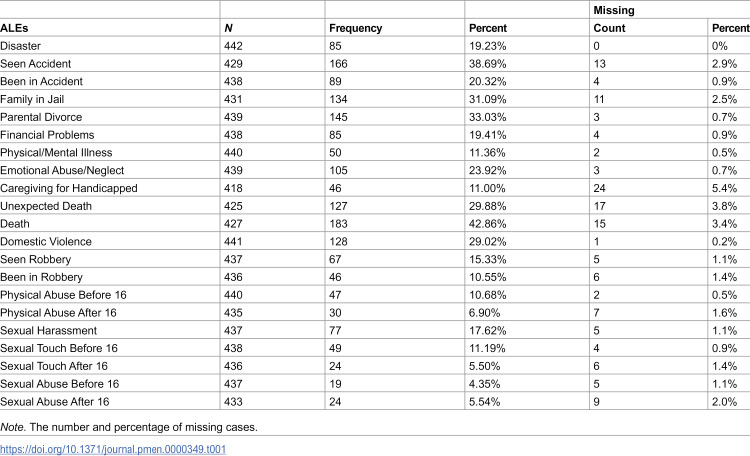 Figure 1
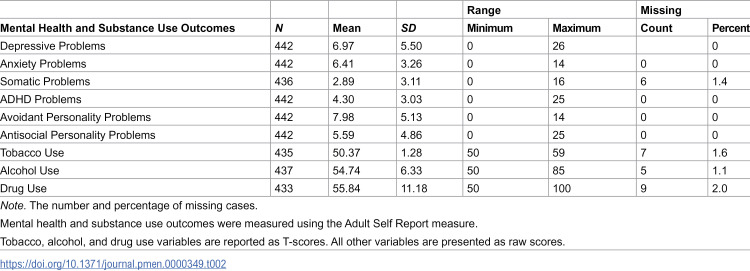 Figure 2
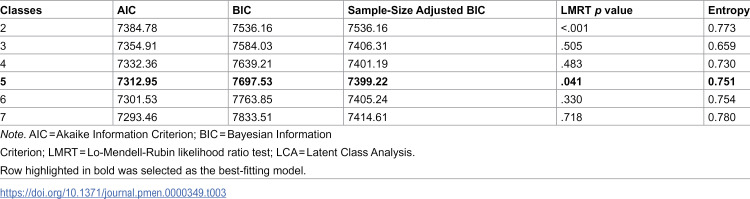 Figure 3
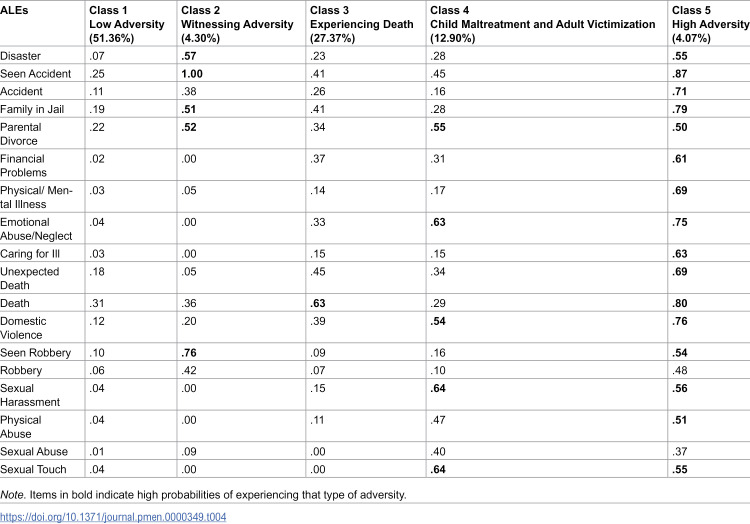 Figure 4
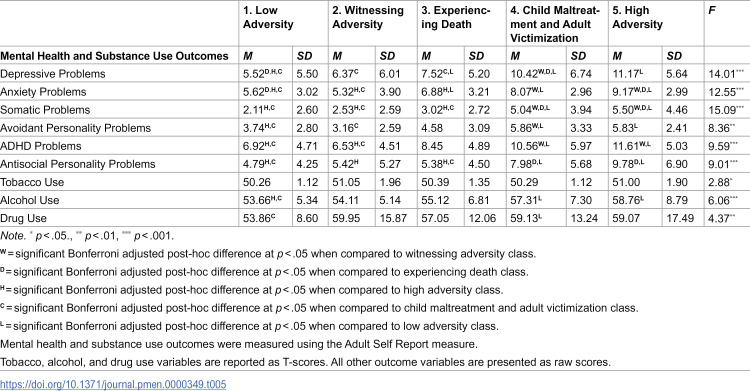 Figure 5
Peer Reviews
No public reviews on file for this paper yet. If you reviewed it on a platform where reviews are public (OpenReview, ICLR, NeurIPS, ICML), you can paste yours below so the community can read it here.
Videos
No videos yet. Explain this paper in a talk, walkthrough, or lecture? Add one.
Taxonomy
TopicsChild Abuse and Trauma · Posttraumatic Stress Disorder Research · Elder Abuse and Neglect