Predicting depression among men who have sex with men in Ghana using machine learning algorithms
Abdulzeid Yen Anafo, LaRon E. Nelson, Leo Wilton, Vincent Uwumboriyhie Gmayinaam, Selasi Ocloo, Avanti Dey, Karli Montague-Cardoso, Karli Montague-Cardoso

TL;DR
This study uses machine learning to predict depression in men who have sex with men in Ghana, finding that social isolation, stress, and stigma are key factors.
Contribution
The study introduces a novel application of tree-based machine learning models to identify depression predictors in a marginalized population in Ghana.
Findings
Random Forest achieved the highest accuracy in predicting depression among MSM in Ghana.
External social isolation, perceived stress, and stigma due to same-sex behavior were the most consistent predictors of depression.
Variables like resilience and community belonging also significantly contributed to depression prediction.
Abstract
Men who have sex with men (MSM) in Ghana face heightened risks of depression due to pervasive stigma, social exclusion, and legal discrimination. Despite this, depression remains underdiagnosed and undertreated in this population. This study applied seven tree-based machine learning (ML) models using tree-based classifiers: Decision Tree, Random Forest, Gradient Boosting, AdaBoost, XGBoost, LightGBM, and CatBoost to identify key psychosocial predictors of depression in a sample of 225 MSM aged 18–60 years. The dataset included sociodemographic variables, perceived stress (PSS), social isolation (internal and external), behavioural risk indicators, and stigma-related measures. After handling missing values, data were pre-processed with feature standardization and one-hot encoding. The Synthetic Minority Over-Sampling Technique was applied to address class imbalance. Model performance was…
Genes, proteins, chemicals, diseases, species, mutations and cell lines named across the full text — each resolved to its canonical identifier and authoritative record.
Click any figure to enlarge with its caption.
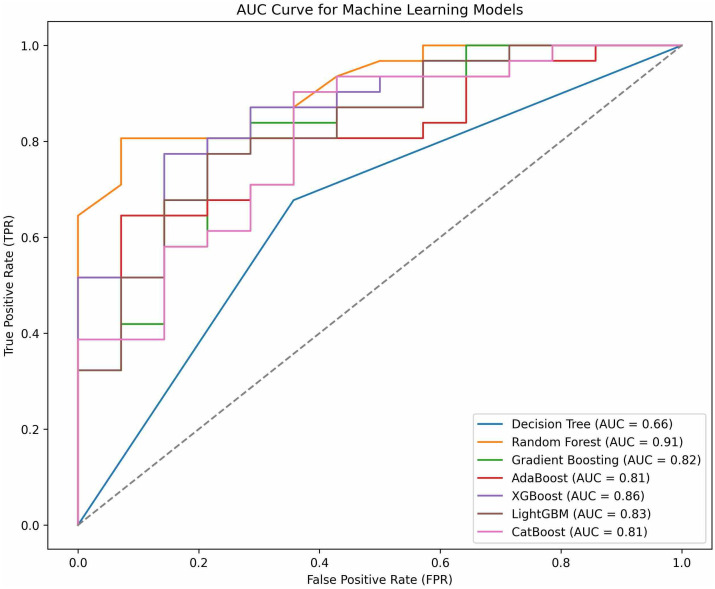 Figure 1
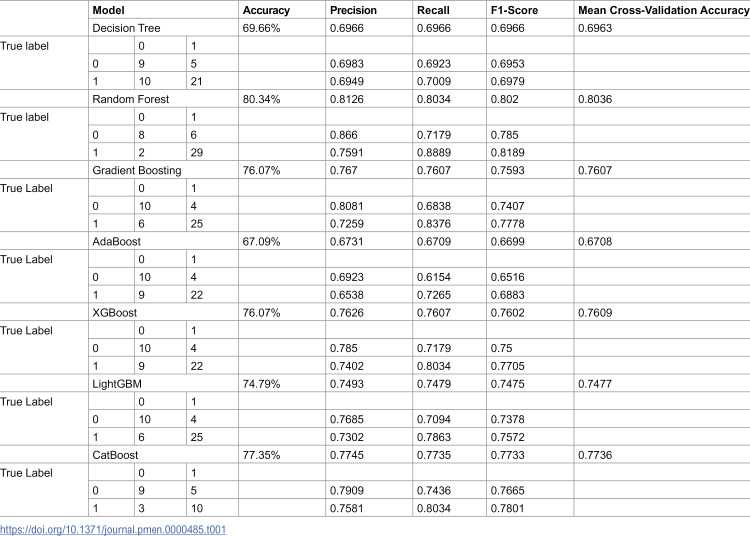 Figure 2
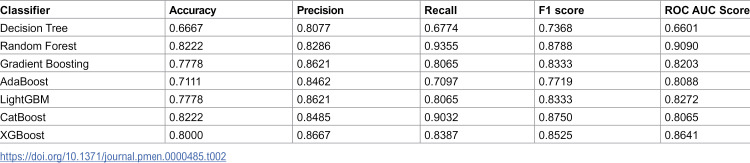 Figure 3
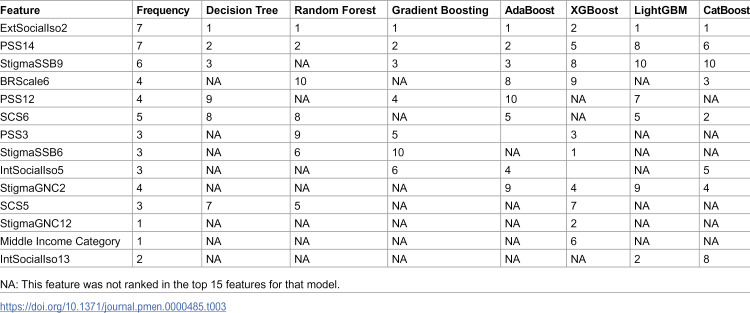 Figure 4
Peer Reviews
No public reviews on file for this paper yet. If you reviewed it on a platform where reviews are public (OpenReview, ICLR, NeurIPS, ICML), you can paste yours below so the community can read it here.
Videos
No videos yet. Explain this paper in a talk, walkthrough, or lecture? Add one.
Taxonomy
TopicsMental Health Treatment and Access · Mental Health via Writing · HIV/AIDS Research and Interventions