Seasonality in mood disorders: Probing association of accelerometer-derived physical activity with daylength and solar insolation
Oleg Kovtun, Sandra J. Rosenthal

TL;DR
This study explores how sunlight and day length affect mood disorders like depression and bipolar disorder by analyzing physical activity data.
Contribution
The study introduces a generalizable strategy using open-source digital tools to link sunlight exposure with motor activity in mood disorders.
Findings
Accelerometer-derived daytime physical activity is significantly associated with depression (p<0.001).
Photoperiod and solar insolation show significant associations with physical activity (p<0.001).
The study provides a strategy for using digital biomarkers to detect mood disturbances in seasonally affected individuals.
Abstract
Mood disorders are the leading cause of disability worldwide. Up to 30 percent of individuals with major depressive disorder (MDD) and bipolar disorder (BD) display a seasonal pattern of onset, a phenomenon now recognized in the official diagnostic manuals (DSM-5 and ICD-11). Very little is known about the influence of day length (photoperiod) and sunlight intensity (solar insolation) on seasonal patterns in MDD and BD. Here we report a quantitative approach to examine the relationship between sunlight measures and objectively measured motor activity patterns to understand environmental factors driving seasonality in MDD and BD. Our generalized linear model (GLM) assessment of the Depresjon dataset, which includes short-term (up to two weeks) motor activity recordings of 23 unipolar and bipolar depressed patients and 32 healthy controls recruited to the study at the University of Bergen…
Genes, proteins, chemicals, diseases, species, mutations and cell lines named across the full text — each resolved to its canonical identifier and authoritative record.
Click any figure to enlarge with its caption.
 Figure 1
 Figure 2
 Figure 3
 Figure 4
 Figure 5
 Figure 6
 Figure 7
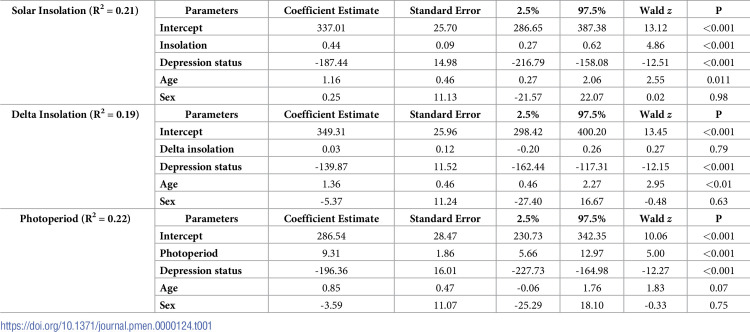 Figure 8
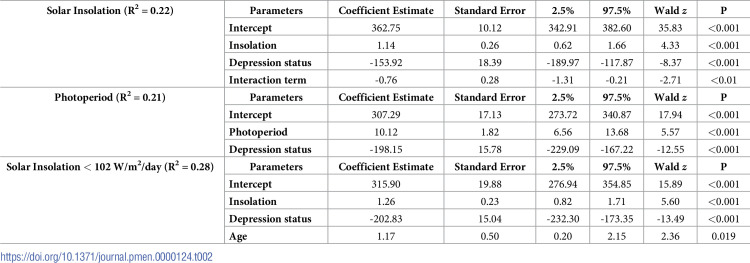 Figure 9
Peer Reviews
No public reviews on file for this paper yet. If you reviewed it on a platform where reviews are public (OpenReview, ICLR, NeurIPS, ICML), you can paste yours below so the community can read it here.
Videos
No videos yet. Explain this paper in a talk, walkthrough, or lecture? Add one.
Taxonomy
TopicsCircadian rhythm and melatonin · Sleep and related disorders · Psychological and Temporal Perspectives Research