A practical assessment of hamstring muscle endurance and fatigue using the maximum-speed single-leg bridge test
Yuto Sano, Masashi Kawabata, Bas Van Hooren, Yuki Sumiya, Masaki Murase, Yuto Watanabe, Yasuhisa Shimono, Tomonori Kenmoku, Hiroyuki Watanabe, Naonobu Takahira

TL;DR
This study evaluates a new test to measure hamstring muscle endurance and fatigue, finding that speed and force are better indicators of fatigue than height.
Contribution
The study introduces the maximum-speed single-leg bridge test as a practical method to assess hamstring fatigue and identifies effective indicators of fatigue.
Findings
The MS-SLBT induces hamstring fatigue, as shown by decreased median frequency and increased amplitude in the ST and BF.
Buttock-raising speed and heel-bearing force decrease with fatigue, making them useful practical indicators.
Buttock-raising height does not change significantly and is not a sensitive fatigue indicator.
Abstract
The single-leg bridge test aims to evaluate hamstring muscle endurance but lacks speed regulation and requires prolonged testing, which may compromise sensitivity and reliability. The maximum-speed single-leg bridge test (MS-SLBT) was developed to address these limitations, but its ability to induce hamstrings fatigue remains unclear. Furthermore, it is unknown which practical outcomes, such as buttock-raising height or speed, best reflect this fatigue. Therefore, we assessed changes in muscle activation, buttock-raising height, buttock-raising speed, and heel-bearing force during 20 repetitions of the MS-SLBT. This cross-sectional observational study included 26 male recreational athletes. Surface electromyography was used to assess fatigue by measuring the median frequency (MDF) and amplitude of the semitendinosus (ST), biceps femoris (BF), and gluteus maximus (GM). Motion…
Genes, proteins, chemicals, diseases, species, mutations and cell lines named across the full text — each resolved to its canonical identifier and authoritative record.
Click any figure to enlarge with its caption.
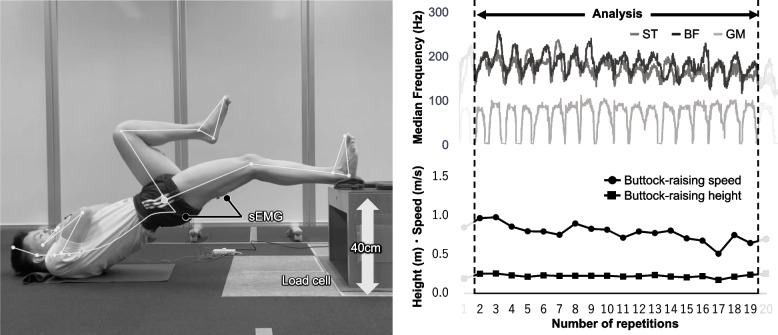 Figure 1
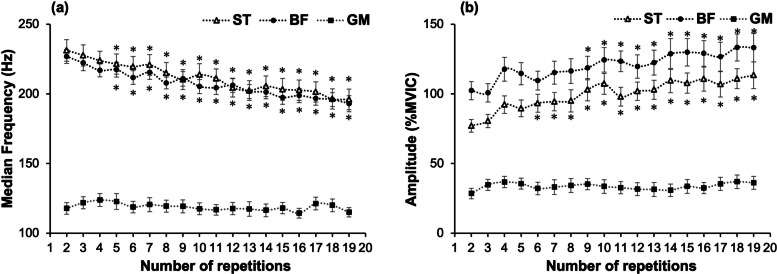 Figure 2
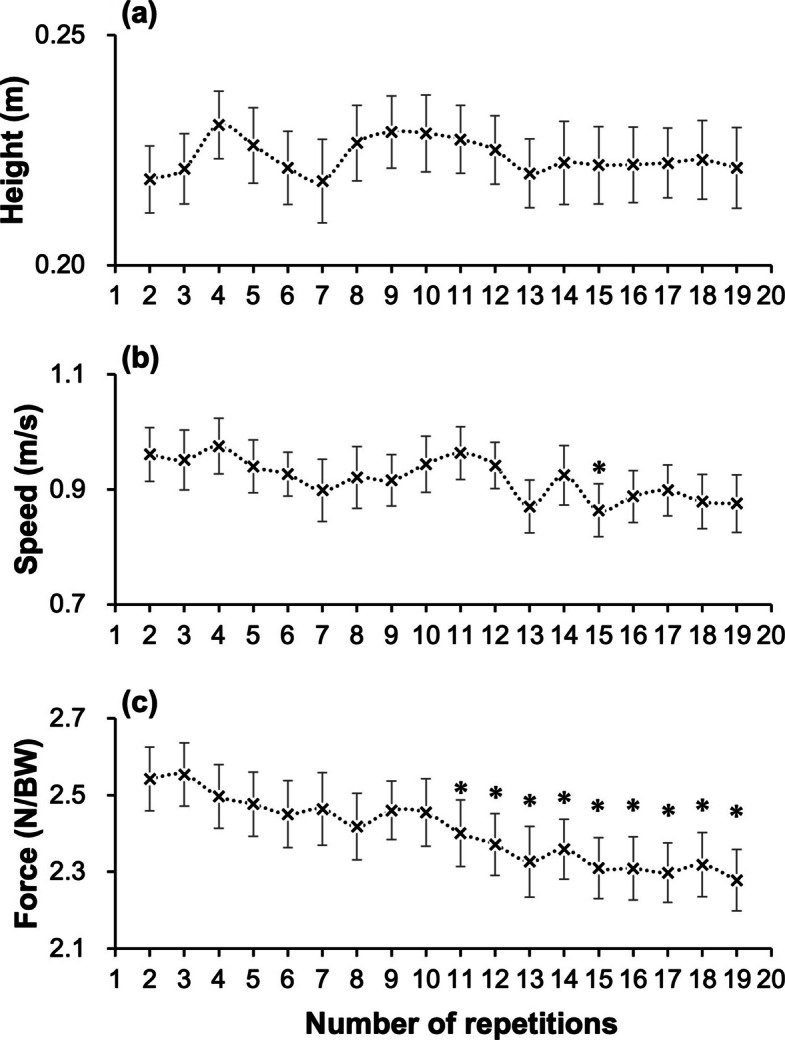 Figure 3
Peer Reviews
No public reviews on file for this paper yet. If you reviewed it on a platform where reviews are public (OpenReview, ICLR, NeurIPS, ICML), you can paste yours below so the community can read it here.
Videos
No videos yet. Explain this paper in a talk, walkthrough, or lecture? Add one.
Taxonomy
TopicsSports injuries and prevention · Sports Performance and Training · Knee injuries and reconstruction techniques