Clinicians’ tolerance for uncertainty and communication about uncertainty with older adults –a standardized patient assessment study
Marij Hillen, Charlotte Nijskens, Sharon Wezeman, Remco Franssen, Ellen Smets

TL;DR
This study examines how resident physicians handle and communicate uncertainty when caring for older adults, finding that they often express uncertainty implicitly and focus on information rather than emotions.
Contribution
The study introduces a standardized patient assessment to explore how resident physicians' tolerance for uncertainty influences communication and patient involvement in decision-making.
Findings
Residents expressed uncertainty an average of 14 times per consultation, mostly implicitly.
Residents primarily used information-focused approaches to communicate uncertainty.
Higher patient involvement in decision-making was linked to more frequent uncertainty expressions by residents.
Abstract
Uncertainty is omnipresent in care for older adults. Resident-physicians may be challenged to manage and communicate about such uncertainty. We aimed to 1) describe how resident-physicians discussed uncertainty with an older adult patient and involved them in decisions; and 2) assess how resident-physicians’ tolerance for uncertainty predicted communication about uncertainty and efforts towards patient involvement. A video-recorded, standardized patient assessment study was conducted involving resident-physicians in internal medicine. Participants conducted online consultations with a standardized geriatric patient. Self-report questionnaires assessed participants’ tolerance for uncertainty, feelings of ambivalence, and satisfaction with communication. Systematic observational coding assessed how residents communicated about uncertainty and involved the patient in decision-making.…
Genes, proteins, chemicals, diseases, species, mutations and cell lines named across the full text — each resolved to its canonical identifier and authoritative record.
Click any figure to enlarge with its caption.
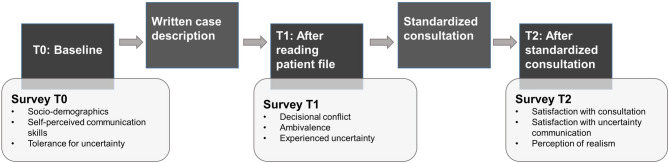 Figure 1
Peer Reviews
No public reviews on file for this paper yet. If you reviewed it on a platform where reviews are public (OpenReview, ICLR, NeurIPS, ICML), you can paste yours below so the community can read it here.
Videos
No videos yet. Explain this paper in a talk, walkthrough, or lecture? Add one.
Taxonomy
TopicsClinical Reasoning and Diagnostic Skills · Patient-Provider Communication in Healthcare · Intensive Care Unit Cognitive Disorders