Coevaporated Formamidinium Tin Triiodide with Suppressed p‑Type Self-Doping
Junhyoung Park, Andrea Olivati, Mirko Prato, Min Kim, Annamaria Petrozza

TL;DR
A new method for making high-quality FASnI3 thin films without additives improves their stability and reduces defects.
Contribution
A solvent-free coevaporation method that suppresses self-doping and oxidation in FASnI3 thin films.
Findings
Coevaporated FASnI3 films have a bandgap of 1.31 eV, matching theoretical predictions.
The method reduces Sn2+ oxidation and self-doping, leading to fewer defects.
The process produces highly crystalline thin films without additives or reducing agents.
Abstract
Coevaporation of formamidinium tin triiodide (FASnI3) precursors, without any additives or reducing agents, leads to the growth of a highly crystalline thin films which show a bandgap around 1.31 eV, closely matching the theoretical value predicted from the ideal single crystal structure of FASnI3. The polycrystalline thin film presents a lower tendency toward Sn2+ to Sn4+ oxidation and highly reduced tendency toward self-doping, demonstrating, overall, an improved resistance to defects formation. These findings suggest solvent-free coevaporation processes as a promising route for high quality Sn-based perovskite polycrystalline thin films.
Genes, proteins, chemicals, diseases, species, mutations and cell lines named across the full text — each resolved to its canonical identifier and authoritative record.
Click any figure to enlarge with its caption.
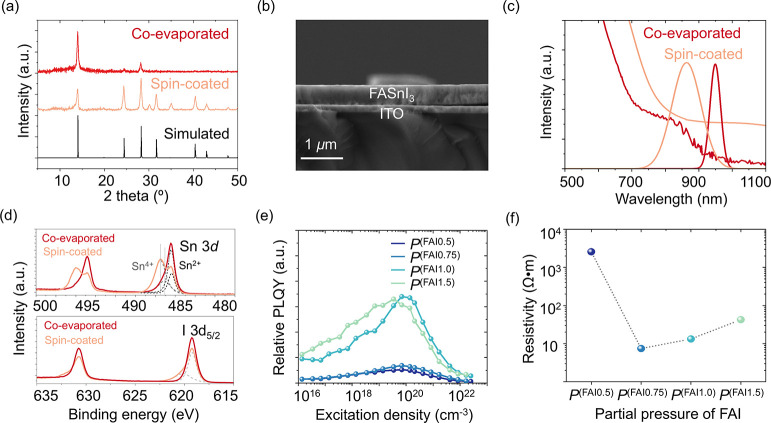 Figure 1
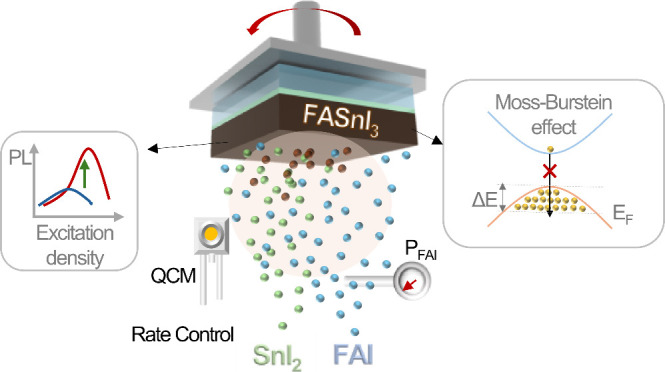 Figure 2
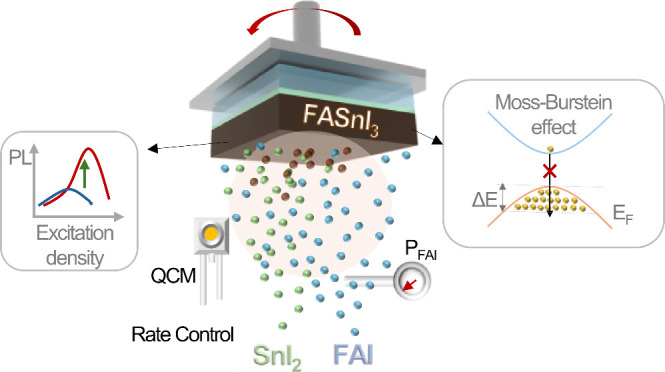 Figure 3
Peer Reviews
No public reviews on file for this paper yet. If you reviewed it on a platform where reviews are public (OpenReview, ICLR, NeurIPS, ICML), you can paste yours below so the community can read it here.
Videos
No videos yet. Explain this paper in a talk, walkthrough, or lecture? Add one.
Taxonomy
TopicsPerovskite Materials and Applications · Electronic and Structural Properties of Oxides · Inorganic Chemistry and Materials