Congenital anomalies after first-trimester dydrogesterone therapy during in vitro fertilization
Wan Yang, Lin Zeng, Lixue Chen, Rui Yang, Haiyan Wang, Ping Liu, Ying Lian, Rong Li, Hongbin Chi, Jie Qiao

TL;DR
This study found no increased risk of birth defects in newborns exposed to dydrogesterone during early pregnancy, with some specific anomalies showing lower rates.
Contribution
The study provides new evidence on the safety of dydrogesterone use during in vitro fertilization in relation to congenital anomalies.
Findings
DYG-exposed newborns had a significantly lower overall congenital anomaly rate compared to unexposed groups.
Musculoskeletal malformations were notably lower in DYG-exposed newborns, especially in frozen embryo cycles.
No increased risk of congenital anomalies was found in multivariate analysis adjusted for confounders.
Abstract
Congenital anomalies are a critical public health concern and warrant prioritization in research. However, the teratogenic potential of dydrogesterone (DYG) remains uncertain and a subject of ongoing debate. This retrospective cohort study included patients undergoing embryo transfer between January 2010 and December 2018. It analyzed 124,815 embryo transfer cycles (80,103 [64.2%] fresh; 44,712 [35.8%] frozen), resulting in 52,175 live births. Newborns were stratified by maternal luteal phase support (DYG-exposed vs. unexposed). Patients with known congenital malformation risk factors were excluded. Congenital anomaly incidence was compared between groups. Stratified analysis and multivariate logistic regression models adjusting for confounders were employed. The total congenital anomaly rate was significantly lower in DYG-exposed newborns compared to unexposed groups (6.05‰ vs.…
Genes, proteins, chemicals, diseases, species, mutations and cell lines named across the full text — each resolved to its canonical identifier and authoritative record.
Click any figure to enlarge with its caption.
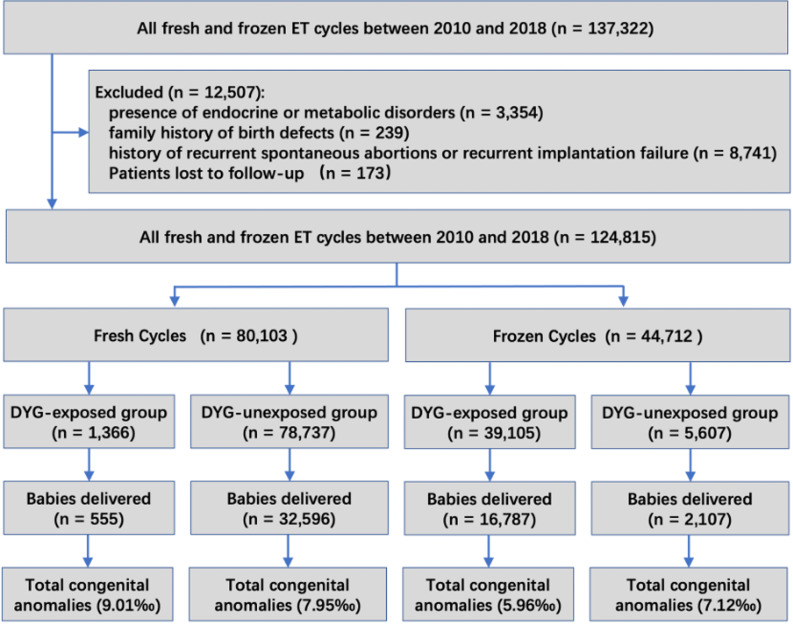 Figure 1
Peer Reviews
No public reviews on file for this paper yet. If you reviewed it on a platform where reviews are public (OpenReview, ICLR, NeurIPS, ICML), you can paste yours below so the community can read it here.
Videos
No videos yet. Explain this paper in a talk, walkthrough, or lecture? Add one.
Taxonomy
TopicsOvarian function and disorders · Reproductive Health and Contraception · Sexual Differentiation and Disorders