Electroacupuncture to point Baihui confers anxiolytic effects by promoting oxytocin release from PVN in Mice
Hengxin Gong, Ban Feng, Ke Cheng, Runsong Cao, Ruifan Zhao, Zaihua Zhao, Ying-ying Zhang, Dake Song, Min Wang, Xu-bo Li, Yu-mei Wu, Shuibing Liu, Kun Zhang

TL;DR
Electroacupuncture at the Baihui point reduces anxiety in mice by boosting oxytocin release from the paraventricular nucleus of the hypothalamus.
Contribution
This study identifies a specific neural pathway and molecular mechanism through which electroacupuncture at Baihui alleviates anxiety.
Findings
EA at Baihui (GV20) with intermittent stimulation showed the strongest anxiolytic effects in mice.
PVN-derived oxytocin signaling is essential for the anxiolytic effects of Baihui EA.
Oxytocin receptor antagonism abolished the anxiety-reducing effects of Baihui EA.
Abstract
Anxiety disorders—including generalized anxiety disorder, posttraumatic stress disorder, and social anxiety disorder—are highly prevalent psychiatric conditions that impose substantial clinical and social burdens. Preclinical and clinical studies have shown that electroacupuncture (EA) can effectively alleviate anxiety-like behaviors; however, the specific neural circuits and molecular mechanisms underlying EA’s therapeutic effects remain incompletely elucidated. We first assessed the impacts of EA at four classical acupoints—Zusanli (ST36), Neiguan (PC6), Tianshu (ST25), and Baihui (GV20)—delivered with distinct stimulation waveforms on anxiety-like behaviors in conventionally housed mice, using the elevated plus maze and open field test paradigms. To identify the neural circuit underlying the behavioral effects of Baihui (GV20) EA, we employed pseudorabies virus expressing enhanced…
Genes, proteins, chemicals, diseases, species, mutations and cell lines named across the full text — each resolved to its canonical identifier and authoritative record.
Click any figure to enlarge with its caption.
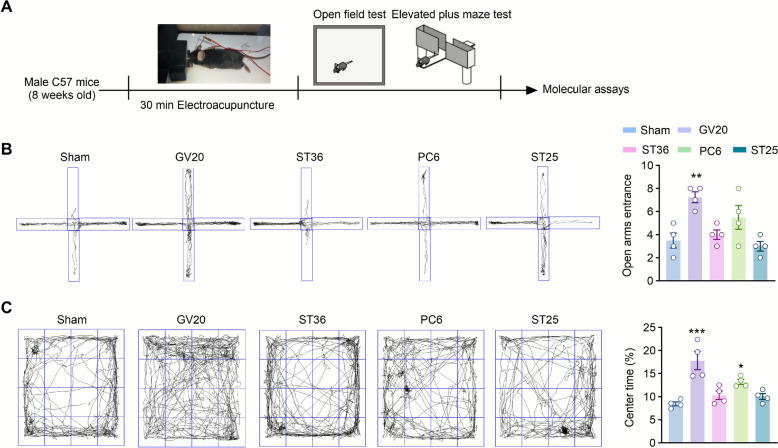 Figure 1
 Figure 2
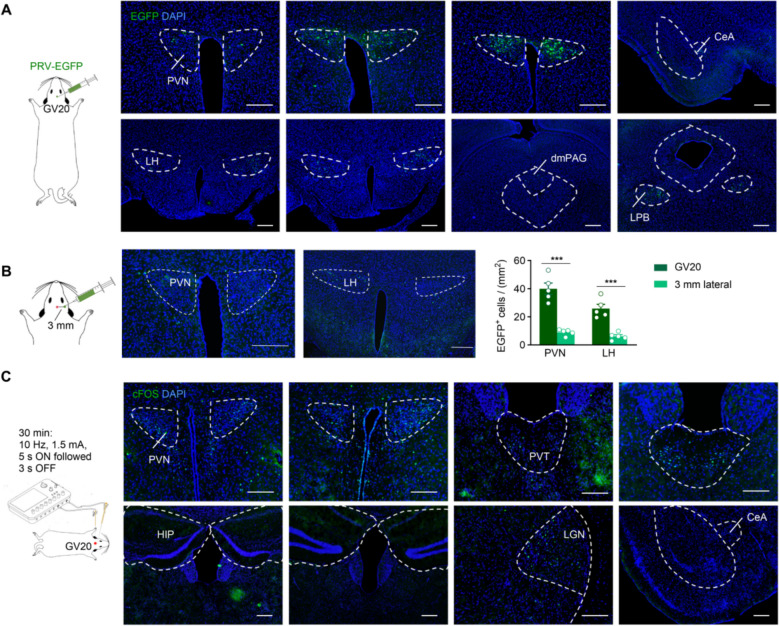 Figure 3
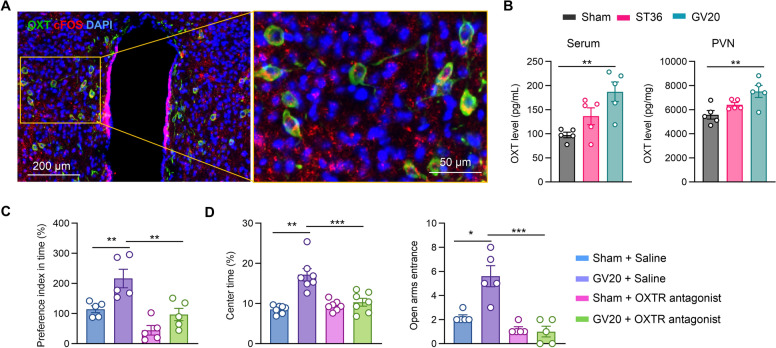 Figure 4
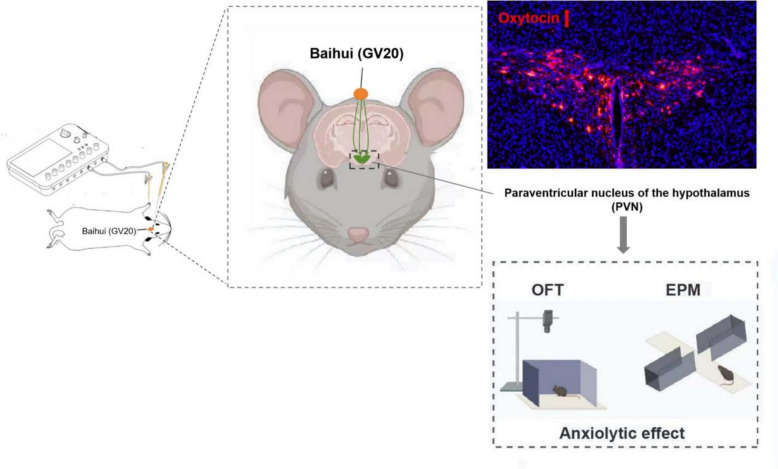 Figure 5
Peer Reviews
No public reviews on file for this paper yet. If you reviewed it on a platform where reviews are public (OpenReview, ICLR, NeurIPS, ICML), you can paste yours below so the community can read it here.
Videos
No videos yet. Explain this paper in a talk, walkthrough, or lecture? Add one.
Taxonomy
TopicsNeuroendocrine regulation and behavior · Acupuncture Treatment Research Studies · Stress Responses and Cortisol