Efficacy of Credelio Quattro™ (lotilaner, moxidectin, praziquantel, and pyrantel chewable tablets) and Credelio™ (lotilaner) chewable tablets in the prevention of Borrelia burgdorferi transmission from infected Ixodes scapularis in dogs
William Anderson, Molly D. Savadelis, Scott Wiseman, Abdelmoneim Mansour, Riaan Maree, Lisa Young

TL;DR
This study shows that Credelio Quattro and Credelio effectively prevent Lyme disease transmission in dogs by blocking tick-borne bacteria for a month.
Contribution
Demonstrates the efficacy of Credelio Quattro and Credelio in preventing Borrelia burgdorferi transmission from ticks in dogs.
Findings
Control dogs had high B. burgdorferi infection rates after tick exposure.
Credelio-treated dogs showed no B. burgdorferi infection during the study period.
Credelio Quattro provided a month-long prevention of Lyme disease transmission.
Abstract
Borrelia burgdorferi, the causative agent of Lyme disease, is a zoonotic vector-borne pathogen transmitted by various Ixodes tick species. Lyme disease, while commonly asymptomatic, can induce fever and intermittent lameness in dogs. Highly effective acaricidal products with a rapid onset of action along with prompt removal of attached ticks are important aspects of successful Lyme disease prevention strategies. Two studies were conducted with a total of 30 dogs each. Dogs were randomized to receive a control sham dose, Credelio Quattro, or Credelio. Treatment was administered on Day 0 in a fed state. On Day 28, all dogs were experimentally infested with wild-caught adult Ixodes scapularis. Blood samples for B. burgdorferi antibody analysis utilizing the SNAP 4Dx Plus and Lyme Quant C6 tests were collected on Days 27, 49, 63, 77, 91, and 105. Skin biopsies were collected from four…
Genes, proteins, chemicals, diseases, species, mutations and cell lines named across the full text — each resolved to its canonical identifier and authoritative record.
Click any figure to enlarge with its caption.
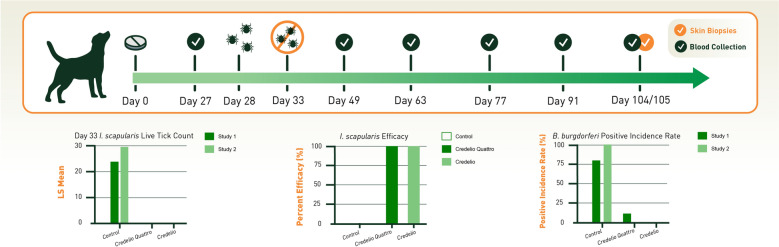 Figure 1
Peer Reviews
No public reviews on file for this paper yet. If you reviewed it on a platform where reviews are public (OpenReview, ICLR, NeurIPS, ICML), you can paste yours below so the community can read it here.
Videos
No videos yet. Explain this paper in a talk, walkthrough, or lecture? Add one.
Taxonomy
TopicsVector-borne infectious diseases · Parasitic Diseases Research and Treatment · Mollusks and Parasites Studies