Flash-Infrared-Annealing-Enabled High-Temperature Sintering of Photoanodes on Flexible Polymer Foils for Ultralight Photovoltaics
David Bradford, Iacopo Benesperi, Hiroaki Jinno, Naveen Bhati, Roberto Avilés-Betanzos, François Maréchal, Gerko Oskam, Chih-Jen Shih, Michael Grätzel, Sandy Sánchez, Kevin Sivula, Marina Freitag

TL;DR
This paper introduces a new method to sinter solar cell components on flexible plastic using infrared heating, enabling lightweight and efficient photovoltaic devices.
Contribution
The novel use of flash infrared annealing enables high-temperature sintering on flexible substrates without damaging them.
Findings
Flexible DSCs achieved a power conversion efficiency of 5.10% under standard illumination.
Localized IR sintering reduces processing barriers for roll-to-roll printable solar cells.
Devices have 51× higher specific power compared to glass-based equivalents.
Abstract
Ultralight photovoltaics are indispensable wherever every gram counts, from self-powered Internet of Things nodes to free-hanging greenhouse covers. In dye-sensitized solar cells (DSCs) the required 450–500 °C sintering of the mesoporous TiO2 (m-TiO2) photoanode has so far limited the use of polymer substrates. Here, we replace the furnace step with flash infrared annealing. Near-IR radiation heats the 3.5 μm m-TiO2 layer to 550 ± 20 °C while keeping a 12.5 μm indium-tin-oxide/polyimide foil below 170 °C with a water-cooled heat-sink. We obtain complete removal of organic binders, while the substrate sheet resistance increases modestly from 60.2 to 129.8 Ω sq–1. Flexible DSCs reach power conversion efficiencies of 5.10% under AM 1.5G illumination, a record value for DSCs on sub-25 μm plastics. The finished devices deliver 51× the specific power of equivalent glass devices. A…
Genes, proteins, chemicals, diseases, species, mutations and cell lines named across the full text — each resolved to its canonical identifier and authoritative record.
Click any figure to enlarge with its caption.
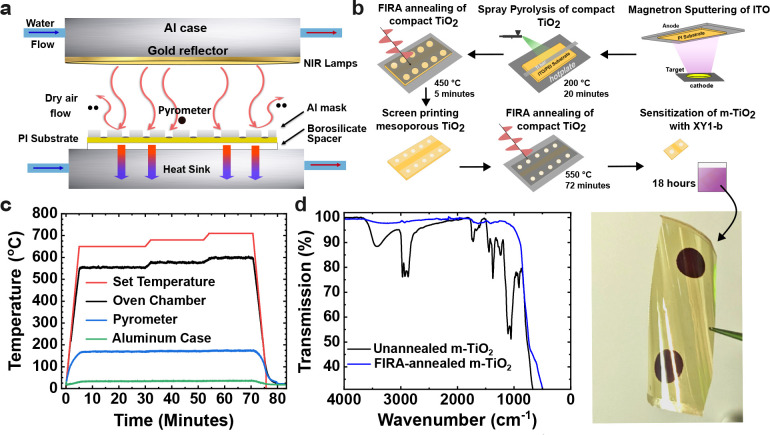 Figure 1
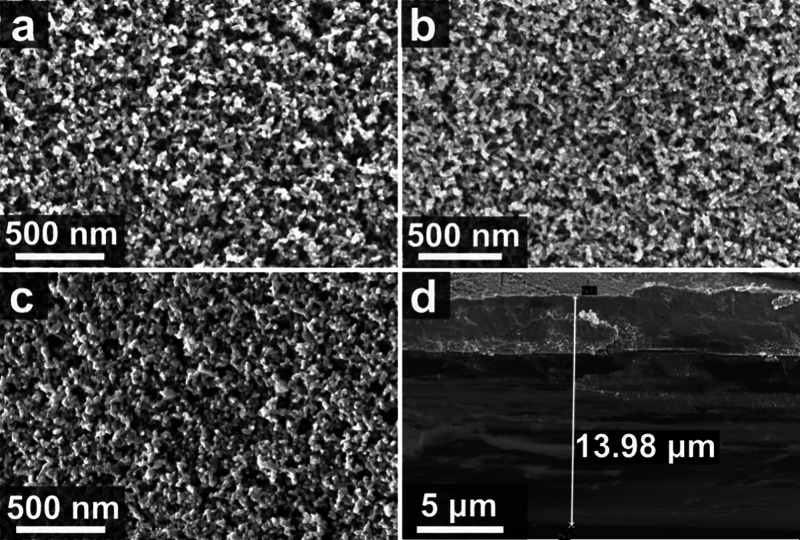 Figure 2
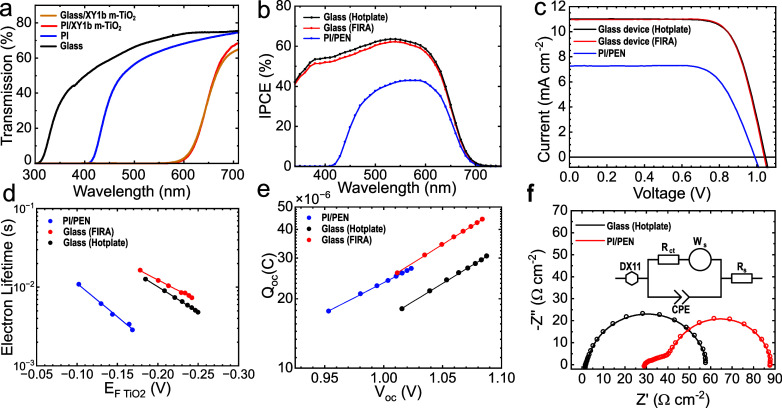 Figure 3
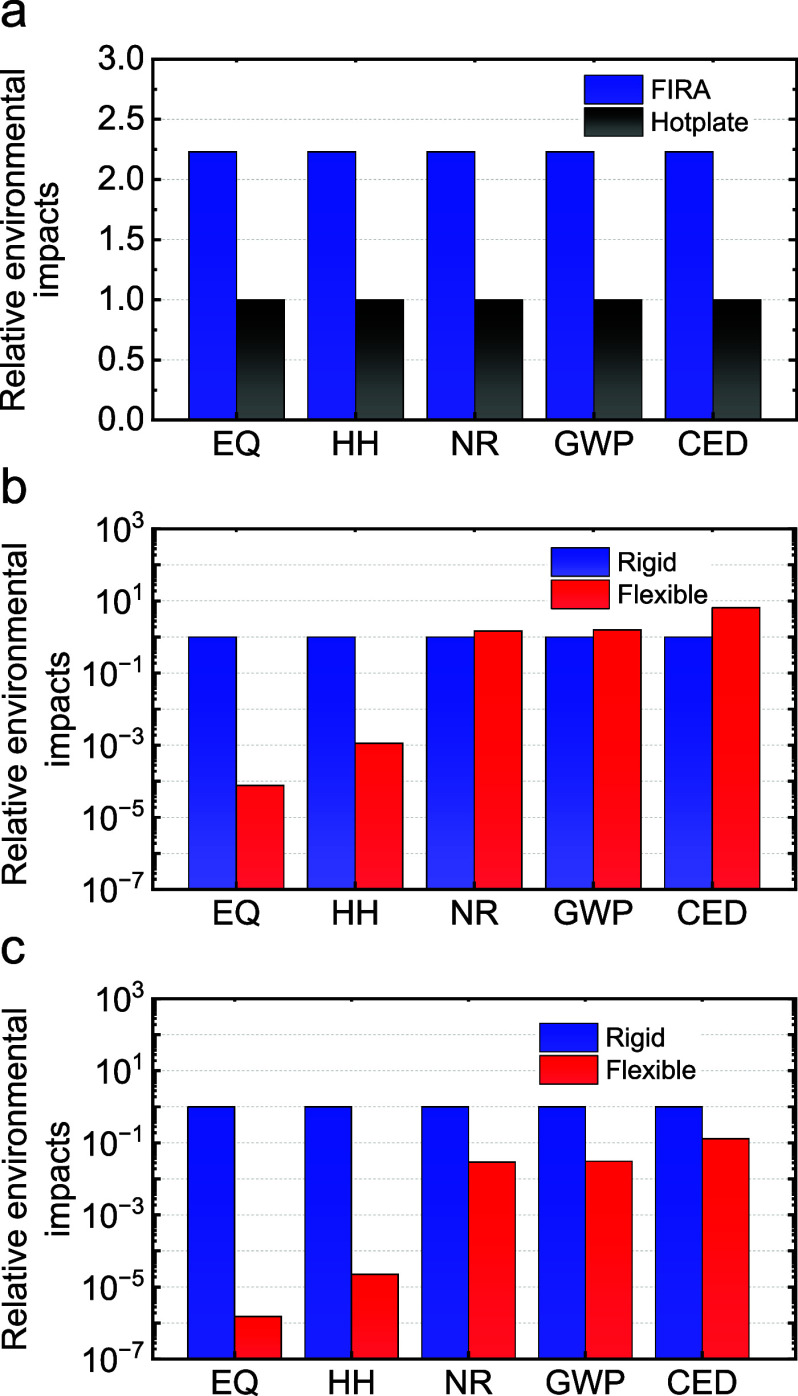 Figure 4
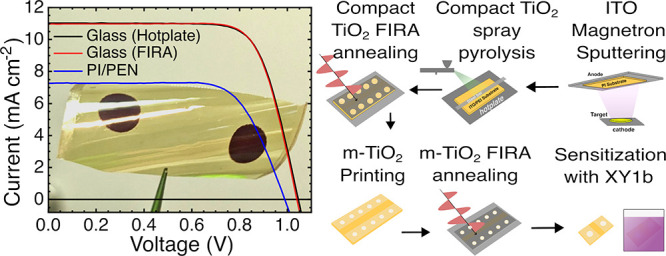 Figure 5
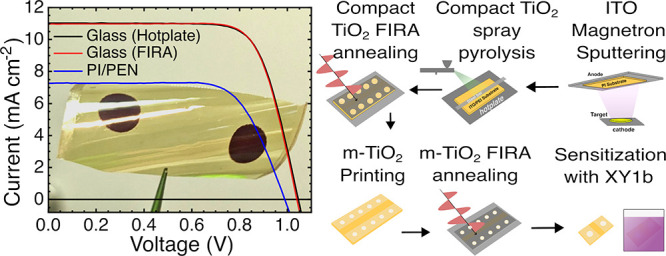 Figure 6
 Figure 7
Peer Reviews
No public reviews on file for this paper yet. If you reviewed it on a platform where reviews are public (OpenReview, ICLR, NeurIPS, ICML), you can paste yours below so the community can read it here.
Videos
No videos yet. Explain this paper in a talk, walkthrough, or lecture? Add one.
Taxonomy
TopicsTiO2 Photocatalysis and Solar Cells · Nanomaterials and Printing Technologies · Pigment Synthesis and Properties