N‑Boryl Pyridyl Radical-Mediated Reductive Homocoupling of Arylsulfonyl Chlorides to Diaryl Disulfides
Yuan-Kai Cheng, Chien-Miao Li, Woo-Jin Yoo

TL;DR
A new method uses radicals to convert arylsulfonyl chlorides into diaryl disulfides efficiently.
Contribution
A novel reductive homocoupling method using N-boryl pyridyl radicals is introduced for diaryl disulfide synthesis.
Findings
Arylsulfonyl chlorides can be converted into symmetrical diaryl disulfides using a 4-cyanopyridine catalyst.
The reaction proceeds via arylsulfonyl radicals and single-electron reductions mediated by N-boryl pyridyl radicals.
The method allows for the synthesis of a variety of diaryl disulfides under mild conditions.
Abstract
Arylsulfonyl chlorides were found to undergo 4-cyanopyridine-catalyzed, bis(pinacolato)diboron-mediated reductive homocoupling to afford a variety of symmetrical diaryl disulfides. Preliminary mechanistic studies suggest that arylsulfonyl radicals are involved and that diaryl disulfide formation likely proceeds through successive single-electron reductions mediated by N-boryl pyridyl radicals.
Genes, proteins, chemicals, diseases, species, mutations and cell lines named across the full text — each resolved to its canonical identifier and authoritative record.
Click any figure to enlarge with its caption.
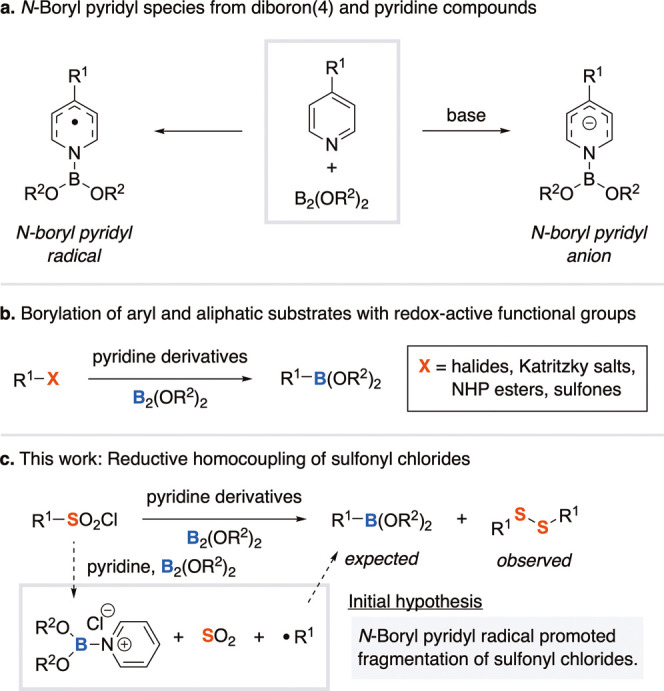 Figure 1
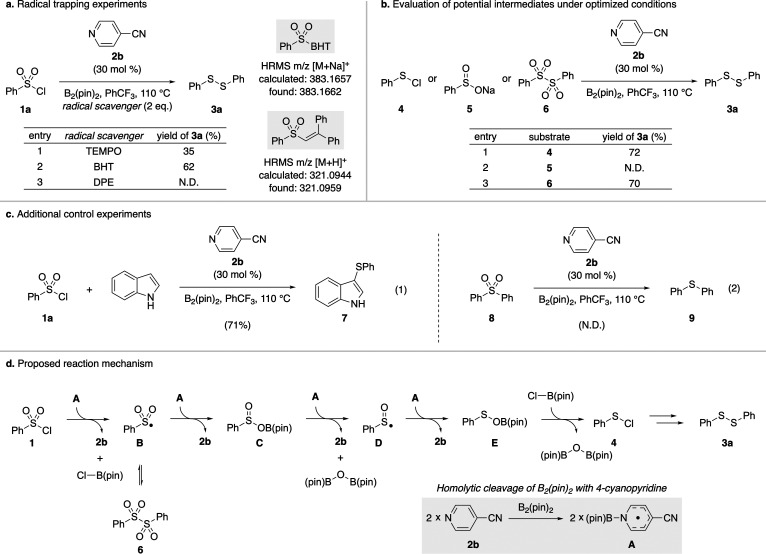 Figure 2
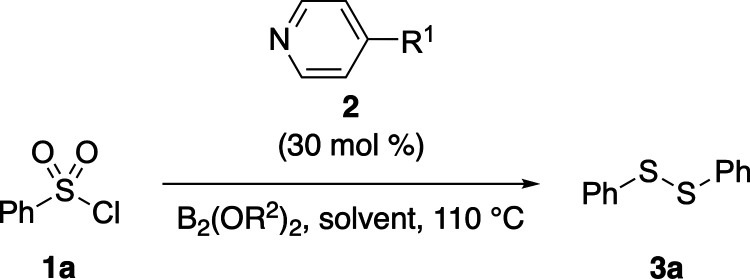 Figure 3
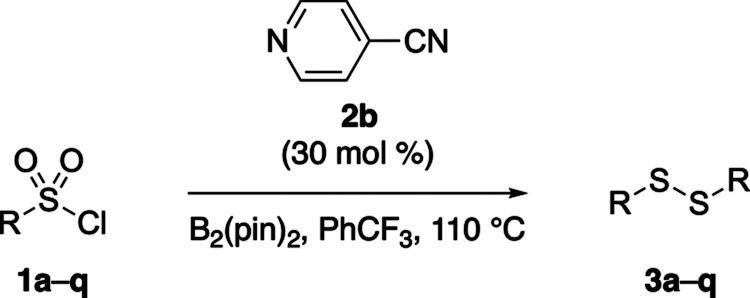 Figure 4
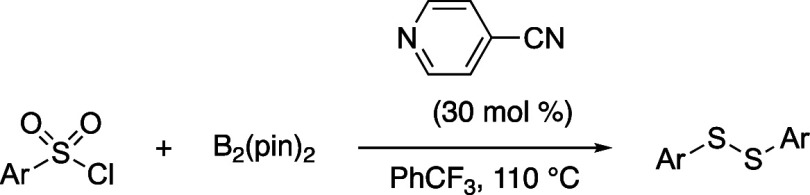 Figure 5
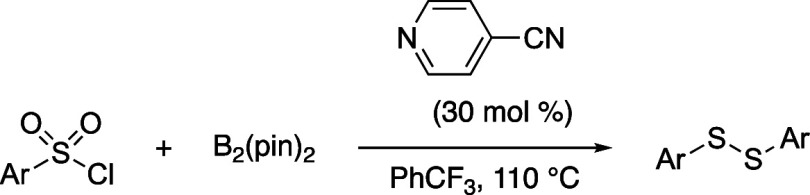 Figure 6
Peer Reviews
No public reviews on file for this paper yet. If you reviewed it on a platform where reviews are public (OpenReview, ICLR, NeurIPS, ICML), you can paste yours below so the community can read it here.
Videos
No videos yet. Explain this paper in a talk, walkthrough, or lecture? Add one.
Taxonomy
TopicsSulfur-Based Synthesis Techniques · Catalytic C–H Functionalization Methods · Radical Photochemical Reactions