Changes in Secondary Organic Aerosol Composition and Volatility Going from a Low to a High HO2/RO2 Regime in α‑Pinene Photooxidation
Veronica Geretti, Yarê Baker, Thomas Bannan, Aristeidis Voliotis, Quanfu He, Thorsten Hohaus, Sungah Kang, Michael Priestley, Epameinondas Tsiligiannis, Hui Wang, Rongrong Wu, Annika Zanders, Sören R. Zorn, Gordon McFiggans, Cheng Wu, Thomas F. Mentel, Mattias Hallquist

TL;DR
This study shows how changes in HO2 and RO2 radicals during α-pinene oxidation affect the composition and volatility of secondary organic aerosols.
Contribution
The study experimentally compares SOA composition and volatility under low and high HO2/RO2 regimes, revealing significant differences in aerosol properties.
Findings
High HO2/RO2 conditions reduced particle-phase monomer, fragment, and accretion product signals by 34%, 29%, and 78%, respectively.
Gas-phase changes aligned with particle-phase changes within a factor of 2, with organic mass reduced by 39%.
Bulk SOA volatility increased slightly, indicating suppression of low-volatility products and formation of high-volatility hydroperoxide monomers.
Abstract
The mechanisms of secondary organic aerosol (SOA) formation are not yet fully understood. The relative abundance of hydroperoxyl radicals (HO2) and peroxy radicals (RO2) affects SOA properties, but chamber experiments often underemphasize the role of HO2. To clarify their contribution, this study compares the composition and volatility of SOA formed by the hydroxyl radical (OH) oxidation of α-pinene under low and high HO2/RO2 regimes with a constant OH concentration. The particle-phase was characterized with a Filter Inlet for Gases and AEROsols coupled to an iodide Chemical Ionization Mass Spectrometer (FIGAERO CIMS), and a CIMS with NO3 – ionization was used for gas-phase measurements. High HO2/RO2 conditions weakened the particle-phase monomer (C10), fragment (C4–9), and accretion product (C11–20) signals by 34%, 29%, and 78%, respectively, compared to low HO2/RO2 conditions. The…
Genes, proteins, chemicals, diseases, species, mutations and cell lines named across the full text — each resolved to its canonical identifier and authoritative record.
Click any figure to enlarge with its caption.
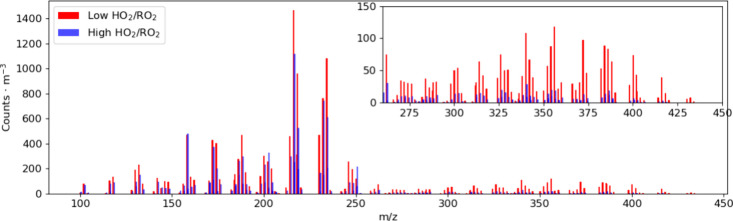 Figure 1
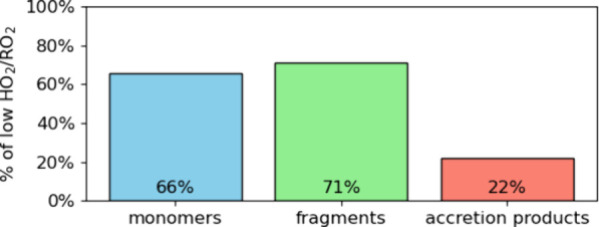 Figure 2
 Figure 3
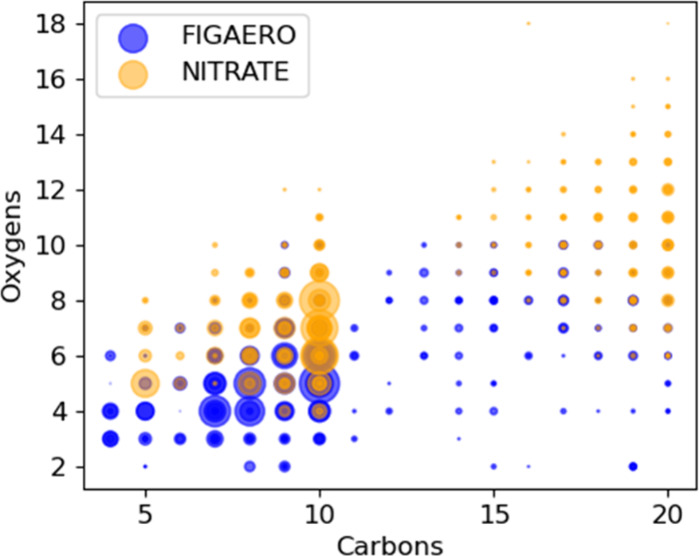 Figure 4
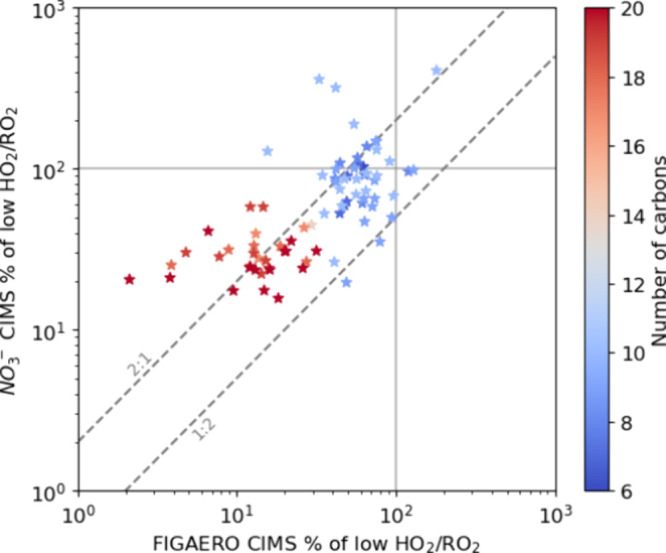 Figure 5
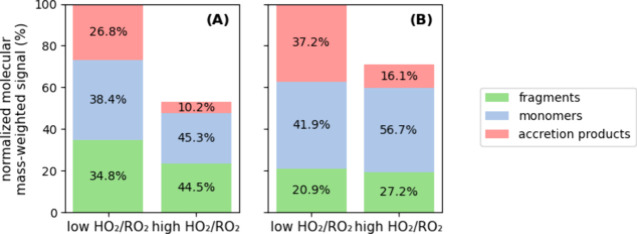 Figure 6
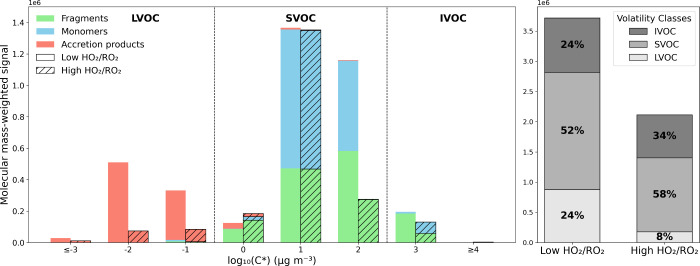 Figure 7
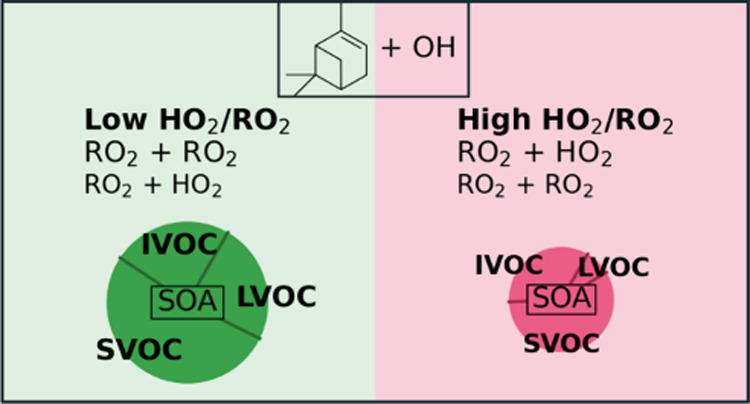 Figure 8
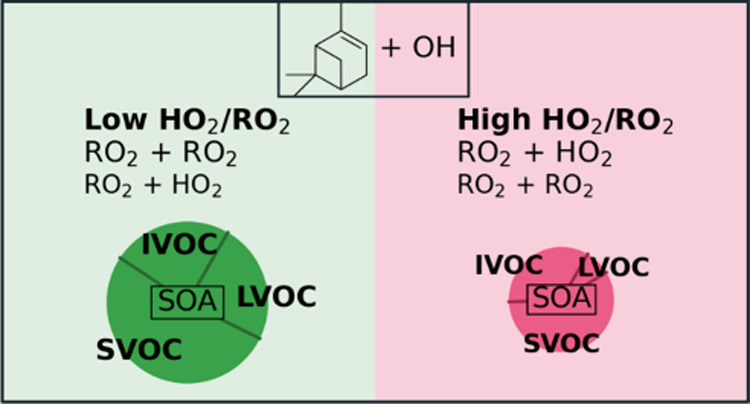 Figure 9
 Figure 10
 Figure 11
 Figure 12
 Figure 13
 Figure 14
 Figure 15
Peer Reviews
No public reviews on file for this paper yet. If you reviewed it on a platform where reviews are public (OpenReview, ICLR, NeurIPS, ICML), you can paste yours below so the community can read it here.
Videos
No videos yet. Explain this paper in a talk, walkthrough, or lecture? Add one.
Taxonomy
TopicsAtmospheric chemistry and aerosols · Indoor Air Quality and Microbial Exposure · Atmospheric Ozone and Climate