A citation index bridging Hirsch’s h and Egghe’s g
Ruheyan Nuermaimaiti, Leonid Bogachev, Jochen Voss

TL;DR
This paper introduces a new citation index ν that bridges the h-index and g-index, offering a flexible way to measure academic impact.
Contribution
The paper introduces a novel parametric family of citation indices that generalizes the h and g indices.
Findings
The new index ν lies between the h-index and g-index.
The parametric family να allows for a smooth transition between h and g indices.
The limiting case ν∞ is defined in terms of the maximum citation count.
Abstract
We propose a new citation index ν (“nu”) and show that it lies between the classical h-index and g-index. This idea is then generalized to a monotone parametric family (να) (α≥0), whereby h=ν0 and ν=ν1, while the limiting value ν∞ is expressed in terms of the maximum citation.
Genes, proteins, chemicals, diseases, species, mutations and cell lines named across the full text — each resolved to its canonical identifier and authoritative record.
Click any figure to enlarge with its caption.
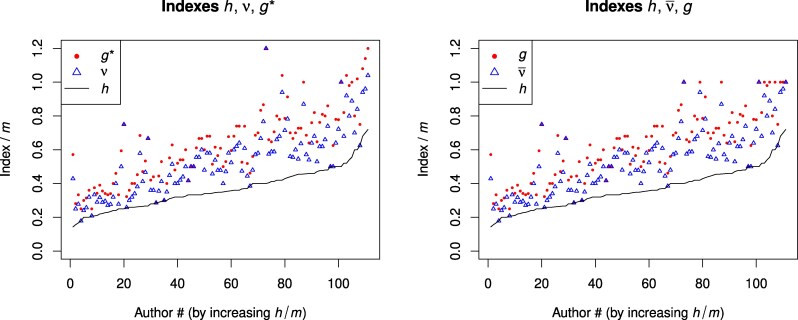 Figure 1
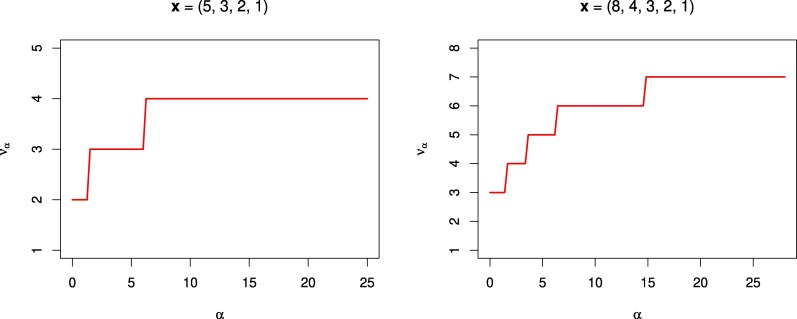 Figure 2
Peer Reviews
No public reviews on file for this paper yet. If you reviewed it on a platform where reviews are public (OpenReview, ICLR, NeurIPS, ICML), you can paste yours below so the community can read it here.
Videos
No videos yet. Explain this paper in a talk, walkthrough, or lecture? Add one.
Taxonomy
TopicsAdvanced Mathematical Identities · Advanced Combinatorial Mathematics · Advanced Operator Algebra Research