Researchers’ roadblocks to including people with intellectual and developmental disabilities (DD) in research: Translational science and I/DD program leaders insights
Karen Bonuck, Patrick George, Mark Harniss, Frank Meeuwis, Suzannah Iadarola

TL;DR
Researchers face barriers like misconceptions and logistical challenges when including people with intellectual and developmental disabilities in medical research.
Contribution
The study identifies attitudinal and logistical barriers to including people with I/DD in research and proposes a survey based on a change management model.
Findings
Key barriers include attitudinal issues like assumptions about consent capacity and logistical challenges like accommodation costs.
Exclusion of people with I/DD is often due to lack of awareness and knowledge rather than insurmountable obstacles.
A survey based on the ADKAR® model was developed to address these barriers.
Abstract
People with disabilities in the US are now a health disparities population. Though 25% of US adults have a disability, only 5% of medical research grants are disability related. Knowledge about researchers’ perceived barriers to including people with disabilities in research has focused on a single disability/condition and thus has limited translational science applications. Our CTSA’s Disability as Difference: Reducing Researcher Roadblocks (D2/R3) project examined such roadblocks towards inclusion of people with intellectual and developmental disabilities (I/DD). I/DDs are broad, heterogeneous conditions that originate in childhood, have varying impact and function, and persist throughout the lifespan. Strategies that mitigate their under-representation in research will likely have general applicability to all disabilities. In D2/R3’s first phase we conducted semi-structured…
Genes, proteins, chemicals, diseases, species, mutations and cell lines named across the full text — each resolved to its canonical identifier and authoritative record.
Click any figure to enlarge with its caption.
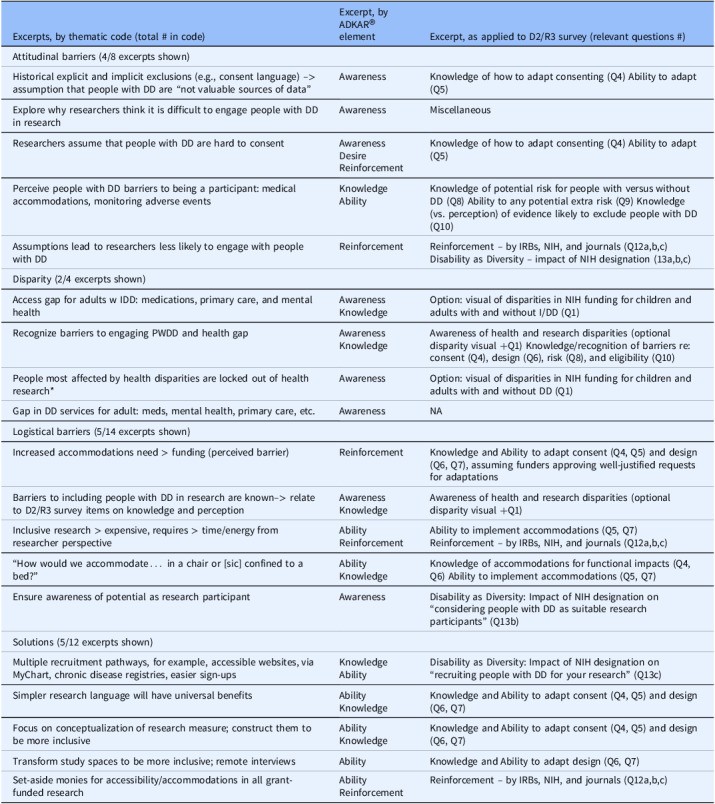 Figure 1
Peer Reviews
No public reviews on file for this paper yet. If you reviewed it on a platform where reviews are public (OpenReview, ICLR, NeurIPS, ICML), you can paste yours below so the community can read it here.
Videos
No videos yet. Explain this paper in a talk, walkthrough, or lecture? Add one.
Taxonomy
TopicsDown syndrome and intellectual disability research · Disability Rights and Representation · Disability Education and Employment