Development of a Four‐Language Questionnaire to Investigate Environmental Risk Factors for the Development of Canine Atopic Dermatitis and to Monitor Disease Course and Progression
Patricia Clara‐Maria Rhodius, Nina Fischer, Ana Rostaher, Franco Martini, Edwin Chapman, Sabrina Audergon, Stefan Hobi, Georg Lehner, Sylvie Wilhelm, Noëmi van Oordt, Claude Favrot, Malwina Kowalska

TL;DR
This paper describes the development of a multilingual questionnaire to study environmental factors in canine atopic dermatitis and track its progression.
Contribution
A four-language questionnaire with high validity and reliability for studying environmental influences on canine atopic dermatitis.
Findings
The questionnaire development process included pilot tests, test–retest assessment, and expert evaluation.
The final questionnaire achieved an Intraclass Correlation Coefficient of 0.80 and a content validity index of 0.99.
Minor adjustments ensured validity and reliability across four languages.
Abstract
The chronic and multifactorial character of canine atopic dermatitis (cAD) often leads to poor disease control and treatment dissatisfaction. Environmental factors are likely to contribute to the disease development and may play a more important role than assumed previously. This opens new research directions that require an appropriate tool to obtain useful data from large representative study populations. A tool such as a questionnaire is suitable for obtaining high‐quality data to investigate the pathogenesis of cAD and monitor the disease. To assure the tool's validity and reliability, the development process of this four‐language questionnaire (original language German) included two pilot tests (with owners' interviews and questionnaire evaluation sheets), test–retest assessment, content validity evaluation and a structured translation and back‐translation into three languages…
Genes, proteins, chemicals, diseases, species, mutations and cell lines named across the full text — each resolved to its canonical identifier and authoritative record.
Click any figure to enlarge with its caption.
 Figure 1
 Figure 2
 Figure 3
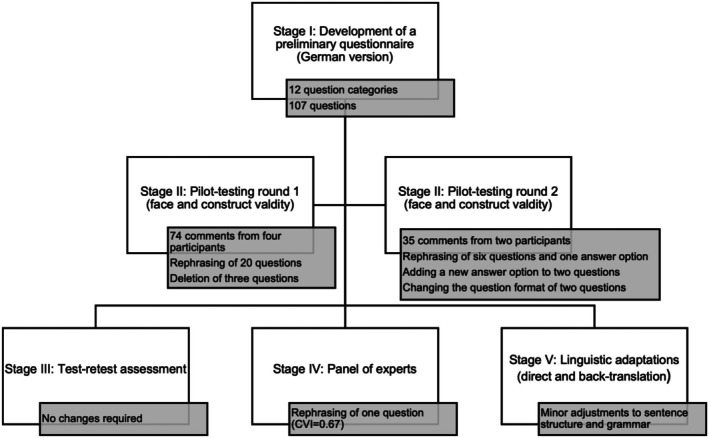 Figure 4
Peer Reviews
No public reviews on file for this paper yet. If you reviewed it on a platform where reviews are public (OpenReview, ICLR, NeurIPS, ICML), you can paste yours below so the community can read it here.
Videos
No videos yet. Explain this paper in a talk, walkthrough, or lecture? Add one.
Taxonomy
TopicsHuman-Animal Interaction Studies · Dermatology and Skin Diseases · Asthma and respiratory diseases