Clip‐Centered Common Bile Duct Stones Managed by Endoscopic Sphincterotomy Plus Endoscopic Papillary Large Balloon Dilation Years After Cholecystectomy
Nobuhiko Fukuba, Erito Ando, Taisuke Ohmachi, Yasuhide Kodama, Masaki Onoe, Kousaku Kawashima, Norihisa Ishimura, Shunji Ishihara

TL;DR
A woman developed bile duct stones years after gallbladder surgery due to migrated surgical clips, which were successfully removed using a specialized endoscopic technique.
Contribution
Demonstrates successful long-term management of clip-induced bile duct stones using endoscopic papillary large balloon dilation without lithotripsy.
Findings
Clip migration into the bile duct can lead to stone formation years after laparoscopic cholecystectomy.
Endoscopic papillary large balloon dilation effectively removed stones composed mainly of calcium bilirubinate.
Symptoms and complications can appear years after clip migration, highlighting the need for long-term monitoring.
Abstract
Migration of clips used in laparoscopic cholecystectomy (LC) is rare, but when a clip migrates into the bile duct, it can serve as a nucleus for common bile duct stone formation and trigger acute cholangitis. An elderly woman in her 80s underwent LC for cholecystolithiasis at another hospital in year X. Abdominal computed tomography in year X+1 revealed that two clips had migrated into the bile duct, but this was not noted at the time, and she remained asymptomatic. In year X+5, she underwent bioprosthetic aortic valve replacement for severe aortic regurgitation. In year X+6, she presented to our emergency department with fever and right upper quadrant pain, and she was diagnosed with acute cholangitis. On the day of admission, only drainage was performed, resulting in rapid improvement of the inflammation. On the sixth hospital day, endoscopic sphincterotomy and endoscopic papillary…
Genes, proteins, chemicals, diseases, species, mutations and cell lines named across the full text — each resolved to its canonical identifier and authoritative record.
Click any figure to enlarge with its caption.
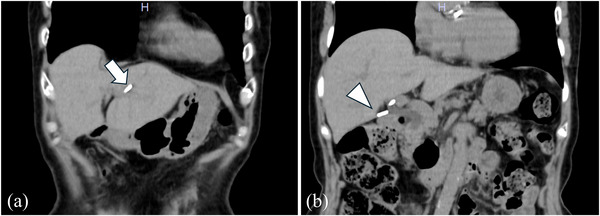 Figure 1
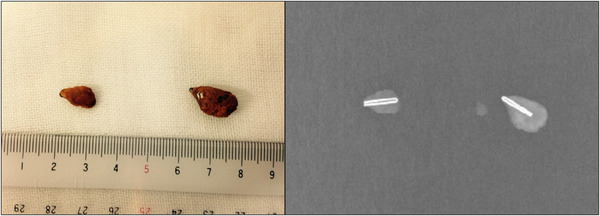 Figure 2
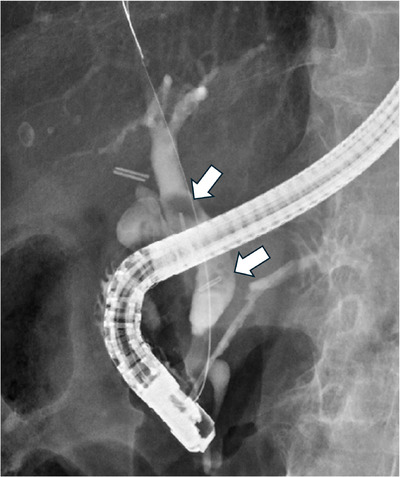 Figure 3
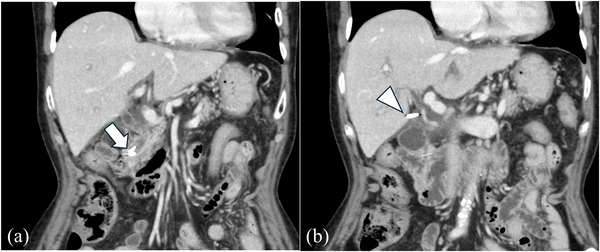 Figure 4
Peer Reviews
No public reviews on file for this paper yet. If you reviewed it on a platform where reviews are public (OpenReview, ICLR, NeurIPS, ICML), you can paste yours below so the community can read it here.
Videos
No videos yet. Explain this paper in a talk, walkthrough, or lecture? Add one.
Taxonomy
TopicsGallbladder and Bile Duct Disorders · Minimally Invasive Surgical Techniques · Pediatric Hepatobiliary Diseases and Treatments